Wednesday, 11 April 2018

Good riddance to Triomphe

1 vine out, 130 to go.
The decision to grub up our 131 twenty-five year old Triomphe d'Alsace vines made itself after the 2017 (non) vintage.

job done
There had been neither the time nor frankly the inclination to do any summer pruning or eventually to pick until it was too late. The day we decided to harvest, we discovered the pheasants had got there first and stripped the vines to the last grape. Already doubtful of making anything useful other than grape juice (strangely not bad) or vinegar (good) it just became clear that ripping these beasts out was the thing to do.

not an actual representation but along the right lines
Our pheasant population had burgeoned but what is the point of growing grapes to feed them especially as we had no opportunity or wish to bag them for our own consumption.

Valentin Blattner
Also, we had an idea of what we might like to plant in their place following our visit to Valentin Blattner, private grape breeder of Soyhieres, Switzerland in March 2017.

Paul and Sam
Thanks to the invaluable advice of Paul Troop and Sam Doncaster we had found Blattner's Cabernet Noir via Annett Rosenberger of Rebschule Freytag in Germany.

Blattner Cabernet Noir
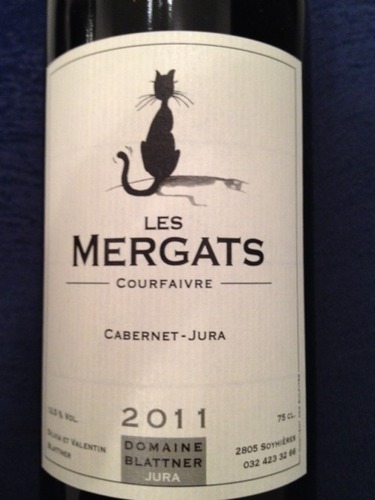
Originally we had thought of Cabernet Jura (also from Blattner) but Cab. Noir ripens much earlier (around the same time as Rondo in the UK - that is in mid-September) and a tasting of Cabernet Noir from the  Domaine de la Colombette in the Languedoc and Blattner's own Cabernet Jura ('Les Mergats') persuaded us that Cabernet Noir was no less good.

Cabernet Noir from the Languedoc
Image result for les mergats cabernet jura
Blattner's own Cabernet Jura


You read about grubbing up vines quite frequently but believe us, it is not a simple business if you don't have expensive dedicated equipment. Also, very few people in the UK have experience of grubbing up vines due to the youth of modern vinegrowing in this country.

our Kubota for the day
a change of tyres
In the end we found that the cheapest wasy of doing it was to hire a Kubota 21hp tractor with chevron tyres one winter's day and pull the vines up with a rope of kinds. This is what is called 'arrachage' (tearing out) in France. The alternative would have been to use a digger but our skills stopped well short of that.

£20,000 of stump grinding equipment hopefully does the job.
Pulling up the Triomphe vines left rather a lot of roots behind so in the end we had to call in profesional stump grinders whose Stakhanovite activity zapped the roots in the 131 holes where the vines had been. No amount of grinding will remove all the roots of course. For that we would have had to remove the trellising and deep plough the whole site but we are too poor and lazy to do that.


Holes have been dug mainly between the spots the old vines occupied.

Stakhanov
Our advice from Derek Pritchard of Dunkery Vineyard, Wooton Courtnay (who supplies us with vines and equipment) was 'I would replant this year, a year of one's life is a long time !'

Cabaret Noir? Someone having a laugh perhaps?
So 144 Cabernet Noir vines duly arrived from Rebschule Freytag and are now tucked up, hopefully safely in our small patch. Whether they will thrive (Derek says new vines don't like decaying vine roots and there are certainly still some present) is another matter but the main thing is we are now a Triomphe-free zone.

                                                            ready for planting

7.50pm. Cabernet Noir safely tucked up.
Note: We've put our 141 Bacchus vines on notice this year, such is our enthusiasm for change. Bacchus is high maintenance (involving too many chemicals) and when we make it, the wine is nothing special. The search is on for a better, resistant variety. Meanwhile, we have been filling some holes with more Solaris, an obliging variety which makes good wine in the UK as its propensity to produce what Jancis Robinson MW calls 'tooth-rottingly high sugar levels' is mitigated in our climate.

Saturday, 7 April 2018

007 in Paris


On a sodden winter's day in Paris, the Seine was at an unusually high. Bridges like the Pont Louis Philippe linking the right bank with the Isle Saint Louis were impassable. Bateaux Mouches were tethered forlornly along flooded quais.


In his safe house on the Rue Jean du Bellay, 007 stood sentry to his treasures, waiting for the interlopers he had been expecting.


Well, not really but the eccentric owner of 'L'Etiquette' does give his name as 007 on the grounds that everyone has a number - National Insurance, Identity, Passport etc. and so he has adopted what he considers the best number - 007 - as his own.

My name is Hervé, Hervé Lethielleux
Hervé Lethielleux is an old rock enthusiast who has had an interesting career including a number of years in Bristol in the restaurant business.

  
The motto of L'Etiquette is 'All you need is wine.'

visiting card of L'Etiquette


obverse side

Herve's treasures
007 specialises in Natural, Organic and Biodynamic wines. He know each and every producer personally.

Here's what we bought;


According to the label, Metis is a unique blend of Gamay (35%), Poulsard (22%), Trousseau (10%), Pinot Noir (18%), Enfarine (5%) and 'vieux cepages' (10%) but what could the vieux cepages be if all the Jura varieties have already been mentioned?

Thanks to a website called www.cancoillotte.net (all about the Franche Comte), we learn the following
  • Foirard, Pourrisseux, Gueuche et autres cépages ancestraux !
Beaucoup d’autres cépages furent cultivés dans le Jura, avec plus ou moins de bonheur. Certains ont totalement disparu en raison de leur fragilité, de leurs défauts, de leur manque de qualité, que sais-je encore ?! De véritables dinosaures dont les noms à eux seuls sont un poème et méritent un petit coup de projecteur ; il n’est pas exclu que certains d’entre eux fassent un jour leur réapparition dans un assemblage purement jurassien, pour ne pas dire jurassique !
  • Le Foirard blanc, ou Gueuche, était à l’origine d’un vin vert et acide, estimé pourtant des moissonneurs qui appréciaient son côté rafraîchissant. Je n’ose envisager les origines exactes de son nom ! Il ne faisait peut-être pas toujours bon se rouler dans la paille à cette époque !
  • Le Chasselas, importé de Suisse Romande, a préféré retourner chez lui aussi discrètement qu‘il était arrivé !
  • Le Pourrisseux ou Peurion, assez spécifique du Jura, donnait plutôt un bon vin blanc mais sa grande fragilité, comme son nom le laisse supposer, a eu raison de son implantation locale.
  • Le Gueuche Noir ou Gouais ou Foirard noir, pendant en rouge du premier cité, donnait des vins « plats, acides et de mauvaise constitution » . Les mauvaises langues aimeraient pouvoir prétendre qu’on en trouve encore dans le Jura, mais ceci n’est qu’une légende !
  • L’Enfariné, fréquemment recouvert d’une pellicule blanchâtre, d’où son nom, fut candidat à l’arrachage en 1731. D’après un dénommé Chevalier, il est aussi « désagréable que le nom est déplaisant ; son vin léger est acerbe et peu coloré ». Il eût pourtant pu être apprécié en assemblage dans un millésime comme 2003 pour corriger naturellement l’acidité qui faisait défaut aux vins !
  • L’Argant, classé dans les meilleurs plants en 1774, connut son heure de gloire au XIXe siècle en raison de sa bonne résistance au mildiou.
  • On peut encore citer le Gamay noir, le Petit Beclan, le Valais noir et le Gros Béclan, autant de cépages qui ne sont pas passés à la postérité jurassienne.
Qui a osé dire que le Jura manquait de variété(s) ?

Look up Argant and you get 'See Gansfuesser.' Ganfuesser was widely cultivate in Germany in the middle ages but is something of a relic now. One Etienne Thiebaud (Domaine des Cavrodes) has rescued an old vineyard in Liesle, South West of Besancon and makes a blend including this and Gueuche Noir, Blauer Portugieser, Enfarine and Mezy as well as more familiar Jura varieties.

Galet says there were 4 ha. of Valais noir in the Jura in 1988 but it has disappeared since.

Beclan 'Wine Grapes' tells us that both Petit and Gros Beclan are still in existance but Gros Beclan is actually Peloursin. Only 1 ha. of Petit Beclan can still be found. Bourdy and Ganevat have re-planted small areas.

Mezy is the Jurassic name for Meslier Noir, the black version of Meslier Saint Francois. Again Etienne Thiebaud has rescued this grape from the Liesle vineyard mentioned above and includes it in his Vin de Pays de Franche Comte.


Less involved, this Pinot D'Aunis from the Loir (nice label)


and again from the Jura, a Poulsard from Thill. We had come across Thill before at both the Salon des Vignerons Independants in Paris and RAW in London. Might this Thill be related somehow to the great French tenor Georges Thill? 007 would probably know.


Tuesday, 27 March 2018

In praise of Fattoria La Vialla


Not having heard of Fattoria La Vialla before we read about it on an Italian site where it had won prizes in a tasting of Organic wine.

Their site is rather extraordinary. Their enthusiasm for their ecological mission is palpable. We can't begin to describe it, so take a look and you'll see.

Ordering is made by post through the order form.

La Vialla produce all sorts of foods and drinks but they are not available in shops. You have to order them directly and they sell in quantities of 6 or more in the case of wine and others respectively in foodstuffs.

We were interested in only a few of their products and they were kind enough to agree to send us smaller quantities as a sample,

We bought


La Casotta


A red wine called 'La Casotta.' An interesting blend of Pugnitello and Malvasia Nera (30% each), Aleatico (20%), Colorino and Sangiovese (10% each). 


14% Abv. A bit of a winter-warmer but original and memorable.

Mostovino dolce leggiero


Something called Mostovino (7% Abv), which is mostly Sangiovese (96%) with tiny amounts of Canaiolo and Aleatico. 


This was far too good! Impossible to take just one glass. If Mostovino could be mass-produced it would fly off supermarket shelves.

Olive oil, red wine vinegar, penne rigate and linguine


as well as red wine vinegar and some pasta.

Vino Novo Sangiovese


Due to some confusione in our order, La Vialla sent us a complimentary bottle of their 'Vino Novo' (Sangiovese in purezza, 14% Abv). 


We found out that as well as their missionary zeal in the production of all these items they have a delivery regime second to none. First they tell you when they're going to deliver (and that is without delay) then they give an update and before you know it a nice person is at your doorstep with the goods. In our case the order came in two shipments, no doubt in order to avoid any delay. Payment was not requested until after delivery in our case and was made simple by La Vialla having set up a UK bank account and pricing in Sterling.

La Casotta came in this handsome box


The next extraordinary thing was the packaging. This can only be described as exquisite. Goodness knows how they balance their books!


The shipments came with all sorts of literature including two thick books - a catalogue and a book of recipes. Everything is in their own cute font.

All of this was beyond delightful and we thought we had made a unique discovery until a leaflet fell out of our Saturday newspaper from, you guessed it Fattoria La Vialla.

They are already established in other countries and now it's our turn.

Book No. 47. La Vialla have been going many years already

Saturday, 24 March 2018

The Blattner tasting.

Valentin Blattner

Our researches into grape breeding have taken us to Geisenheim, Geilweilerhof, Freiburg-im-Breisgau in Germany, Cornell University at Geneva New York and to Valentin Blattner, private grape breeder of Soyhieres, Switzerland.

Geisenheim

These have been fascinating visits and we urge every winelover to try one of these institutions for themselves. They will be welcomed by charming dedicated people and have the opportunity to taste or buy wines especially bred to resist diseases (notably powedry and downy mildew) leading to the reduction or elimination of chemical sprays.

Freiburg

Some of these new varieties are better than others. All are hybrids. There is some truth in what Jose Vouillarmoz has said in that there are so few good wines made from these grapes that perhaps until there are more they should be called something other than wine. That is a bit hard and there are plenty of wines from vinifera varieties that are so bad as to merit another name.


Geilweilerhof
 

One of the best PIWI (Pilzwiderstandsfähig or Fungus resistant) wines we know - and one that can definitely be called wine is made from Cabernet Jura which is one of Valentin Blattner's varieties. We have also tasted a marvellous wine from Regent, one of Geiweilerhof's best productions. Solaris and Cabernet Cortis bred by Freiburg have also produced good wines in our opinion.

Cornell's New York State Agricultural Experiment Station, Geneva (NY)

A lot of these are complicated crosses of varieties that are less than distinguished in themselves. Where Valentin Blattner differs from the others is in taking high quality varieties such as Cabernet Sauvignon (which he uses in the majority* of cases) but also Viognier and others and wedding them to what he calls a 'Resistenzpartner,' the identity of which is a closely guarded secret. In this way, it seems to us he retains more quality than otherwise.

Paul Troop (left) and Sam Doncaster

We were lucky enough to meet the two greatest proponents of the Blattner school in the English speaking world at least: Paul Troop of Saltspring Island Vineyards on Vancouver Island and Sam Doncaster who is one of the foremost authorities on Blattner varieties and has worked  extensively in vineyard establishment and management, grafting, winemaking and wine sales. Paul has planted about 150 varieties of which 10 are now in production. Both have known Valentin Blattner for many years.


The duo invited us to what must be a unique tasting - perhaps the first ever comprehensive survey of Blattner varieties with wine from from two continents which Sam had been collecting for a number of years and squirreling away under his bed as he told us.


Here is a list of some of the 24 wines they presented;

Rummel (Pfalz), Cabernet Blanc Sparkling
Rummel, Cabernet Blanc (still), 2014, '15 and '16
Graf von Weyher (Pfalz), Cabernet Blanc
Stockel Hoos, Cabernet Blanc, 2015, '16
Schneider, Cal 06-04, 'Namenlos'
Rummel California
Rummel Rose
Unsworth, Sauvignette,
Rummel, Cabertin
Unsworth, Cabernet Libre
Patenwein VB-91-26-29, 2015
Les Mergats, Cabernet Jura, 2015 (Blattner's own production)
Schneider, Pinotin
Leiner, Laurot, 2016
Michlovsky, Rinot, 2015
Metz, Cabernet Noir


Those attending in the impressive purpose-built tasting room at the Plumpton College Wine Centre included students and academic staff.

Paul Troop gave a fascinating detailed account of PIWI varieties and Blattner's work in particular. A surprising amount of this information appeared to be news to some of those present and a lively discussion followed. The Plumpton community was impressively focussed on practicalities and probed both Paul and Sam numerous times from this point of view. Paul and Sam's answers were frequently along the lines of there soon being no choice but to perfect PIWI varieties if the alternative is ever increased use of an ever diminishing amount of authorised chemical sprays. These answers were convincing and so the exercise appeared to be valuable indeed.

On to the wines, it became clear that the white Blattner varieties, Cabernet Blanc, 'Namenlos' (Nameless, CAL-06-04) and Ravel (VB 37-2) are aromatic. For our taste, very tasty indeed.

The reds are maybe more mainstream. We have already paid tribute to Cabernet Jura and Cabernet Noir in this blog. Indeed, we have chosen Cabernet Noir for replacing our unloved Triomphe D'Alsace vines in our little experimental vineyard in the Thames Valley this year. The fact that these and other Blattner reds are obtained from Cabernet Sauvignon (+ 'Resistenzpartner') makes them more attractive than other PIWI hybrids as we have said and that is, for us the main strength of Valentin's work.


* He has also produced good varieties from varieties including Bacchus and Seyval as Seed Parents and Marechal Foch and Leon Millot among others as Pollen Parents.


Pules i Bylyshit


Seen on p. 859 or 'Wine Grapes'

 PULES

Minor Albanian white

BERRY COLOUR  O O O O O

___________________________________________________________________________________
PRINCIPAL SYNONYMS: Pules, Puls
______________________________________________________________________________________________________

ORIGINS AND PARENTHOOD

Pules most likely originates in the Berat region in south-central Albania but its ampelographic identity is still obscure because two reference vines called Pules i Bylyshit, sampled in Tepelene in Southern Albania, turned out to have distinct and unique DNA profiles in Ladoukakis et al. (2005) and it is not known which of the two is the true-to-type Pules.


Thursday, 22 March 2018

The 'Beyond the pale' tasting.


Section 1. The conservative wine-lover.

     We  sent a bottle of Pineau D'Aunis to a client on his birthday with the request that he sent us his impressions. We knew he had never tasted this grape despite being French and a wine connoisseur.

He answered;

You asked our verdict about the wine which we opened yesterday with friends... Honestly it was just terrible ! (laughs). We couldn't drink it. You should never buy this one again ! But please don't worry : we keep the fondest memories of the wonderful chocolates ! 


Pineau D'Aunis. 2015. Vin de France. Vendome, Loir et Cher. Brendan Tracey. 12.5%

Image result for bernard Tracey pineau d'aunis


We thought it might be interesting to taste a few wines which would probe the limits of what a group of friends might define as wine.

Encouragingly they found this wine rather to their liking which made understanding the Frenchman's reaction a bit difficult.


Next:


Champagne Gruet brut NV, Cuvee Arbane (100% Arbane). Buxeuil. 12% 


This Champagne is 100% Arbane, the most obscure of the 7 permitted Champagne grapes (Pinots Noir, Blanc and Meunier, Chardonnay, Petit Meslier and Semillon are the others). There is less than 1 hectare left of Arbane and those vines are very old. Jancis Robinson may be right in saying Arbane is perhaps not the future as far as Champagne is concerned but I hope this bottle is as pleasurable as we have found Arbane to be in the past. Diversity is surely something to which we can subscribe?

As expected, this went down very well.  Tasters found individuality and pleasurableness. Not all were aware of Arbane and few had tasted it in purezza. A good start.


* * *


Section 2. Varieties bred to combat vine diseases that might have destroyed Vitis Vinifera and left us with these as alternatives. 


Uhudler. Trummer, Stegersbach, Burgenland. (Clinton, Concord, Delaware, Isabella?) 10%


Before we get too judgemental about Pineau D'Aunis and other 'Cepages modestes' we should remember what we might have been drinking had a solution to the problem of Phylloxera not been found and had Vitis Vinifera been wiped out 100 years ago.

This really put the cat among the pigeons. It is not likely any of our wine buffs had ever tasted wine from the old American varieties, Most remarkable, one thought was the strong strawberry taste,


Henry of Pelham Baco Noir 2015. Vqa Ontario. 13% 


Phylloxera isn’t the only threat to grapes. Shortly before that plague, Powdery Mildew had become entrenched in vineyards. The French accused the British and others saw America as the origin. Baco Noir was obtained in 1902 by crossing Folle Blanche with a Vitis Riparia called Grand Glabre possibly with Vitis Riparia ordinaire. The use of Vitis Riparia instead of Vitis Labrusca avoided the foxy flavours of the above. European plantings of Baco Noir have dwindled but it still thrives in North America, especially Ontario.

Far more like wine than Uhudler. Nonetheless everyone ran for the spitoon and later this may have been one to have been poured down the sink.

* * *


Section 3, other crossings and hybrids for different purposes. 


Turan ‘Mocus’ Losonci. 2015. Gyongyos, ‘Terra Hungarica.’ 2015.


Turan is an extreme test of one’s definition of wine. Can it have been made with grapes one is tempted to ask. The ultimate Marmite wine? It is a 1964 hybrid from Bikaver 8/Kadarka cross and Gardonyi Geza which in turn is a Menoire/Csaba Gyongye cross although to what end is not clear. It is used in the Eger region in Egri Bikaver blends and has been planted in British Columbia where it is known as Agria.


NB. In English, Mocus = a medical condition related to alcohol abuse (!)

It had been hoped that this would have sprked a debate as to how to define wine and whether this might make it under any definition but everyone rather liked it, unique though its red-muscat taste is.


* * *

Section 4. Wines from Vinifera varieties without any crossing or hybridisation. 


Glinavos Sparkling wine 'Pailiokairisio.' Ioannina, Epirus, Greece. (Vlahiko and Debina). 10.5%


Made from two uncommon Greek varieties (a red and a white respectively), Paliokairisio (Old Times) doesn't resemble any other wine or fit into any category really. People say they enjoy it but wouldn't know when to drink it or what to drink it with. Should that mean it ought not to exist?

As soon as this was poured into a glass it rased a laugh. Tasters had heard of White wine, Red wine and Orange wine, but Brown wine? they were flummoxed by the strong cidery taste and again we had something they didn't call wine.


Szeremi Zold. 2015. Maurer. Hajdukovo, Vojevodina. Serbia. 11%


This is another extremely rare variety (Syrmia Green) from another great producer, Oszkar Maurer, devoted to working with rare local varieties (you won’t find Szeremi Zold in ‘Wine Grapes’). His estate, now in Serbia is just over the border from Hungary. Syrmia is a fertile region of the Pannonian Plain which lies between the Danube and the river Sava. We suggested that this is a variety, although individual, even our French client might not have too much trouble with. We think it proves that a variety can be great as well as obscure.

The company gave a firm thumbs up to this one.


Mando. 2015. Bodegas Abadal, Bages (Catalunya). 12.5%


Mando or Mandon proves there are many other little known varieties which have great merit and would not frighten the horses. In 2008 there was only 1 hectare left but there have been new plantings since.

This was also a hit.


Abouriou 2015. Terre d’Abouriou. Cote du Marmandais. Cave du Marmandais, Vignobles du Sud-Ouest. 12.5%


Abouriou was actually unknown until 1882 when a man called Numa Nauge presented a chance seedling found by a farmer 40 years previously growing up the wall of a castle in the Lot-et-Garonne. By the 1950s there were over 600 ha. in France and a few in California. In 2008 there remained 338 ha. In France.

Several well known grapes owe their popularity today to individuals. Godello on the verge of extinction - down to several hundred vines in the 1970s when Horacio Fernandez and Luis Hidalgos reversed the tide.

Michel Aimé Pouget brought cuttings of Malbec from France to Argentina in 1868 but as late as the 1980s the variety had declined to 9,000 ha. and had dwindled in Bordeaux to 1% having been the dominant variety in the mid 19th century. The revival in Argentina was thanks to the Italian winemaker and consultant Roberto Cipresso and subsequently to others including Nicola Catena Zapata. Only since 1995 has it been the predominant grape in Argentina. Now Cahors – the original home of the variety - markets itself as Malbec.

Abouriou is presently championed by the Cave du Marmandais co-operative and the Couillaud brothers in the Loire Atlantique.

We can’t imagine why this variety hasn’t caught on yet. We might send a bottle to mour French friend for his next birthday. If he likes it who knows?

 Abouriou was another hit to end up with.