Monday, 12 September 2011

2011 Edinburgh Wine Festival


There is no Edinburgh Wine Festival, official or fringe as yet but that doesn't stop Slotovino creating one out of the many interesting manifestations of wine in this city. It is the darndest thing that in this respect Edinburgh has everything whereas its larger neighbour Glasgow has practically nothing. According to Adam, owner of The Fine Wine Company of Edinburgh/Portobello and Edinburgh/Musselburgh it was ever thus. He conceded that Glasgow's interests are more spiritual (geddit?).

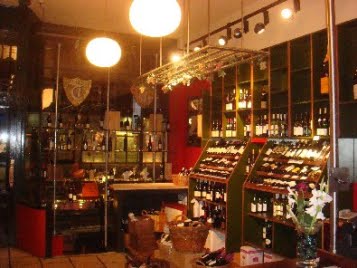
Adam's main business these days is internet sales. He ships cases of wine all over the country. The shop was host to a delivery just about to go out. Interestingly, he has identified the hot spot for his sales as the home counties to the north of London, around Watford. Fascinating. With over 3,250 wines on his list there had to be something for everyone. The shop carries a much smaller selection of course but we left with an Argentinian Bonarda/Sangiovese which sounded a good idea and which we had not seen or heard of before, an Austrian 'Landswein' from Gamay apparently - Landswein (country wine) is another rarity, perhaps unprecedented in the UK and a Nero di Troia by Tufarello (Puglia).


Of these so far, the Heinrich Landswein was the sandout. Even at £11.95 this is a wonderful bargain. Only 12.5% it packs a generous Gamay flavour superior to much New World Gamay.


The Fine Wine Company have other interesting wines such as St. Pourcain Pinot Noir, the A, C, G etc. collection from the Veneto which we admire so much (A for Amarone, C for Corvina, G for Garganega etc), and much else. The website is arrangesd extremely well so you can browse by grape, price, country, colour and so on. Only the Abv figures are missing.

No visit to what we will now call the Edinburgh Wine Festival is complete without a trip to Leith Walk and Valvona and Crolla - winner of yet more prizes. For some reason they do not figure on Winesearcher; a huge omission. Perhaps they don't want to participate? In any case they have some of our favourite rarities including Italian Bonarda and Gutturnio as well as so much besides.

Paying our respects to Villeneuve Fine Wines, we learned of another company in town called Hendersons. This is an offshoot of the well known restaurant of the same name in the centre of Edinburgh, but the wine shop is in the charming region of Edinburgh/Morningside, butt of many affectionate jokes:

A Morningside lawyer has some business in Glasgow so walking down Sauchihall Street there he is accosted by the archytipal Glaswegian drunk. Staggering up to him with a bag of chips in one hand and a cigarette in the other he says to the Morningside gent "Hey, Jimmie, giss' a light." Morningside gent: "Sorry my good man I'm afraid I don't smoke, but tell me, how did you know my name was James?"


OK, Hendersons in Morningside is not at all well behaved at least as far as our interests are concerned. By that, we mean they have a quite remarkable amount of interesting wines from the rarest of grape varieties. These include one which doesn't yet have a name.

It is a crossing between Melon de Bougogne and Chardonnay, grown in the Maconnais and rather delicious.

This was only the start. Next came an Australian Sparkling White from the producer Irvine made from 100% Petit Meslier, one of the more obscure Champagne grapes never seen in purezza as far as we know and rarely in any Champagne blend. The result here was certainly interesting if "dusty" in the word of The Prof. There followed two further fascinating bottles. An Italian white called Pantastico,

apparently the ancient name cited by Pliny for a variety now known as Cachhione and grown in Nettuno, Costa dei Cesari (Lazio) and a red from Wales, "Glyndwr", believed from Regent and Rondo. Our final bottle from here was a field blend of 23 different varieties no less from Domaine La Tour Boisee, Minervois, called 'Plantation 1905'. The back label, for once, bears reproduction in full.

Ce vin est issu de la plus vieille vigne de la commune, qui est composee de 23 cepages, dont certains directement issus du 19e siecle. Cette vigne est la propriete des familles Cambon et Grauby, vielles familles du village.
Cette vigne patrimoine du Languedoc, est un veritable monument historique que nous saurons entretenir comme il se doit.
Les greffons que nous serons suceptibles de prelever a l'avenir pourront favoriser une renaissance de certains cepages oublies qui sont encore aujourd'hui, des cepages recommandes pour des vins reputes de notre region.


So nice to have a rest from the reams the French like to write about Terroir.

Our guide on our hurried visit to Hendersons was Doug - surely one of the quickest on the uptake we have ever encountered when asked to suggest some rare grape varieties. Henderson's motto is 'Independent Wines for Independent Minds'. Doug lamented that most punters are reluctant to stray from well worn paths but at least he gives them the opportunity.

This was a great festival and like the actual International and Fringe Festival, we couldn't include everything, so who knows what Tony Crolla has been up to at Enoteca Divino discovered last year or Raeburn Fine Wines, the supplyer of the more pukka set in Edinburgh?

Tuesday, 2 August 2011

Los vinedas de Ronda

While in the area we thought we would have a look at the vineyards of Ronda, having enjoyed some of the wines made in this new frontier region and remembering what a lovely place Ronda is to visit.

Assuming vineyards would be visible on all sides when approaching the perfectly preserved small town on its vertiginous crag, our first disillusionment came thanks to the new road which actually descends into a plain strewn with light industry and social housing.

No vineyards to be seen anywhere and just the back end of Ronda of which we had been previously blissfully unaware.

Ploughing through the town (much larger than suspected) we finally came on the Centro Ciudad and missed any Bodegas and the local branch of the Museo del Vino we somehow expected would be on hand, soon finding ourselves going out the other side. Still optimistic, we pressed on through nothing but olive groves on side roads and the small road signposted 'Algeciras'. Time was against us by now so we stopped at a 'Mirador' and surveyed the horizon without success. There was a small patch of lighter green near the ring road from which we had come so we drove towards tha,t again without success.

So finally we had to ask at a roadside bar. The caballero looked mystified but then suggested we took the road for Sevilla and turn off after a few Km. towards Ronda Vieja.

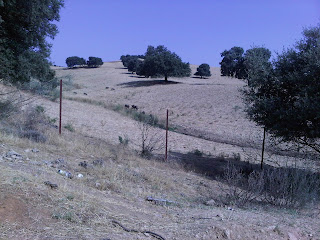
And so it was that we finally found our Vinedas de Ronda, discretely tucked away, almost apologetically among the olive groves and various other farming enterprises.

Decidedly vine-growing in Ronda is still in its infancy.

Our favourite producer, Schatz was the first property we came upon.

It was so much smaller than we imagined and there was no sign of life, let alone a Cellar Door shop or a Reception Area. Herr Schatz is a Swabian who set up here some years ago and brought Lemberger vines with him, hence his popularity in our pages. He must have been looking for somewhere pretty wild and isolated; the contrast with German wine villages where the vineyards are part of the town couldn't be more stark. Huge birds (Buzzards?) wheeled overhead and masses of other rather exotic tiny ones seemed to spring up on our approach. They can't be a pest in the vineyard because we didn't see any netting.
The vineyard itself is immaculately kept and large solar panels lead one to believe the Ecological tag must be serious. There was one other vineyard signposted at the Ronda Vieja turn-off: Dona Feliza 'Chinchilla'. Finding this was no easy matter as we careered down the wrong road clearly signposted as far as we were concerned but not intended by whoever planted the sign. Never mind - we happened by some small plots planted with vines - hardly enough to make more than boutique or even garage quantities.


Retracing our route through this beautiful and very Spanish counryside, we drove through what we fancied might have been a valley of Cork Trees

(identifying trees is not one of Slotovino's greatest accomplishments) and finally reached Chinchilla,

only once again to find the place deserted and firmly barred to visitors.

There must be other areas under vine around if not in Ronda. We are sure the Museo del Vino arranges guided visits. Our little disorganised trip was valuable however in putting the wines in context and understanding the tiny scale of wine production in this beautiful and wild part of Andalucia. Where else might you find fields with Donkeys or families of black hogs, Buzzards or Eagles circling overhead on your way to a European vineyard?

Monday, 1 August 2011

Catedral de Leon

It is difficult to find Spanish wine below 13% and even these seem to be in a minority these days with 14.5% making an increasing proportion of wines on offer - especially new wave reds. Do the Spanish really drink these winter-warmers in summer? 'Joven' and 'Verano' wines do not offer any mitigation in terms of alcohol it seems.

So when in El Corte Ingles we like to try to find the lowest alcohol wines just out of interest. There are a few styles of white which are satisfyingly low including Treixaduras from Ribeiro, the dreaded Zalemas in Condado de Heulva (Cadiz), a wine from Sevilla which looked nicely obscure and indeed some Verdejos from Rueda at 12.5% etc. The reds posed a greater challenge. At Casa Pablo in Marbella we had been warned not to expect anything from Ribeira del Duero and had been steered towards Rioja of all sections but there was tiddley squat under 13%.

So it seemed that the only place to look was on the bottom shelf at El Corte Ingles among the cheapest wines and lo, for E. 1.69 there was a 12% -er, the bottom of the class - with a satisfyingly cheap but decidedly uncheerful label "Catedral de Leon". The back label is one of those which tells you that the wine is made in our winery, that the colour is red and that it goes with appetisers, meats, roasts and cheeses etc. Not a word about the variety or varieties from which it is made of course.

We bought this bottle anyway, as much for the mystery as for the low alcohol and put it on ice while we logged into the producers' website www.bodegasvinosdeleon.es' There, in sharp contrast to the back and indeed front labels was a very well presented and informative descriprion of this excellent operation and its wines. We were thrilled to discover that the major constuent of our bottle was PRIETO PICUDO, one of Slotovino's recent additions to our hallowed Hall of Fame for rare grape varieties and a standout at our January tasting.

And so it was: the wine was delicious and excellent chilled with a lunch including Gazpacho and prawns, salad etc. So what was going on? Obviously the people responsible for marketing this excellent wine decided that the words Prieto Picudo would spell commercial death to their bottle and furthermore, only a crap name and design would persuade anyone to buy it, priced as it was at the bottom end of the spectrum with the lowest Abv in the shop. Marketing triumphs again, no doubt. Perhaps they sell masses of this wine. Good luck to them. We are sure the consumers don't complain. It's just a pity they may never know their enjoyment comes from Prieto Picudo and another opportunity to advance the cause of diversity is lost.

Wednesday, 27 July 2011

Welcome Dingac

Even if 14.5% we enjoyed our bottle of Dingac, one of the Croatian wines bought at Murray Hill Wines of New York a couple of months ago.

We recommend readers faced with a choice between Babic and Dingac to go for the latter.

Concerning the thorny question of admission to the Slotovino Hall of Fame, our jury is out for the moment. If the high alcohol level is necessary for this grape to express itself to the level of our sample it would be a disadvantage in our opinion. Also the rather rustic and Eastern European flavour on the tongue initially might be an acquired taste. This is less evident as progress is made down the bottle. Nonetheless, Dingac appears to be a worthwhile addition to any winelist for those seeking something fun and out of the ordinary.

Now for Klarnica and Debit!

8/10/11 IMPORTANT UPDATE

We were wrong! Dingac is not a grape variety but a wine area! We might be excused for making this mistake perhaps because it is obscure enough not to get a separate entry in Jancis Robinson's Wine Companion although it is mentioned as a place where Plavac Mali is produced in the general entry on Croatia.

We stand by our advice to choose Dingac/Plavac Mali over Babic and are relieved not to have to tear Dingac from the Slotovino Hall of Fame having not admitted it in the first place, We have tasted some excellent Plavac Malis in general though so we can admit this grape on the strength of those experiences. TA-DAH!

Sunday, 17 July 2011

Slotovino awards 2010/11

A bit later than usual and perhaps a little shorter than for previous years, the 2010/11 Slotovino awards are nonetheless as eclectic and fascinating as before thanks to the ever-changing face of wine as they say and our luck in finding wonderful new experiences every year.

As ever, we exclude previous winners, so our choices may not always represent net improvements.

Best Red Wine discovery


Casetta, Trentino

A grape totally new to us - as delicious as it is obscure.

Best White Wine discovery


Astley Vineyard 'Veritas' Kerner.

An English white which doesn't taste like an English white - high praise indeed but not only that. This example of the usually uninspiring variety, Kerner is as good if not better than any we have tasted from Central Europe or Italy. Could this be the signature grape for English white one day? Probably not if only because according to Astley Vineyards who inherited the planting from the original owners in the days when it was England's most northerly vineyard, Kerner is very difficult to grow. All praise to them and their hard work.

Best Rose discovery

Strohmeier Schilcher Lestoa (Blaue Wildbacher) (Austria)

This tastes like no other Schilcher we know. It has the weight of a red wine despite the pink clothing. Fascinating as well as delicious. The Blaue Wildbacher is another inexplicably neglected variety, responsible for some wonderful reds as well as this Rose. We are in good company here;
"After the weekend, Schubert and Jenger, in the company of Anselm Huettenbrenner and the Pachlers, made a three-day visit to the castle of Wildbach some twenty miles south-west of Graz, which was managed by an aunt of Dr. Pachler, Anna Massegg. Again they made music, assisted by Massegg's eldest daughter, in a beautiful 'blue room' with fine views across the garden; and they were refreshed by generous supplies of the excellent local wine, the Schilcher, a light rose which proved a particular favourite with Schubert."

Franz Schubert, A Biography, by Elizabeth Norman McKay (p.284). Oxford University Press, 1996

The date of Schubert's visit to Wildbach was September 1827.

Schubert was a great lover of wine; sometimes too much so. As with others at this period there is little information concerning what they actually drank apart from the odd mention of Riesling or Tokay, so this reference to Schubert's actual visit to Wildbach and liking for Schilcher is rare and interesting - to us as Schubert lovers at least.

Best Wine Merchant (UK)

Troubadour Wines, London


Best Wine Merchant (rest of world)


Chambers St. Wines, NYC


Best Supermarket for wine

no award this year

Best Airport Duty Free

Vino Volo, JFK T8


(Worst Airport Duty Free)

Vasteras, Sweden. NB. this concludes our competition to recognise this establishment in May 2011 which our photo showed the entire selection.


Best Promotional outlet for Wine

Vini nuovi Tai, Venice Airport


Most surprising wine discovery
Biddenden Gribble Ridge Dornfelder, the first English Red Wine ofwhich we would not mind having a case (and how many English reds can one say that of?).

Slotovino Prediction for 2011/12

The wine investment bubble will burst.

Best Sommelier


Laure Patry, the 'Bordelaise' at the Pollen St. Social Club, London. We went to this restaurant months before 'Decanter' sang its praises (August 2011) and had already chosen Laure Patry potentially as our Sommelier of the year. Not even realising the magnificent and fascinating winelist was all her own work, we ordered a bottle of Wild Fermant Assyritiko from Gaia, Greece. When Laure showed us the bottle we were disappointed to see the wine was more alcoholic than we would have liked. At those moments with a 500 bottle winelist from which to choose a lower alcohol substitute, we put ourselves in Laure's hands and she suggested without missing a beat a Verdejo by Calamar of Rueda which was ideal. The point about calling Laure 'la Bordelaise' is that we learned she comes from near Bordeaux and we admit prejudice in being surprised she recommended a Spanish wine rather than a French one. She is wonderfully businesslike with a quiet charm. This is what Decanter subsequently said about her;

Sommelier savvy: Head sommelier Laure Patry has
assembled a brilliant list: nearly 500 wines from
all over the world, about half of them natural
(organic, biodynamic, etc) and all good value. We
had an eclectic selection of small plates, and she
recommended MarĂ­a Gomes (the Portuguese
grape) from LuĂ­s Pato, and Gaia’s Assyrtiko from
Greece – both among the three dozen offered by
the glass, and both perfect.

Best Restaurant winelist


Caffe Muzio, NYC.

We likes the fact there was maximum diversity and interest in a comparatively minuscule list.


Most promising grape

Ortrugo, Emilia Romagna


Vigneron of the year

Domenici Pedrini (oenologist), Azienda Agricola Pravis, Lasino, Trento who is an owner together with his two partners Mario Zambarda (Vineyard) and Gianni Chiste (sales).
Pravis are a superlative outfit dedicated to reviving, maintaining and restoring 'heritage' grape varieties including Negrara, Rebo, Gropello, Franconia (Blaufrankisch/Lemberger), Nosiola, Schiava Gentile etc.Bold

Most depressing marketing campaign


'Turkey produces 3 times as much grapes as South Africa' but how many of these are for wine production?Best kept wine secret

The wines of Trentino

Most pleasant surprise


Italian alternatives to Prosecco: Passarina, Pignoletto, Spergola

Best wine website

Winesearcher