Saturday, 6 July 2019

In praise of Le P'tit Bio, Maubec.


In the titchy village of Maubec near Oppede le Vieux in the Luberon there is a tiny grocery called 'Le P'tit bio.'


It's one of those places where it looks as if they have not much but in fact they have everything. Mangos? Sure - fresh or dried?

Of course everthing is Bio as the name suggests.


There is an adorable couple, Julie and Vincent who own and run the place. Their excellent English they say was learned by watching 'The Crown' to which they became addicted. If you think we're suffering from holiday-euphoria, take a look at some of the rave reviews satified customers have posted on Facebook;

Très accueillant, de très bons produits mais aussi la livraison qui est très pratique.... Merci Julie et Vincent pour vos conseils...

Super accueil et très sympathique, des fruits et légumes de très bonne qualité, quel bonheur de pouvoir manger des produits sains et délicieux!!!
Je recommande fortement

Qualité des produits très bonne et accueil exceptionnel

Super accueil, supers produits, excellents conseils et bonnes découvertes !

D’excellents produits bio à des prix très raisonnables et cerise sur le gâteau des conseils avisés des deux propriétaires passionnés sympathiques et souriants. Je recommence absolument et je fréquente assidûment. J’ai trouvé mon magasin 

Très contente d’avoir ce petit producteur bio sur la commune : très accueillants et pleins de conseils, des beaux produits, j’ai hâte d’essayer les jus avec les feuilles de patates douces riches en vitamines...

There are any number of similar testimonials but none of them mentions the wine that can be found at Le P'Tit Bio. Strange because the choice is exceptional if you like your wine bio.

We were particularly intrigued by natural wines made locally by Domaine Val de Combrès. Vincent told us this really was a local operation. He actually takes part in the vendange and winemaking. We are guests of dear friends in the area on an annual basis and have watched the wines from the Luberon go from obscurity to a supermarket near you but we had never heard of Domaine Val de Combrès. 

We immediately bought 'Ghost in ze bottle' because it is made from the Gros Vert grape. This is indeed a rarity in wine because Gros Vert is actually a dessert grape. There is a grey area between dessert grapes and wine grapes. Basically there aren't many wine grapes worth eating and not many dessert grapes worth making wine with but wine is made from those in the middle. This example was so delicious that we went back to Le P'tit Bio and bought another bottle plus

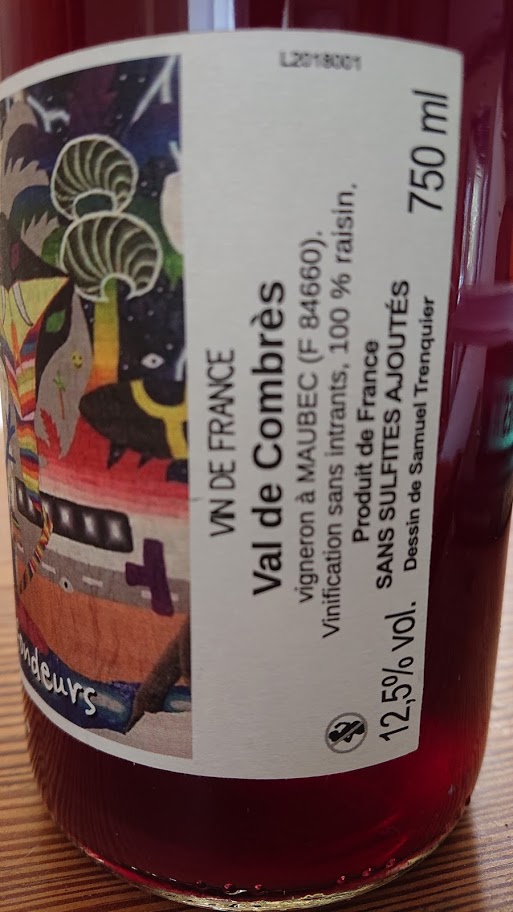
a bottle of red called Ivresse des Profondeurs from 45% Grenache, 20% Cabernet Franc, 20% Syrah and the remaining 15% unspecified. Delicious.


The third wine was called 'La tempete Eparpouille', a blanc de noirs (100% Grenache noir).

The Domaine Val de Combrès is characterised as follows;

Artisanal winemaker, production of organic, natural, sulfite-free wines in native yeasts. Established in 2013 on 4 hectares, the cultivation is organic and biodynamic in animal traction. Artisanal production (about 10000 bottles/year) of natural wines without sulphites, with only the yeast of the grapes. All 3 colors are produced.

Amazing to have them as your local winemakers and for sale at your local 'Le P'tit Bio.'


Les Affranchis, Paris, 2019


 On the same day as the Concours Amphore in Paris, there was a show called 'Les Affranchis.' Also devoted to Natural Wine. This fair has been going already for some years and attracts a young and 'branché' crowd.


The name Affranchi  refers to the fact that the wines have been made in the main free of any rules or regulations.


Zipping round we discovered Nicolas Camarans having a spot of lunch.


We had come across his wines at L'Etiquette and were intrigued that he was growing Chenin in the Aveyron, not far from St. Come D'Olt where the Rencontres de Cepages Modestes takes place. Other cepages include Fer Servadou, Negret de Banhars, and Cabernet Franc.

Nicolas was owned and ran a bar in Paris but decided to go back to the family's native village where his forbears had been vignerons. The vineyards ahd been abandoned after the terrible frost of 1956 and Camarens nursed them back to life and now produces famous wines under the name 'Mauvais Temps' (the name of his house there) which can be found at Chambers St. Wines and Flatiron in New York, The Smiling Grape company in the UK, as well as in Australia, Switzerland and of course in many places in France.

It is a great pleasure and privilege to meet such producers who merit a pilgrimage themselves rather than hauling their wines to these events, sometimes on the other side of the world.


Another Chambers Street wine was Puzelat, the prominent Loire producer. We know the wines of Thierry Puzelat under the name of Clos du Tue Boeuf. Unusual grapes include Fie Gris, Menu Pinot and Romorantin. The Puzelat website claims nicely 'For the Puzelats, making wine entails positioning as an intermediary between the soil and the glass of wine.'


We were unaware that the family are also involved as agents for some of the other big names in Natural Wine.

Alaverdi
Arianna Occhipinti
Cascina Tavijn
Cos
Cotar
Dario Princic
Foradori
Iago
Natenadze
Pheasants Tears
Vinos Ambiz

and many other prominent natural wine and even Sake producers.


During our quick tour (we had a train to catch), we almost ignored the sole representative of Chile but there was something atypical about their labels so we paused for a moment. In this way we were introduced to the wines of Antoine and Dorothee Luyt. Luyt is another house imported by Puzelat and stocked by Chambers Street Wines by the way.


The story of how Louis-Antoire Luyt from Bourgogne found himself making natural wine in a remote part Maule in Chile is picaresque to say the least. It involved a move to Chile following discontent with Europe, disillusionmment with Chilean wine, a spell washing dishes in a restaurant, setting up a winery, a catastrophic earthquake and the rebuilding of his operation.

Today his Clos Ouvert wines are celebrated internationally. He farms Pais vines - some up to 300 years old - as well as growing and/or buying in Carignan, Carmenere, Cinsault, Cabernet Sauvignon, Merlot, Pinot Noir, Syrah and Muscat of Alexandria for the whites.

We think this might be a pipeño behind the bottle but images are hard to come by.
A feature of Luyt's wines is the use of Pipeños in the Chilean peasant tradition. He describes them as more about the grape varieties than terroir. Now that's right iconoclastic for a Frenchman.

The wines themselves are completely different from anything you might associate with Chile. They are totally delightful and adorable. We made enquiries immediately as to how we could lay our hands on those not already available in the UK at Buon Vino, Yorkshire. They may be imported from Zoe Puzelat at Tue Boeuf or Chabrol wines in Amsterdam.

A day spent at the Concours Amphore and Les Affranchis was certainly packed with interest. Recommended.


Thursday, 4 July 2019

Just announced. New grapes for Bordeaux!


The hottest most unexpected news has just come out of Bordeaux of all places. 

Bordeaux you would have thought is a well established wine producing area if ever there was one. Over centuries of large scale production for an international market, Bordeaux styles, regions vineyards and not least grape varieties have evolved. 
 
 
The classification of 1855 seemed to have set all this in stone.

You would have thought there was no need to fix anything in Bordeaux as nothing appeared to be broke. 

Certainly Bordeaux has changed not exactly out of all recognition but substantially over the last 50 years - and a lot for the good. Dry white wine is the obvious example. Your Semillon Sauvignon and sometimes Muscadelle is now making word class wine. Whole satellite regions are no longer a byword for poor mean plonk. Even Bordeaux Superieur and even plain Bordeaux can be excellent.

On the negative side the inexorable march of the abv results in wines which are almost new world in their concentration and extraction.

Perhaps it is this that has prompted the  wine producers' syndicate to vote unanimously to think again about permissible grapes and make 7 choices. It still needs to be approved by France's national oversight body, INAO.  Just to recap, the varieties currently authorized include

Carmenere
Cabernet Franc
Cabernet Sauvignon
Malbec
Medoc Blanc (no longer cultivated)
Merlot
Petit Verdot
Saint Macaire

and for the whites

Colombard
Folle Blanche
Muscadelle
Sauvignon Blanc
Sauvignon Gris
Semillon
Ugni blanc


When you consider Burgundy, this is not a bad palette of choice and the various Bordeaux areas take advantage of whatever is best for them, 

And yet it has been announced out of the blue that several further grape varieties are to be permitted under certain circumstances and some of them are not even native French varieties:
 
White

Liliorila
Petit Manseng
 
Red
 
Alvarinho
Arinarnoa
Castets 
Marselan
Touriga Nacional
 
We welcome these varieties even if they are not permitted for the moment to cover more than 5% of the vineyard or form more than 10% of any blend. Bordeaux has shown surprising forward-looking flexibility. We think there is no doubt others will follow.

Apparently the impetus to the initiative has been global warming. There may even be further additions to these new grapes.

If crossings such as Arinarnoa (Cabernet Sauvignon and Tannat) and Marselan (Cabernet Sauvigon and Grenache) are allowed, why not resistant hybrids such as those being developed by the Vivai Cooperativo di Rauscedo, the worlds' largest and most important vine nursery? It is the VCR's intention to produce resistant versions of all the great grape varieties and they have made a good start on this.
 
What else might be considered?


In a previous post we wrote about an estate in the Graves called Liber Pater. There a gentleman called Loïc Pasquet is attempting to re-create a pre-phylloxera vineyard. to that end he has planted an eclectic variety of grapes:

Camaralet (a white grape associated with several areas in SW France but not Bordeaux)
Lauzet (a white grape from Jurancon) Mancin (aka Tarnay Coulant - a red grape formerly quite widespread in the Gironde including Bordeaux but now down to less than 1 ha.) Pardotte (red grape considered productive but giving an ordinary wine low in alcohol and flat. Unclassified, there were 183 ha. in 1958 in many Bordeaux sub-zones, a few in 1988 and in 2011, none.)  Prunelard (a red grape nursed back to life by the Plageolles family in Gaillac) . Although parent of Cot (aka Malbec or Pressac in Bordeaux) it is not a Bordeaux grape.


And our own personal suggestions? 


Sauvignonasse aka Tocai Friulano or Friulano. Surprisingly this originated in Bordeaux but has never been much cultivated there. If you want a resistant version of Friulano, VCR have two varieties, Fleurtai and Soreli.
 
The huge Adega Regional was built following the time when Colares stood in for Bordeaux during the Phylloxera epidemic.
Ramisco. OK, we are obsessed with Ramisco. Why? Because it grows in sand over clay and therefore was never affected by Phylloxera, it produces age-worthy wines, is planted by the sea - the same Atlantic Ocean that abuts Bordeaux and makes low alcohol wines, typically 11% or 12% (although admittedly this has been creeping up) and is perhaps the most 'Bordelais' of all Portuguese wine. There is also an interesting historical connection with Bordeaux. During the Phylloxera blight, the wines of Colares went some way to step in to supply the Bordeaux market being one of the few places still producing wine. It became known as the Bordeaux of Portugal.


Wednesday, 3 July 2019

Concours Amphore 2019


We were fortunate enough to be allowed to take part as one of the 150 - 200 jury members in the 2018 Concours Amphore in Paris. We found the experience so interesting and enjoyable that we applied again this year and were once more accepted for jury duty.

The competition has been going 23 years under the benevolent leadership of Pierre Guigui who seems to be on friendly terms with everyone participating. It exists in order to bring organic wines (including natural and biodynamic wines) ever further to the attention of the wine world and general public by awarding gold, silver and bronze medals to worthy wines submitted. There is no doubt that this works.

Pierre is also an animateur of the first order in many other activities to do with wine. He is a selection consultant Les Excellences Biocoop wines as well as three major purchasing offices; Paris Trade Fair’s Grand Jury ; Gault Millau’s label wines for Monoprix and Savour Club, lecturer, author and interestingly Founding Member of the Renewal of Breton Wines movement.

For the 2019 Concours, we had requested to be put on an 'etranger' table only because we noticed last year that there were so many bottles from so many diffrerent countries outside France that we were tempted by the sheer variety.

Our story for 2019 begins with the closure of the Chatelet Metro station to the line we needed to get to the somewhat far flung venue. The generous time we had allotted to arrive at the appointed hour began to trickle away as we attempted to pick up the metro at a neighbouring station. Things went so badly we decided to jump in a taxi but there were none to be found. Finally a taxi appeared but our euphoria was short-lived. Practically the entire route was bumper to bumper. We arrived no less than 45 minutes late assuming we would not be admitted since there was no point in jury members being partly absent.


Mercifully, the proceedings had been delayed even longer and we joined the merry throng for another 15 minutes at least.


A beaming Pierre Guigui was on hand to greet each and every one of the jurists.


Everyone took their places smartly. In 2018 we had been placed at a Jura and Savoie table but we looked in vain for those regions this time. Strange.


We had been assigned Greece and Hungary. What great luck.


Our three fellow-jurors were all delightful Greek ladies involved professionally in the wine business. There was a Sommelier, an importer and a writer - all wonderfully qualified and knowledgeable. They were kind enough to draw us into their circle and discuss our markings. Fortunately we agreed on these more often than not.

Out of the 20 wines presented we will omit the Hungarian contribution because there were only 3 in number and without any very great interest


Eirini Daskalaki makes amphora - and organic wine with her son Yannis.

Discoveries among the Greek wines included the Daskalaki winery from Sliva in Crete.

Their Rose is made from Kotsifali.

The red is from Liatiko.


An Orange wine from Anatolikos Vineyards in Xanthi on the Aegean in Northern Greece was made from Assyrtiko and Malagoussia. You can get it at Pure Wines in the UK but the abv is 14%. Just sayin'.


Also from Anatolikos was this red dessert wine, Pollios Oinos from Mavroudi, Assyrtiko and Muscat.

There had been a wine made from the white Begleri grape but we are not sure which it was. In any case, we didn't give it a high score. Begleri is also known as Thrapsathiri which we have come across before.


For us the major discovery was a winery in Paros called Moraitico. We had singled out this rosetasted  blind as were all the wines. We noted a lovely hint of rose petals.


Also standing out was Moraitico's red from Mandilaria, Monemvasia and Mavrotragono. This was perhaps the best in show for our taste. Our notes included words such as Fascinating, lovely, soft, individual and original. Moraitico seems not to be widely available. This must change!

We were amazed to find Moraitico in this way. We had been to Paros and visited the famous Moraitis winery whose wines we also love but until this Concours Amphore had never heard of Moraitico. Might they by any chance be related?

No less than 6 gold medals and 3 bronze were awarded by the ladies at our table. We didn't contribute to that discussion because such had been the rigour of our other deliberations that we were the very last to hand in our results. Also, thanks to Herve Letheilleux of our favourite natural wine shop 'L'Etiquette,' there was another wine fair not far away which was taking place on the same day: 'Les Affranchis.' We had to get over there quick.


Yet another Paris Round Up

1st time
2nd time
3rd time

this time
Our tradition of snapping the Pont Louis Phlippe in Paris on our way to Cave L'Etiquette continues.


This time, Hervé Lethielleux was ready for us. He grabbed this Orbois from the rack as soon as we walked in. We were amazed and thankful even when we discovered later that Orbois is Menu Pineau. We've had Menu Pineau before in an Australian sparkler and found it very tasty.


Hervé  had featured Domaine de l'Etoile du Matin, Fin de Vie, Peinard au Soleil from the Languedoc a while ago in his weekly video and we fell for it as well as the next wine. Hervé had put the two bpttles aside for us. 

The grapes of the Fin de vie are 80% Grenache Gris, with Clairette, Macabeu and Terret Gris (aka Bourret). Up to 1958, Terret Gris was the most planted grape in the Languedoc. There are white and red mutations of Terret too. This assemblage makes a delicious Pet Nat. 13%, organic and without any sulphites or other additional ingedients. Full of life unlike its peculiar name.


Our second Pet Nat also has a peculiar name unless you are old enough to remember the soft drink in France which really had the name Pschitt. This referred to the sound when opening the bottle. It was a more innocent time.


This Pet Nat from fun blend of Grenache Gris, Macabeu and Clairette and is made by an interesting vigneron-cum-museun curator-cum-photographer, Sebastien Godret. His wines consist only of juice. Godret's red fizz is from Grenache Noir and is onlt 12% abv. We like the style as well as the labels. 


One Hervé hadn't mentioned was this Gris D'Aunis by Brendan Tracey. Any wine containing either the word Aunis or Tracey is a green light for us and indeed this blanc de noir was sensational. 


Over to 'Le Nouveau Nez' now more resto than cave but Valerio (above right) had an interesting bottle back in stock.


Seibel is an old French hybrid known mostly in its white incarnations. However, there are no fewer than 56 different Seibels, all produced by crossing Vinifera with native American varieties. They are not much used these days. There are some plantings in Michigan but they are not authorised in France which makes this bottle from Boisset-Saint-Priest near St. Etienne particularly intriguing. 


We had passed this pretty shop front on previous visits but never entered Divvino. It's a nice place - quite traditional but reliably covering all the usual bases.


As so often, even in the not always welcoming city of Paris, there was an amiable and helpful person on hand. This seems to be so especially in the case of wine merchants.


There was one surprise we couldn't resist. A rare bottle of Viuva Gomez's Collares. Amazing.

Seen outside another wine shop: 'Celui qui fait uriner son chien sur cette planche ou table n'ira pas au paradis - Dieu'