RAW (always in caps) is trademarked. The subtitle is 'The artisan drinks fair'. We assumed that RAW is an acronym for Real Artisan Wine but perhaps it is just the word 'raw' as in 'uncooked'?
No matter, the fair has been going since 2012 and has now spawned fairs in Berlin, New York and Los Angeles. The founder and moving spirit Isabelle Legeron MW has also written books on Natural Wine and deserves all possible credit for arguing the case for what she calls living wine. That case is still not won but it makes inroads with every fair.
The London fair has seen ups and downs over the years. 2018 was definitely vintage.
As ever, we concentrated on the lesser known grape varieties of which there was a bumper crop. We earmarked 20 of the 150 exhibitors for special attention and were not disappointed.
 |
| Giorgi NatEnadze with one of his wild vine discoveries |
The rarest, most obscure varieties were to be found at table 71, Natenadze's Wine Cellar, Samtskhe-Javakheti, Georgia. To whit:
I have spent much of the past decade traipsing through mountain forests in search of ancient vines growing the way nature intended - up trees. I have found some vines that are more than 100 years oldand one that I reckon is more than 400 years old. I have uncovered 40 rare grape varieties in the forests in the south of the country, near the border with Turkey.
Giorgi Natenadze.
 |
| This variety must be the strangest of all with grapes of all known colours |
Asked exactly which of these wild varieties went into his wines, Mr. Natenadze wrote us the following list;
Meshkuri Tetri (White); Akhaltsikhuri-tetri, Chitiskverstkha-tetri, Udis-tetri, Meskhuri and Mtsvane.
Meshkuri Red; Tskhenis dzudzu tetri (Horse Breast White), Meshkuri Sapere, Meskuri Kharistvala.
His website is gthe best source of information about his fascinating operation
:
 |
| Giorgi Natenadze (left) and team at RAW |
About Meskheti and Natenadze's Wine Cellar
Region Samtskhe-Javakheti, historical name - Meskheti
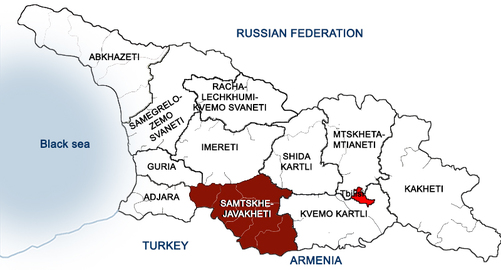
My region Samtskhe-Javakheti (Meskheti) was occupied for 3 centuries by Ottomans (Turks). They destroyed wine
yards and wine villages, they destroyed all local endemic grape species
and today I decided to research, study, identify and multiply oldest
Meskhetian vines.
... " I
have spent much of the past decade traipsing through mountain forests in
search of ancient vines growing the way nature intended — up trees. I
have found some vines that are more than 100 years old and one that I
reckon is more than 400 years old. I have uncovered 40 rare grape
varieties in the forests in the south of the country, near the border
with Turkey, but I have only been able to identify 24 of them so
far. Each year I makes a different wine from these ancient varieties at
Natenadze’s Wine Cellar in the Samtskhe-Javakheti region" ...
In
my Region it is first wine making after 16th century. Most of my grapes
I collect from forest and oldest destroyed villages, mostly grape trees
are more than 1-2 hundred years old and the biggest is more the 4
centuries old which is still alive and gives me the grape for my wine.
"So I am making wild wines from volcanic mountaineer region where
everything is wild and natural".
The minimum see level is 1000
meter and maximum (for vines) is 1650 meters. My wild wines are very
limited production. I produce from 1 to 1200 bottles (from different grapes) in a year.
when
you taste Meskhuri wine, you fill whole Meskhetian history legends and
absolutely unique different aromas. Georgia is the first wine making
country in the world and Georgian scientist think that birthplace for
wine is Meskheti Region.
Qvevri Wines (4-6 month skin contact in Qvevri)
1) Meskhuri Red 2009 - grapes: Meskhuri Sapere, Meskhuri Tskhenis dzudzu tetri, Kharistvala Shavi.
1) Meskhuri Red 2010 - grapes: Meskhuri Sapere, Meskhuri Tskhenis dzudzu tetri, Kharistvala Shavi.
2) Meskhuri Red 2012 - grapes: Meskhuri Sapere, Meskhuri Tskhenis dzudzu tetri, Kharistvala Shavi.
3) Meskhuri Red 2015 - grapes: Meskhuri Sapere, Meskhuri Tskhenis dzudzu tetri, Kharistvala Shavi.
4) Meskhuri Mtsvane, white 2013 - grape Meskhuri Mtsvane (only 5 grape tree in region).
5) Meskhuri Mtsvane, white 2015 - grape Meskhuri Mtsvane (only 5 grape tree in region).
6) Tamaris Vazi, Red 2015 - grape: Tamaris Vazi, 1st time of its production in 2015.
7) Chachkari, Rose 2015 - grape: Kapnis Kurdzeni, 1st time of its production in 2015.
8) Akhaltsikhuri Tetri - white 2015 - grape: Akhaltsikhuri Tetri - 1st time of its production in 2015.
9) Natenadzis Tetri - white 2015 - grape: Natenadzis tetri - I found this grape specie and gave it my name
10) Meskhuri Tetri - white 2015 - grapes: Akhaltsikhuri tetri, Meskhuri Mtsvane, Udis Tetri, Chitiskvertskha Tetri.
11) Tskhenis Dzua - Red 2015 - grape: Tskhenis Dzua Shavi, only 2 grape trees in Region. very unique wine.
 |
| Natenadze Red wines with mini Qvevri |
Georgi makes these wines in tiny quantities but there is nothing small about their quality. Novel flavours to be sure but lovely and delightful.
In particular the Meshkuri Red is a real find at only 10.5%. One of those wines that belie their modest alcohol content.
The names of the grape varities might be a problem for some who already struggle with names such as Kovidinka or Assyrtiko. Chitiskvertskha for example is a bit of a mouthful but then so is the wine.
 |
| Thygge Benned Jensen |
Next point of interest was Bodega Frontio, Arribes, Spain run by a
charming bear-like Danish gent called Thyge Benned Jensen. Thyge gave up
his job trading gas for Maersk to work with what he calls 'the fragile
local grape variety Juan Garcia'.
We have encountered Juan Garcia bafore and agree with him that it is well worth cultivating. Arribes is on the Duero on the Spanish side of the border with Portugal and is the home of Juan Garcia.
Foglia Tonda is a genuine obscure Tuscan variety we have been skirmishing with for too long. We have been sold bottles only to discover this grape was just part of the blend.
 |
| Guido Gualandi of Podere Gualandi |
 |
| Ruedi Gerber and team of Sequerciani |
At RAW London there were no less than 2 producers of Foglia Tonda in purezza almost side-by-side and good colleagues: Podere Gualandi and Sequerciani, both of Toscana.
 |
| Outstanding |
Both versions of Foglia Tonda were outstanding and we were left with that by now familiar feeling of why on earth such a distinctive and gorgeous variety could be so scarce and difficult to find. We will put Foglia Tonda right up there with other Italian rarities meriting a much larger audience such as Grignolino and Rossese.
 |
| Gorgeous |
Sequerciani also has a sweet Aleatico which we didn't fail to taste.
 |
| Aleatico; a great variety |
It reminded us of what a great variety Aleatico is. We would love to taste a dry version one day (they exist).
Nearby was an Albarossa by Forti del
Vento, Piemonte. We remember having been enthused by an Albarossa some years ago but could not muster the same impression on this occasion. Perhaps the Foglia Tondas were still too present in our palate memory?
Hovering around a producer from Vicenza and asking if they had a Tai Rosso, we were directed further along to Sieman - a new outfit from the Veneto founded by three brothers. Sieman is Venetian for Six Hands.
 |
| one of the Filipini brothers at Seiman |
When asked about Tai Rosso, the chap on duty (presumably one of the brothers) offered us not just a red wine, Tai Rosso but also a white vino Frizzante made from Tai Rosso, Garganega and Incrocio Manzoni
and - wait for it - a beer, YES, A BEER made from Tai Rosso must added to beer wort! We tasted it, dear Slotovino reader
and it was good!
Note. Tai Rosso was formerly Tocai Rosso, believed to be an indiginous grape variety from the Colli Berici near Vicenza, Italy. Subsequently identified as none other than Grenache, Tai Rosso growers still maintain that it has evolved into something other thanks to the centuries of transplantation to this particular terroir. they have a point is that the wines are most un-Grenache-like.
 |
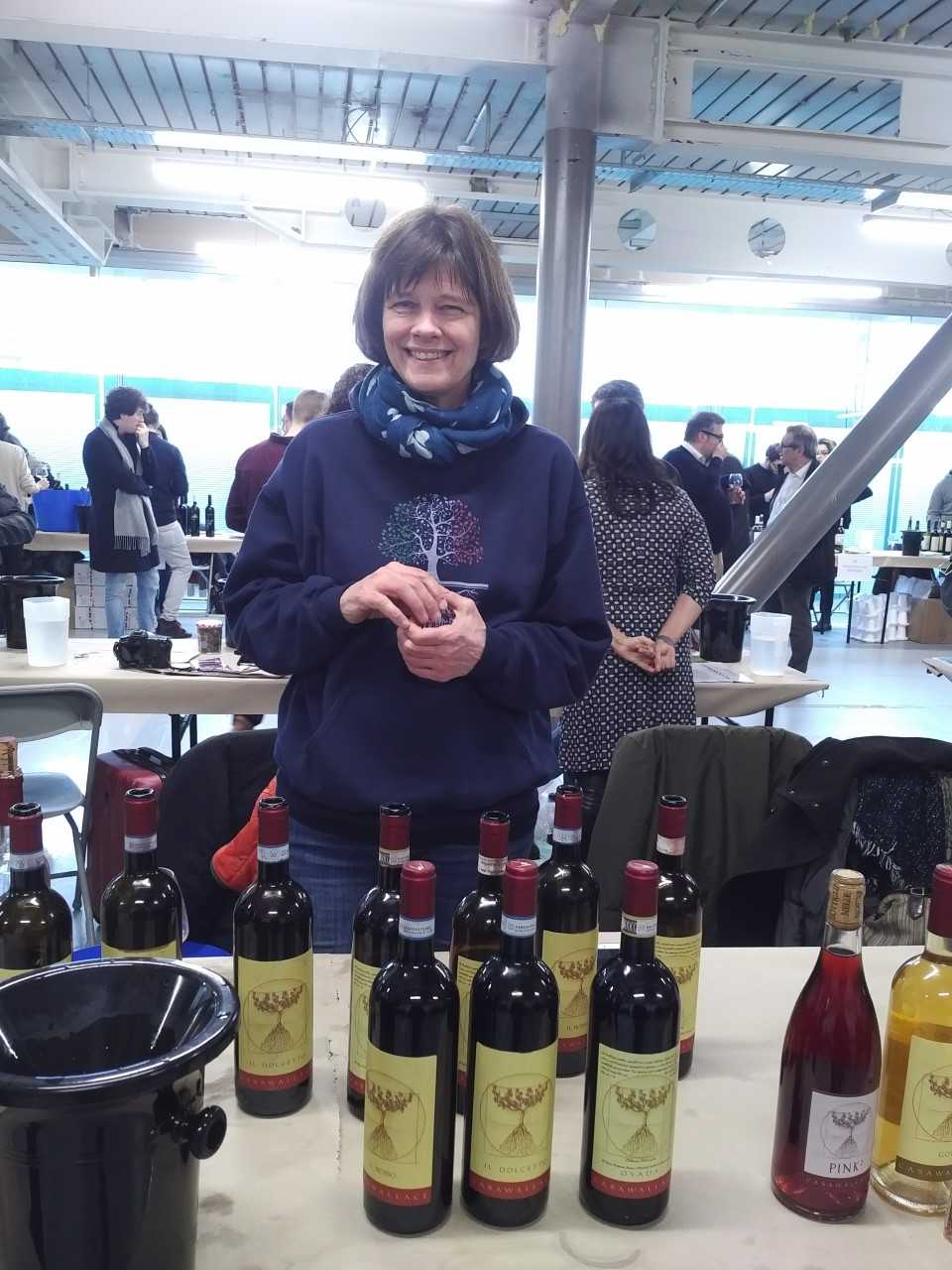
| Casa Wallace Dolcetto experts |
We were drawn to a Piemonte grower of Dolcetto by the name, Wallace rather than the grape. We have had the acquaintance of a Tai Rosso grower in the Colli Berici called Alan Wallace Bruzzo and wondered if the Wallaces of Piemonte were by some chance related.
 |
| Sarah Wallace of Casa Wallace (?) |
Not so but the elegant lady at the Casa Wallace table (who might have been Sarah Wallace herself) persuaded us to taste her Dolcettos on the grounds that there were three vintages including an older one. Now Dolcetto is a grape we have never been able to get a handle on. Strangely, its neighbour Barbera is another and we even find the obsession with Nebbiolo hard to understand.
 |
| Three Dolcettos |
The Casa Wallace Dolcetto Ovada 2011 was something of a revelation especially when compared to the more recent Dolcettos of 2015 and 2016/17. Perhaps Dolcetto, which Mrs Wallace stated was a tannic wine needs time - quite a lot of it?
There only remained to visit two old friends from RAW, Ancre Hill and Palazzo Tronconi.
The news from Ancre Hill, the Welsh winery in Monmouthshire is that they have found a new use for their Triomphe d'Alsace grapes:
Triomphe Pet Nat! Previously the Morris family had managed to achieve the impossible by producing a drinkable Triomphe red. This they did via carbonic maceration.
 |
| Morris family at Ancre Hill table |
Now they have done it again by producing this Pet Nat from the unlovely Triomphe. Having tried for 25 years to make even a cooking wine from Triomphe we have now grubbed up this variety and are taking great pleasure in burning the mighty ex-vines in our home fire. Hats off to Ancre Hill for achieving the impossible.
Palazzo Tronconi, our favourite producer from Lazio still has no British importer but that will surely not be long in coming on present form. The genial Marco Marrocco was on hand to present his masterworks Fatia (Malvasia Puntinata, Tebbiano), Fregellae (Maturano Bianco, Capolongo, Pampanaro), Donnico (Ulivello Nero - aka Sciascinoso) and Zitore (Lecinaro). The first three were even better than ever but the Zitore, made from Lecinaro
in purezza was, how can we put it - different. At 13.5% it was more alcoholic but it was also somehow not as generous. Previously Donnico had been the junior partner. This time the roles were reversed we thought. All good though and heartwarming to see these rare vareties flourishing at Palazzo Tronconi.
Along the way there had been several other points of interest including some Blauer Potugiesers from Hungary and Moravia, Podere Pradarolo of Emilia Romagna whose wines we had previously admired and whose Vej Bianco Antico (Orannge wine) we had since discovered,
Case, another winery in Emilia Romagna who produce an interesting Bianco (Vin de Table) blend of Ortrugo, Malvasia, Marsanne and Moscato.
and something called Caleb Leisure Wines from California who make their
wines in 10 authentic Georgian Qvevri buried in the earthen cellar at
Coturri Winery (Sonoma).
So these Californian Qvevri bring us back to the Georgian ones of Natanadze's Wine Cellar above. You could say Qvevris are catching on.