Tuesday, 19 March 2013

In praise of Bedell Vineyards


For BHO's second inaugural, there was Korbel's Californian Sparkling Brut Naturel and two wines from New York State, a Finger Lakes Riesling and Bedell's Musee Merlot from the North Fork of Long Island.

We happened to be in the US at the time and sampled the Korbel and various Bedell wines, the Riesling being available only from the two wineries which had collaborated in its production (not something you hear about very often!).

We also tried Korbel's Extra Dry and preferred it to the Naturel because the latter was rather neutral and the Extra Dry, although less dry had more character.

On a previous trip to America we had done a crawl of the North Fork vineyards of Long Island but had not tasted Bedell's wines as we were driving and had already tasted most everyone elses. We had no idea that here was perhaps the best Red wine produced in the state of New York. It appears that it has been going for 30 years, the last 13 of which have been under the ownership of Michael Lynne, a prominent film producer (Lord of the Rings).

The winemaker is Rich Olsen-Harbich who is known as a Merlot expert in the business. Bedell's website has it thus;

Bedell's Winemaker, 30-year veteran Rich Olsen-Harbich, wrote the North Fork of Long Island appellation into existence in 1986, and is the only Winemaker in Eastern North America to use entirely indigenous yeasts as part of a holistic natural winemaking program. Complementing this 30-year tradition with a critically acclaimed Artist Series, dynamic management team, and some of the oldest grapevines in the region, Bedell exists at the forefront of creativity and excellence in the modern American wine industry.

So far so good but even this didn't prepare us for the excellence of their wines.
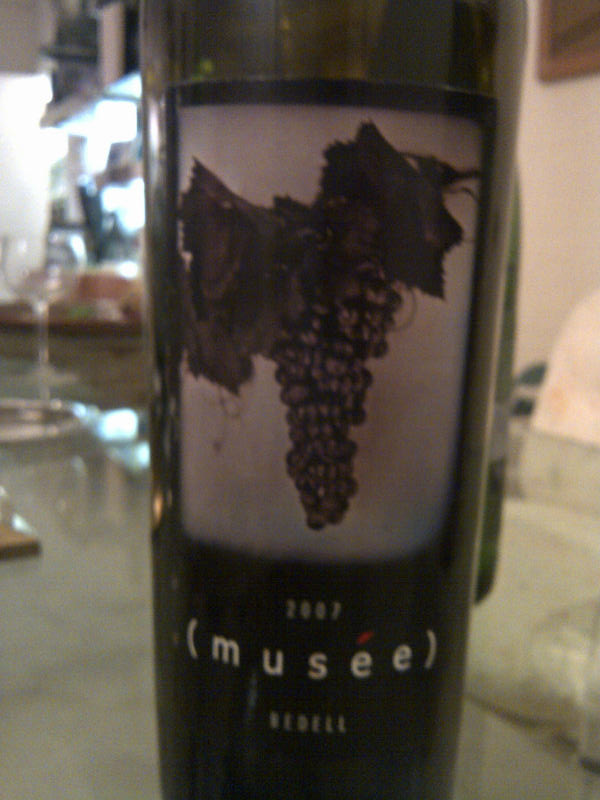


Encouraged by this excellent wine we sought out two othe Bedell versions of Merlot. The first was called "First Crush". At modest alcohol and early release this was the epitome of lightness and freshness, so rare in American wines. It reminded us of something called "Merlesco" produced by Joseph Grillo in South Australia. If anything this was better.


For a version of the inauguration dinner back in London we served the 2008 Bedell Merlot - something between the First Crush and the Musee. This was perhaps the least sensational of the three but still really good.


When will someone succeed in importing these wines in Europe - or anywhere?


Friday, 15 March 2013

Christian Chaussard 1954 - 2012


One of our very favourite winemakers and one of the best. We had the honour to meet him at last year's Real Wine Fair. His natural wines from Pineau d'Aunis have been described as 'transformative'. It is very sad but his good work will live on.


Saturday, 9 March 2013

What's happening to Bardolino?


This blog is mainly to do with individual grape varieties so blends don't get much of a look-in. However we have always had a soft spot for Bardolino. It just appeals as a light drinkable food wine. Its ups and downs have also tugged at our heart strings so we suffered with its reputation during the times when it got a bad name for over-production and general lowering of standards.

We looked on helplessly while its sister Valpollicella seemed to go from strength to strength, for a while almost to the exclusion of Bardolino. Then Bardolino made a come-back by getting rid of the worst kind of cheap and not so cheerful products and generally cleaning up its act. Nevertheless, it is Valpolicella that is more expensive and better regarded with Bardolino treated in a patroniising way if at all. Here is a particularly delicious econium from the Sotheby's Wine Encyclopedia;

Bardolino DOC produces dry, sometimes frizzante, red and rose (chiaretto) wines from the southeast shores of Lake Garda. The reds, made from Corvina, Molinara and Negrara (sic) could be very interesting , but unfortunately most producers tend to make rather bland, lightweight wines.

Why should this be? We have various theories; Valpolicella is the base wine for others of considerable interest including Ripasso, Recioto and of course Amarone which has a claim as one of Italy's great wine styles. Or could it be that Valpolicella is in general more substantial than Bardolino with a greater percentage of Corvinone permitted - up to 50% as opposed to 10% for Bardolino. We think this might be significant because otherwise the constituents, Corvina, Rondinella and sometimes Molinara with small amounts (no more than 10% of any one and 20% of any combination) of Rossignola, Barbera, Sangiovese, Marzemino, Negrara Veronese, Cabernet Sauvignon are the same. As a footnote, Molinara is no longer obligatory for Valpolicella and has been dropped in the main.

Now Corvinone is a different grape from Corvina. Harding Robinson and Vouillermoz say it may be from the same family but it is indeed different. In our limited experience it is a bit of a brute of a grape. Could it be that the significantly higher percentage of Corvinone in Valpolicella makes the difference? We wish someone would tell us because we think there must be something more than terroir to explain the vivid distinction between Bardolino and Valpolicella.


So we always like to have a bottle of Bardolino on hand and we enjoy trying different makers. Old favourites include Recchia, Guerrieri Rizzardi, Monte del Fra, Bolla, Masi etc.


We even  "discovered" Bardolino Chiaretto - for some time it was the only mildly interesting wine at British airports. Now even that has disappeared from their shelves.

Recently however we have stumbled across some distinctly unattractive Bardolinos. They have one thing in common. They are all heavier, more alcoholic and concentrated. Maybe their producers have been reading the Wine Encyclopedia and have taken things too far the other way from bland. This doesn't suit the style at all. It results in a homogenised wine which could have come from anywhere. Guerrieri Rizzardi made a version with if we remember correctly had 10% Cabernet Sauvignon but it was done skilfully and didn't throw the baby out with the bath water.


It would be too sad if this is the future for Bardolino. More than that, it's a trend over several other wine styles including Valpolicella actually. We prefer also the lighter kind of Frappato and Rossese for example.


Saturday, 2 March 2013

Some nice wine shops in Spain, Italy and Poland

No posts in February? We have been too busy bottle-fondling across Europe.


We have visited some lovely shops and met some charming and erudite people in them. Our favourite was Julio Carrasco, the main man at Vinoteca La Cartuja in Malaga. We had been there years ago but Julio has changed it out of all recognition.


 It is now lavishly appointed with all kinds of amenities including Enomatic machines, a temperature-controlled inner sanctum for the top bottles, a tasting table and an area at the back with a table for dining, lectures etc.


Julio is the kind of person who knows all his many bottles intimately. In answer to our question about rare grape varieties he zeroed in immediately on all kinds of treasures, only a few of which we could take with us, air travel being what it is. These included a Subirat Parent  (a what? we hear you cry)


and a Zalema. The latter we bought by way of giving it an even break, having condemned our first bottle more or less out of hand. Vamos a ver!


Julio entered into the spirit of things so completely that he produced his very last bottle of Malvasia Rosada Dulce - rare grape variety from the Canary Islands with a flourish and threw it in to our basket as a gift!


That's the kind of enthusiastic person he is. He deserves to prosper.

 
In Sevilla, we re-visited another nice shop called La Carta de Vinos where rather less had changed.

 
The same rather reserved girl held sway but this time in answer to a question about the percentage of certain varieties in a particularly interesting blend she took ages consulting various books and websites to satisfy our curiosity. At the end of perhaps 20 minutes of this she would have been in her rights to throw the bottle at us but she drew the enquiry to a close by saying that in any event the local varieties would not constitute more than 10%. We were grateful for this information and for her efforts particularly as she could have told us that at the very beginning and saved herself a lot of trouble.


Moving on to Rome we returned to our old haunt, Enoteca Costantini but there the uniformed staff seemed too overstretched stacking shelves to give us very much time.

 
They knew their stuff though. Having perused the Puglia section for a Sususmaniello and not finding it, one of their number climbed down his ladder and zeroed in on two bottles we had somehow contrived to miss.


They also had a kind of insider's knowledge. We asked them about some other obscure varieties in purezza and they explained that depending on the vintage, it was difficult to know what various growers put into their wines. One forgets that.


Determined to broaden our Roman horizons we made a pilgimage to Enoteca Lucantoni in the Northern part of the city.


 This shop is not as historic or imposing as Costantini but we found some interesting things there including a Catalanesca,


 a Pallagrello Bianco


and some Malvasia Puntinata in purezza. This is a constituent of Frascati and in particular the wines of Marino - the village near Rome where Hans Werner Henze lived and had recently died. We didn't buy the Lucantoni version of Malvasia Puntinata as it was rather alcoholic for a white wine but we found this bottle at an Enoteca in the Via Ferrara in the centre of town.


Polish Wine? We had heard of its existance but on a visit to Gdansk, there was none to be found. The Baltic coast of Poland is not a desert as far as wine is concerned though. In particular there is a certain entrepreneur who has opened a number of excellent wine shops called Festus


 as well as a restaurant called La La La


and a so-called Art Hotel in Sopot,


the seaside resord 30km from Gdansk. We didn't meet this gentleman but his presence was tangible. His staff at Festus/Gdansk told us he liked to travel all over the world searching for good wines to sell in his establishments.


She herself was able to fill us in a little on the wines of Poland. She was not especially enthusiastic about these, mentioning a watery Pinot Noir and a Pinot Gris which hadn't exactly bowled her over.

 
It's a real pleasure to encounter such shops in different places. They provide experiences and products you could never get in a supermarket.