
There are many parameters in the making of wine. You know the kind of thing - terroir vs. grape variety, vineyard vs. cellar, nature vs.
intervention. The success of Ridge raises another
important variable, one which is perhaps normally recognized only in passing but in the case of Ridge, may be the secret of why their wines are counted among the best in the world.
We are talking about vine age or otherwise vine
productivity. Old vines produce the most concentrated juice
and the term Vieilles Vignes (first used by Bollinger only 50 years ago it
seems) is used wherever possible by producers to add value to their offerings.
There is nothing mystical about old vines. They are just less productive than
when they are in their prime.
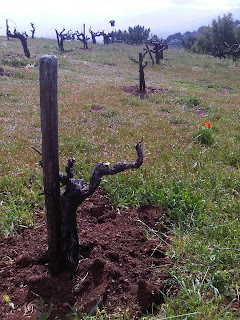

In fact they can produce concentrated grapes when very young, before their root systems have developed. That is why some wines from new Californian producers did so well against French Grands Crus at the ‘Judgement of Paris’. In their most vigorous phase, say between the ages of 3 and 20 years, productivity goes up and concentration, hence quality goes down.
In fact they can produce concentrated grapes when very young, before their root systems have developed. That is why some wines from new Californian producers did so well against French Grands Crus at the ‘Judgement of Paris’. In their most vigorous phase, say between the ages of 3 and 20 years, productivity goes up and concentration, hence quality goes down.
Paul Draper of Ridge Vineyards has taken this particular
lesson to heart for various reasons, one being that his love for Zinfandel in
particular led him to choose with special care the most appropriate vines – not
a simple matter as so much Zinfandel had been planted in inappropriate places
in California with results that did not do justice to the variety. Poorly situated vines frequently have to be left too long in order to ripen and produce the overblown jammy high-octane Zinfandels which doesn't add to the variety's reputation.
Mr. Draper has become expert in identifying plots of old
vine Zinfandel and other varieties all over California . Many such plots contain vines
100 - 130 years old. He has acquired some of these for Ridge and others
are still farmed in some cases by the original families who planted the grapes
generations ago. These Zinfandel vineyards include
Buchignani
Carmichael
Mazzoni
East Bench
Geyserville
Lytton Springs
Pagani
Paso Robles
Three Valleys
York Creek
Other varieties grown by or for Ridge include Petite Sirah (Lytton Springs, Dynamite Hill), Grenache, Syrah, Merlot (Torre), Carignane (aka Carignan), Alicante Bouschet, Chardonnay (Monte Bello, Jimsomare, Mikulaco), Cabernet Franc and others. Cabernet Sauvignon is of course the variety planted onMonte Bello where Ridge has its headquarters, tasting room, production facility etc.



- the site of the original winery, complete with cellars carved out of the rock by the founder, Dr. Osea Perrone about whom Paul Draper speaks with the greatest respect
By focusing on old vines which they do not only for their Zinfandel but across the board, Ridge is able to create a unifying style across a number of wine types. All are different and yet all seem to be related in the way that might be credited to terroir in theOld World .
Buchignani
Carmichael
Mazzoni
East Bench
Geyserville
Lytton Springs
Pagani
Paso Robles
Three Valleys
York Creek
Other varieties grown by or for Ridge include Petite Sirah (Lytton Springs, Dynamite Hill), Grenache, Syrah, Merlot (Torre), Carignane (aka Carignan), Alicante Bouschet, Chardonnay (Monte Bello, Jimsomare, Mikulaco), Cabernet Franc and others. Cabernet Sauvignon is of course the variety planted on
- the site of the original winery, complete with cellars carved out of the rock by the founder, Dr. Osea Perrone about whom Paul Draper speaks with the greatest respect
By focusing on old vines which they do not only for their Zinfandel but across the board, Ridge is able to create a unifying style across a number of wine types. All are different and yet all seem to be related in the way that might be credited to terroir in the
We were fortunate enough to have an introduction to Paul Draper
at Ridge, Monte Bello
from Anthony Rose, long time wine-writer on The Independent, correspondent for
Decanter, member of the Wine Gang, author, blogger, judge and much besides.
Anthony described Ridge as ‘the American producer nearest to
the [French] concept of Terroir, whatever
that means’ (our italics). Mr.
Draper kindly agreed to receive us so we hurriedly read up on the history of
Ridge and his part in it. We had been drinking Ridge Geyserville, Santa Cruz Mountain
Mr. Draper received us with old-world graciousness and began a well-practiced tour of the site starting with the view over the eponymous ridge of the Santa Cruz mountains to San Francisco which may be seen on sunny days and pointing out the San Andreas Fault in a cleft just below us.

This ridge is a watershed dividing the coastal maritime climate from the dryer and hotter inland one.We then moved on cellars and winery while Mr. Draper explained how he found a number of important books written by 19th Century Californian wine-growers including a manual of 1883 by E.H. Rixford who had grown grapes at La Cuesta from where Dr. Perrone had taken cuttings when planting his vineyard at Monte Bello. He has studied these and says he has learned a great deal from them. Such literature was rejected by everyone else trying to re-establish winemaking in California after Prohibition. In particular, the University of California at Davis has undertaken the task of educating the new generation of wine makers but according to Paul Draper has done so in a way as to encourage what he calls industrial winemaking.
This ridge is a watershed dividing the coastal maritime climate from the dryer and hotter inland one.We then moved on cellars and winery while Mr. Draper explained how he found a number of important books written by 19th Century Californian wine-growers including a manual of 1883 by E.H. Rixford who had grown grapes at La Cuesta from where Dr. Perrone had taken cuttings when planting his vineyard at Monte Bello. He has studied these and says he has learned a great deal from them. Such literature was rejected by everyone else trying to re-establish winemaking in California after Prohibition. In particular, the University of California at Davis has undertaken the task of educating the new generation of wine makers but according to Paul Draper has done so in a way as to encourage what he calls industrial winemaking.

Clearly he has found time to receive very many visitors as well as carrying out the huge amount of work necessary to establish and maintain his operation. He is really keen for you to know the history of Ridge, what he has learned from the past and how this has been put into effect. He has also learned a vast amount from practice. He tells the story of how he was invited to UC Davis to give a lecture on Natural Yeasts. The orthodoxy at UCD was that Natural Yeasts (present in the air) were too risky to use and mostly ended in disaster. Paul Draper explained that with experience he could use these yeasts with almost complete security. The Chairperson asked him to say he had been lucky but he stated that the success was due to obtaining a real understanding of all the different elements involved in fermenting any particular batch of grapes; this is slightly different each time.
The more Paul Draper talked the more we realized that here was not only an immensely erudite and experienced practitioner but an original one still pioneering in all aspects of wine. His beliefs include some surprising but welcome precepts. He keeps prices at a reasonable level so that as many people as possible may enjoy his wines. He ensures their availability in different markets sometimes preferring to take a loss on currency fluctuations rather than raise prices or interrupt supply. He likes to keep alcohol levels lower than many in California and steers a sensible course through the Organic/Biodynamic/Natural wine debate.
In the main cellar we tasted the slumbering 2009 and 2010 Monte Bello Cabernet Sauvignon, flagship wine of Ridge. Mr. Draper extracted just the right quantities from the barrels to provide tasting samples. We didn't finish these and he poured the remaining drops back into the barrels. this seemed to speak for the way with which he treasured his produce. He then asked what we wanted to taste next and seemed pleased that we mentioned some of the rarer varieties such as Carignane and Petite Sirah. We had the impression many visitors just wanted to neck as much Monte Bello as possible. Mr. Draper liaised with his cellar staff to identify barrels of these and Zinfandel ready for tasting.

In the main cellar we tasted the slumbering 2009 and 2010 Monte Bello Cabernet Sauvignon, flagship wine of Ridge. Mr. Draper extracted just the right quantities from the barrels to provide tasting samples. We didn't finish these and he poured the remaining drops back into the barrels. this seemed to speak for the way with which he treasured his produce. He then asked what we wanted to taste next and seemed pleased that we mentioned some of the rarer varieties such as Carignane and Petite Sirah. We had the impression many visitors just wanted to neck as much Monte Bello as possible. Mr. Draper liaised with his cellar staff to identify barrels of these and Zinfandel ready for tasting.

As we traversed the beautiful Redwood and Douglas Fir clad offices and other winery rooms, Paul Draper introduced us to his colleagues who are mostly long-standing collaborators but who included some younger ones. All are included in regular meetings to decide on blends and other matters. As an indication of how democratic and inclusive these sessions are he asks the youngest first for their opinion so they are not influenced by the more experienced members of the team.


Down in the lower cellars, he deftly identified the designated barrels and deftly climbed up one or two levels in order to obtain the samples, explaining that Petite Sirah (in small quantities) was a perfect blending partner with Zinfandel, adding elegance. Passing through other cellars he took time to say a few words about the beautiful barrels he uses. Almost all of them are from American Oak. He uses about 5% French oak each year for experimental purposes but based on these researches, has not yet been tempted to make changes. This sums up the unceasing efforts to learn and improve which are part and parcel of Ridge's success. In very few minutes we learned much about the question of oak including the amazing fact that in the 19th century, a majority of French producers used Baltic oak.

Paul Draper had even become involved in developing the US cooperage industry encouraging a Cooper in Canton Ohio to supply him.This firm were the original suppliers of barrels to the Kentucky Whiskey industry. In 1970 Mr. Draper encouraged the company to make barrels from discarded whiskey barrel staves since they had been left out in the open and weathered to a more appropriate extent for the use with wine. He had decided that American wine should not taste like French wine which is what earlier vintages of Ridge, elevated in French oak had seemed to him.


We then made a quick tour of the vineyards by car on our way to the kitchen of what we assumed was the residence at Ridge, Monte Bello. We had learned on our visit that there are 4 producers on the beautiful Monte Bello mountain. Ridge had acquired two of the lower vineyards, the so-called Jimsomare (ex-Klein) vineyard,
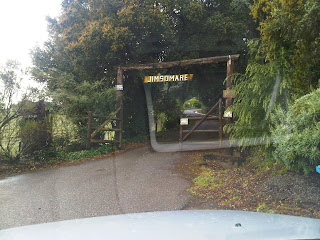
named after the owners three children, James, Sophie and Maria and a small plot where Ridge grows its Chardonnay. The other producers are obscure, the tasting room staff told us. Their properties are not open to the public and their wines are not in evidence.

In the kitchen, we were introduced to The Poet, a larger than life personality, very Californian who turned out to be almost as much a wine philosopher and academic as his boss. He had laid out bottles of Chardonnay, Petite Sirah, Carignane and Zinfandel together with cheese and biscuits. In the relaxed atmosphere of this tasting Paul Draper enlarged on the differences between Ridge and Californian winemaking in general. There were major surprises in this part of our conversation. We had not realized that the majority of Californian wines found in supermarkets were what might be called Negotiants' products. In other words, these wines are sourced from various grape growers by no means exclusively from one particular area, 'vinted' in some industrial facility and perhaps even bottled in another place altogether. These bottles are then marketed as something separate so any element of terroir is meaningless. We had been entirely ignorant of the fact that an estate grown, produced and bottled wine in California has to state all these three things on the label. Otherwise you can take it that it is a concoction as just described.
Worse, these wines and perhaps even the estate ones are subjected to all kinds of chemical manipulation. It is possible to strip out every element of a wine and then replace them chemically. There is a product available fro Bayer which Mr. Draper refers to as the 'Death Star' which is the chemical used to neutralize wine. Then water, acid and a host of other things may be added. Reverse Osmosis can be used to lower alcohol etc.
So much of Californian wine is processed in this way that what is left is that produced by the minority of reputable producers, "Critter producers" as he calls small scale operations and honorable exceptions.
Returning to the unique quality of Ridge wines derived from many sites over Northern California, terroir is derived in this case from unifying concepts of vine age, vine husbandry, and vinification. Surprisingly the full portfolio of Ridge wines is not exported. In the UK, only a fraction is available. Paul Draper explained this was due in some cases to small production of some of these vineyards and to some extent to the fact that the grapes were grown by partners, albeit trusted ones (he likes to have control of as many elements as possible).
We returned to the tasting room/shop and bought 4 bottles;


Dynamite Hill (100% Petite Sirah), York Creek Vineyard, Spring Mountain District, 13.8%


Lytton Estate Syrah (88% Syrah, 12% Viognier), Drt Creek Valley, 14.55%


Back in London, we could be sure of having something special as well as unique outside the US, but we had come away with so much more from the generous 2 1/2 hours of Paul Draper's time - the equivalent of a year at university indeed!


Down in the lower cellars, he deftly identified the designated barrels and deftly climbed up one or two levels in order to obtain the samples, explaining that Petite Sirah (in small quantities) was a perfect blending partner with Zinfandel, adding elegance. Passing through other cellars he took time to say a few words about the beautiful barrels he uses. Almost all of them are from American Oak. He uses about 5% French oak each year for experimental purposes but based on these researches, has not yet been tempted to make changes. This sums up the unceasing efforts to learn and improve which are part and parcel of Ridge's success. In very few minutes we learned much about the question of oak including the amazing fact that in the 19th century, a majority of French producers used Baltic oak.
Paul Draper had even become involved in developing the US cooperage industry encouraging a Cooper in Canton Ohio to supply him.This firm were the original suppliers of barrels to the Kentucky Whiskey industry. In 1970 Mr. Draper encouraged the company to make barrels from discarded whiskey barrel staves since they had been left out in the open and weathered to a more appropriate extent for the use with wine. He had decided that American wine should not taste like French wine which is what earlier vintages of Ridge, elevated in French oak had seemed to him.
We then made a quick tour of the vineyards by car on our way to the kitchen of what we assumed was the residence at Ridge, Monte Bello. We had learned on our visit that there are 4 producers on the beautiful Monte Bello mountain. Ridge had acquired two of the lower vineyards, the so-called Jimsomare (ex-Klein) vineyard,
named after the owners three children, James, Sophie and Maria and a small plot where Ridge grows its Chardonnay. The other producers are obscure, the tasting room staff told us. Their properties are not open to the public and their wines are not in evidence.
In the kitchen, we were introduced to The Poet, a larger than life personality, very Californian who turned out to be almost as much a wine philosopher and academic as his boss. He had laid out bottles of Chardonnay, Petite Sirah, Carignane and Zinfandel together with cheese and biscuits. In the relaxed atmosphere of this tasting Paul Draper enlarged on the differences between Ridge and Californian winemaking in general. There were major surprises in this part of our conversation. We had not realized that the majority of Californian wines found in supermarkets were what might be called Negotiants' products. In other words, these wines are sourced from various grape growers by no means exclusively from one particular area, 'vinted' in some industrial facility and perhaps even bottled in another place altogether. These bottles are then marketed as something separate so any element of terroir is meaningless. We had been entirely ignorant of the fact that an estate grown, produced and bottled wine in California has to state all these three things on the label. Otherwise you can take it that it is a concoction as just described.
Worse, these wines and perhaps even the estate ones are subjected to all kinds of chemical manipulation. It is possible to strip out every element of a wine and then replace them chemically. There is a product available fro Bayer which Mr. Draper refers to as the 'Death Star' which is the chemical used to neutralize wine. Then water, acid and a host of other things may be added. Reverse Osmosis can be used to lower alcohol etc.
So much of Californian wine is processed in this way that what is left is that produced by the minority of reputable producers, "Critter producers" as he calls small scale operations and honorable exceptions.
Returning to the unique quality of Ridge wines derived from many sites over Northern California, terroir is derived in this case from unifying concepts of vine age, vine husbandry, and vinification. Surprisingly the full portfolio of Ridge wines is not exported. In the UK, only a fraction is available. Paul Draper explained this was due in some cases to small production of some of these vineyards and to some extent to the fact that the grapes were grown by partners, albeit trusted ones (he likes to have control of as many elements as possible).
We returned to the tasting room/shop and bought 4 bottles;
Mazzoni Home Ranch (58% Zinfandel, 40% Carignane, 2% Petite Sirah), Sonoma County 13.7%
Lytton Estate Syrah (88% Syrah, 12% Viognier), Drt Creek Valley, 14.55%
Bucignani Ranch (100% Hillside Grown Old Vine Carignane, 2010. 14.5%
Back in London, we could be sure of having something special as well as unique outside the US, but we had come away with so much more from the generous 2 1/2 hours of Paul Draper's time - the equivalent of a year at university indeed!


