Sunday, 8 November 2015

Trimani wines better


they certainly do wine better at Trimani, Rome's oldest wine merchant. Trimani Vinai a Roma was founded in 1821, its doors have been open ever since under the direction of successive members of the Trimani family. The most recent of these is a relatively young man, Giovanni Trimani very much born to the office.

Sr. Trimani himself, the latest of scions of the family dating back to 1821
Enoteca Costantini, the other serious wine shop in Rome looks more venerable with its vaults and Art Nouveau filigree but it was only founded in 1972. It may have a larger stock than Trimani (6364 wines as opposed to 3158). Its salesmen may walk the floors in uniform creating the impression of a veritable temple to wine, but Sr. Trimani has something unique and precious; an exhaustive knowledge of every single bottle in his shop. He can tell you every detail of the producer, the terroir, the grape varieties, vinification and taste. This is something we have never encountered before. He is something approaching a living treasure.

Not only all this but Sr. Trimani is one of those rare souls who would like to share his enthusiasm with you and is genuinely happy that you might have the same pleasure as he obviously does from his wines and the stories behind them. Discreet and somewhat diffident, he will spend as much time as you wish pursuing the common academic interest in wine with no discernible impulse actually to sell you anything or God forbid, steer you towards an expensive bottle. If you are lucky enough to have half an hour of his time as we were one morning soon after the shop had opened, it is as good as an entire wine course.


His staff are also very knowledgeable and seem to have been at the shop for decades. Despite signs of modernity - the marketing slogan, the contemporary prints on the wall, the excellent 'Trimani il Wine Bar' around the corner (which we visited earlier this year) and so forth, there are pleasant remnants of tradition to be found including a glass booth where a lady cashier sits and must receive your payment before your purchases are wrapped,


 the old Vino Sfuso taps behind a marble fascia, the glass winelist preserved from an earlier incarnation of the shop.


So what about the wines of Enoteca Trimani?


We first asked for a Nero Buono and were not disappointed. Sr. Trimani had more than one. We chose this less expensive one despite its 14.5% alcohol.


Next, a Malvasia Puntinata to replace the one we had previously brought back from Rome and which had 'gone off' due to poor storage and too long a passage of time. No problem, again there were others.


Next, we chose a Rossese di Dolceacqua on Sr. Trimani's recommendation (he has over 20 different Rossesi) and not least as it was low in alcohol


and then a very interesting bottle indeed from the Val d'Aosta, a Chambave Rouge made from Petit Rouge, Dolcetto and Gros Vien de Nus. There may have been others - grapes that dared not speak their names. Sr. Trimani explained that because of the DOC laws, vignerons lived in fear and trembling of any component of local varieties entering the food chain as it were. The addition of heritage varieties not permitted in the DOC could spell ruin so hence the unwillingness of many producers to specify the components. We always imagined they were just worried no one would buy the wine if they thought it contained something they had never heard of. This was an eye-opener.

In his classic 'Italian Wines' Victor Hazan waxes very lyrical about Chambave Rouge concluding that it is a deeply satisfying red, irresistibly good with Val d'Aosta specialities.


Wines we didn't buy included a wine by the famous Sardinian producer, Dettori made from Cannonau at 17.5% alcohol. Alessandro Dettori says “I do not follow the market; I make wines that please me, wine of my own local area, wines of Sennori. They are what they have to be and not what you want them to be.” Perhaps we should try this one, one day?


Thursday, 29 October 2015

Bottle Apostle disciple


Bottle Apostle is an independent chain in London now numbering 5 shops in different areas. It has been on our radar for some time and we have bought some nice and interesting bottles there in the past. Now they have opened their latest branch near us in Primrose Hill, we took the opportunity to check it it out and were astounded at the amount of really interesting wine (and beer) they have in a relatively small space (compared to a Majestic branch for example).

They opened their first shop only in 2009 since when they have won a lot of awards including the
Telegraph Magazine “Britain's Best Small Wine Shop” in 2011 after only a short time of trading,  "Small Independent Merchant of the Year" in 2012 by the International Wine Challenge, and  “London Merchant of the Year” in 2014.

On the day we paid our visit there were two extremely knowledgeable members of staff, one from the Czech Republic and one from Japan who was presiding over a Sake tasting.

To give an idea of the range of wines on offer, we counted over 150 varieties listed on their search engine. Admittedly these included some minor constituents in blends including white port which tends to be made from some really obscure varieties but we think this is wonderfully diverse for a limited stock.


On this subject Bottle Apostle charmingly lists a wine's grape variety under 'We're not sure'.


Among the more recherche items we found a Blauer Wildbacher/Zweigelt blend from Strohmeier (Red Wine No. 5, 2012), a wine so rare that Bottle Apostle have the entire UK allocation.


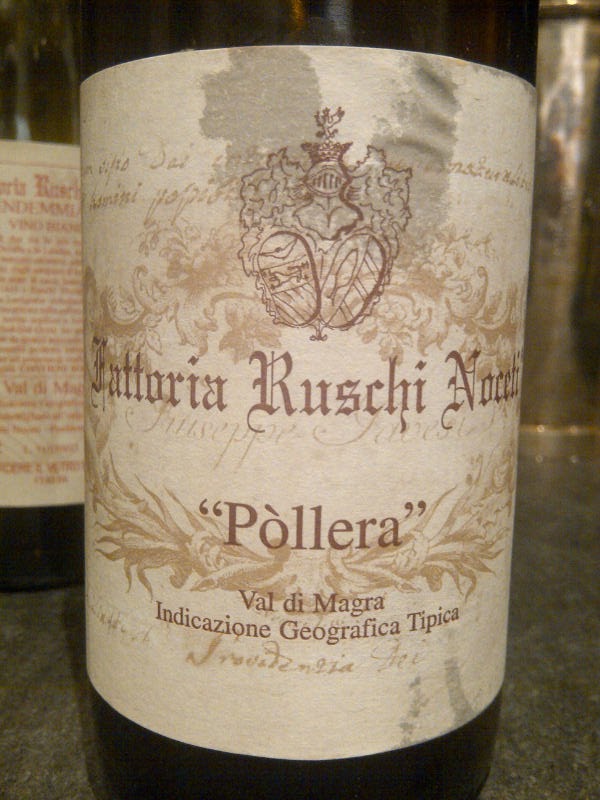
 Also, the amazingly elusive Ruschi Noceti range (see our post appetizingly entitled 'Looking Up A Dead Goat's Arse'),


Abadia de Gomariz's Brancellao/Ferrol/Mencia/Souson blend from Ribeiro. These last two co-incided with our recent obsession with the wines of 'A lost corner of Tuscany' and 'The least Spanish region of Spain' (q.v.).


There were also not one but two Petite Arvines,


a Rotgipfler,


an enticing Penedes blend of Garnatxa Blanca/Macabeu/Moscatell/Panse/ Parallada/Vinyater and Xerel-lo at only 10% (VN Vinel-lo Blanco 2014) and many more. Who has ever heard of Vinyater? Not 'Wine Grapes' but Galet has. He offers the information that there are only 13ha of Vinyater in Spain.

We have indeed become Bottle Apostle Disciples. Do take a look and see if you don't as well.

Thursday, 22 October 2015

Looking Up A Dead Goat's Arse

Apologies for the usual Slotovino focus. We hope you can just make out the name Luadga in line two.

Imagine you are an intrepid African explorer and have mounted 2 or 3 expeditions to find an elusive animal last heard of many years ago. there lurks a suspicion that this species may be extinct and indeed you return empty handed. Your worst fears seem to have been realized but one day walking by a pet shop you see the very animal in the window.

When you have finished hyperventilating you go in and buy the creature thus securing it for your collection and the greater knowledge of mankind.

Something like this has just happened to Slotovino. Remember our investigation of the 'Lost corner of Tuscany'? We said then that the wines from the area Colli di Candia, Alpi Apuani, Val di Magra etc. were little known even in the area and in some cases we had the feeling that producers were not interested in selling their wines. The producer we had in mind was one whose wines we couldn't find no matter how hard we tried: Fattoria Ruschi Noceti (Val di Magra, Liguria). They did not take telephone calls or answer emails. Their wines were nowhere to be found. We assumed they may have become extinct.


Then we discovered not one but three of their wines on the shelves of Bottle Apostle, now opened in Regent's Park Road, Primrose Hill, London. We nearly did hyperventilate.

We bought the red made from Pollera grapes - such a great discovery at our tasting and a white made from Durella and something called Luadga. Durella we had heard of but Luadga? There is no mention of it in 'Wine Grapes', 'Native wine grapes of Italy' or the 'Dictionnaire encyclopedique des cepages'.

not dead, not a goat but you get the picture (one we had conveniently archived for just such an occasion).


There was even one entry on Google which speculated that Luagda is an acrostic for Looking Up A Dead Goat's Arse.


Don't be put off. The wine is really attractive. It is an orange wine in fact and tastes delicious. How much of its success is down to Luagda and how much to the Durello it is hard to say.

Sunday, 18 October 2015

Summer in Greece


Invited to a remote Greek Island, we took the precaution of having some wine sent from two merchants in Athens.

                                                                                   
Domaine Glinavos 'Paliokairisio' Debina/Vlahiko sparkling natural wine


Botilia had supplied us previously with our (Slotovino) award winning sparkling orange wine 'Paliokairisio' so 6 x 50cl bottles of that seemed like a good idea for aperitif and House of Wine to whom we were led in our search for the Lyrarakis 'Plyto' which we wanted to try as one of our whites having discovered it at the Athens wine fair Oenorama in 2014.

Rather carried away, we ordered 12 bottles each from these two companies with the request for delivery shortly after our arrival. The House of Wine case arrived exactly on time but the one from Botilia suffered a breakage and had to be sent back to Athens and re-sent, arriving on our last day, so our tasting of their wines was perfunctory.

Here are the two lists:

House of Wine 

White

Kidonitsa


Theodorakakos - Kydonitsa
Papaiomylos - Malagouzia
Lyrarakis - Plyto

Savaitaino


Mylonas - Savatiano
Brintzikis Estate - Tinaktorogos

Orange


Methymnaios - Chidiriotiko

Red

Avgoustatis


Brintzikis Estate -  Avgoustatis


Lyrarakis - Kotsifali
Douloufakis - Liatiko
Limniona

Theopetra - Limniona


Lyrarakis - Mandilari

This our landlord assured us was one of Greece's best reds. The winemaker at Gentilini is a Mr. Jones from the UK. 'Wine Grapes' is not sure if Mavrodafni of Cephalonia is any different from Mavrodafni tout court.

Gentilini - 'Eclipse' Mavrodafni of Cephalonia

Mavroudi. Mavrud in Bulgaria. Quite broadly spread in the region


Theodorakakos - Mavroudi

Vlahiko is a speciality of Domaine Glinavos. They use it in their Orange sparkling wine 'Paliokairisio' (see above).

Glinavos - Vlahiko

Red Blend

Mercouri's red containing Refosco - a grape grown by others in Greece as well as Mercouri - used to be reasonably priced and quite easy to obtain in the UK at one point. Now rather expensive it is more rarely available. It still tastes good.


Mercouri - 'Red' Refosco, Mavrodafni


Botilia.gr

White

Vidiano is similar to Vilana to which it is related. It was rescued from extinction by growers such as Doloufakis and Alexakis. Both Vilana and Vidiano are from Crete


Alexakis - Vidiano


Miliarakis - Vilana

Found in Cephalonia, Zakynthos among other regions. Rustic and quite robust, this is a rare monovarietal bottling.


Sotiriou - Goustolidi (aka. Agoustelidi - Jewel of August).

White Blend


Nikolouzos - Pavlo (Malvasia Bianca) & Kakotrygis (an old varietu from Corfu)


Domaine Asfodelos - Moschatella, Tsaousi & Vostilidi. Moschatella is not to be found in 'Wine Grapes' but is clearly yet another member of the Muscat family. It is included in Galet's 'Dictionnaire encyclopedique des Cepages' but the information there doesn't specifically mention its relationship to Muscat. It does provide of plenty muscatty synonyms though (Moschatelo, Moschardina etc).

Rose

Nagoska


Domaine Tsatsis - Negoska. We tried a Nagoska red from Les Caves du Pantheon a while back. We were warned it would be the most tannic wine we had ever tasted. We didn't have time to try this rose from Nagoska but hardly imagine it would have been as tannic as the red.

Orange

Glinavos - Debina, Vlahiko


To get to the more remote Greek islands you have to take a ferry from Athens so taking advantage of a stopover there we stumbled on a fantastic wine bar cum wine merchant called Oinoscent.

There we met one of the owners, a real wine enthusiast who just wants you to have a great wine experience. He was just opening the bar when we importuned him but when he understood the nature of our quest for obscure Greek varieties he locked all doors and took us down to the cellar.


There we found several versions of Mavrotragono, the newly re-discovered hit grape which is achieving lift-off and will soon be ubiquitous it seems. In particular, we remember


Lyrarakis - Dafni (W)

Grapes grown in a unique terroir including fields with meteorites!


T-Oinos - Avgoustiatis & Mavrotragono (R)

Due to a combination of holiday mode and total loss of data, we can't say as much as we would have liked about these wines except for the fact that there was hardly a disappointment among them. A strange phenomenon concerned the reds. They seemed to merge one into another. This sounds as if we were so inebriated as to be unable to tell the difference but if that was the case, how come the whites seemed so much more clearly differentiated?

Liatiko is the most widely planted red variety on Crete from where it originates


The reds were all warm and fruity. They were mostly dark except for the Liatiko which stood our a little bit as something different ('Wine Grapes' describes it as 'Idiosyncratic' and 'Aromatic' and so it was). We wonder about this uniformity. Might Greek producers all be using the same yeast or something? Back in March 2014, we came away from Oenorama thinking the Greeks could do anything the Spanish or Italians could. Now that judgement seems a bit hasty.

Tinaktorogos is another obscure variety needing to be added to a future edition of 'Wine Grapes'. This was the hit of the holiday.

Variety Asprodes is misleading. Asproudes simply means white wine. The variety is Tinaktorogos.


So what about the whites? As mentioned, more variety there. In particular, the Tinaktorogos of Brintzikis Estate stood out. We thought this was fabulous as they say on Tripadvisor. Aromatic and lovely. We were so impressed with it - not least because Tinaktorogos is another grape which someone has pulled back from extinction (Brintzikis Estate seem to be the only ones to be working with it) - that we ordered a case as soon as we came home. Sadly this turned out to be one of those occasions in which a holiday hit was a flop back at the ranch. Here the wine had much less character. We had to chill it very lightly so as to preserve much taste at all.


Also at Oenorama, we had been able to compare Lyrarakis's Dafni with their Plyto. We liked the latter so much more than the former that it was a surprise to see that only Dafni is imported to the UK. On this showing it was the other way around and preferred Dafni.


Malagoussia is a great grape. If in doubt, go for it! It should be easy to find on any Greek restaurant winelist. Not as easy as Assyritiko though. Why does everyone have such a mania for Assyritiko and Agiorgitiko for that matter? Is it because those were the first Greek grapes to reach us in the present period of Greek wine revival?

Hardimos Hatzidakis with one of his minions, August 11th, 2015
For the Assyritiko craze we probably have Hardimos Hatzidakis to thank. Hatzidakis is the pioneer of the Vin Santo and dry Assyritiko of Santorini and it was there, not by accident that our travels took us next.

Hatzidakis is something of a Greek Pier Paolo Lorieri (Mr. Vermentino Nero). Not content with raising the profile of Assyritiko both dry and sweet, he has pioneered Mavrotragono too. We were honoured to meet him as he busily directed operations at his rustic winery. When we told him we were from the UK he reeled off the impressive list of British importers (Waitrose, The Wine Society, Berry Brothers and Rudd etc) with a touch of diffidence which indicated that his main interest was in the wine itself and not his success in having the world beat a path to his door.

Everything mentioned in this was a joy really, so if you go to Athens, go to Oinoscent. If you want to order some lovely Greek wine, go to House of Wine or Botilia. If you go to Santorini, make the pilgrimage to Hatzidakis. There is obviously so much more as well.