We drank a wine made from Sauvignon Gris last night. It tasted very much like Sauvignon Blanc. Nice enough.
Further research showed that Sauvignon Gris is a synonym for Fié Gris which has already appeared in these pages.
We drank a wine made from Sauvignon Gris last night. It tasted very much like Sauvignon Blanc. Nice enough.
Further research showed that Sauvignon Gris is a synonym for Fié Gris which has already appeared in these pages.
Encouraged by the discovery of a name for our Gm 1807-3 after so many years, and what a name: 'Fidelio' (see previous post), we checked on our other variety GF 93-22.6 yet to be so dignified.
It seems that the wine establishments in Germany have been hard at work because mirabile dictu, there is now a name for GF 93-22.6 too:
Calardis Blanc.
OK, something catchier such as La Traviata, La Sonnambula or Luisa Miller might have stuck in mind a little easier but Calardis Blanc is a name at least.
The following comes from a grape nursery called Sibbus:
Calardis blanc - resistant variety
Calardis blanc bunch
Origin:
This is a white fungus-resistant cross of the german Julius Kühn Institute at the Geilweilerhof in Siebeldingen in the Palatinate from 1993.
Cross: Calardis Musqué x Seyve Villard 39-639.
The name is derived from "Calardiswilre", as the Geilweilerhof was historically called.
Synonyms:
Gf.1993-22-6 (breeders name)
Requirements to the site:
Calardis blanc is a fungus-resistant white wine variety with high yield potential. Therefore, the site should not be chosen too weak. It does not tend to high alcohol content.
Spread:
Calardis blanc was only approved in Germany in 2020, and is therefore still very young and not widely spread.
Special characteristics:
The resistance to Peronospora (downy mildew) is very high, but also the resistance to Oidium (powdery mildew) is high. Due to the very loose grape structure, there are almost no Botrytis infestation. Calardis blanc also has good resistance to black rot.
The straight growth and the relatively low stinginess also make it very interesting from a viticultural point of view. This also includes the low sensitivity to sunburn.
It has been registered in the German variety list since 2020. This means that it may be planted in Germany.
Wines:
The mostly slightly fruity wines lie somewhere between Burgundy and Riesling.
Meanwhile, a reminder from our post of March 22nd 2015 of how we came to buy GF 93-22.6/Calardis Blanc in the first place:

 |
| Frau Wolf, left and colleague preparing vines for planting |


 |
| the Wolf's gemuetlich tasting room |


Back in 2011 we went to the famous grape research institute and university at Geisenheim and came away having spotted a promising variety with no name referred only as Gm 8107-3.

Here is Slotovino on that discovery made during a tasting of many of the new varieties obtained at Geisenheim. The tasting was by courtesy of Dipl. Ing. Bettina Lindner.
Gm 8107-3
a deliciously apply (Bettina preferred citrussy) wine from grapes descended from Ehrenbreitsteiner and FR 52-64 (meaning a grape cultivated by the Freiburg Institute in 1952). Ehrenbreitsteiner is itself a crossing of two generations of other crossings. As in any other kind of breeding the hope is that progress may be made over time. Bettina Lindner told us she had sold the GM 8107-3 to a French gentleman looking for varieties to plant in Brasil or some such humid part of the world and this person had decided the variety should have a proper name and chose 'Bettina'. We were pleased to follow his lead, so 'Bettina' it is.
We bought 25 bare rooted vines and planted them that year so the vines are now 12 years old. They have always been quite vigorous but the grapes have never ripened fully until this year. Suddenly we have huge bunches of beautiful large grapes undisturbed by birds or wasps. No sign of the rather strident taste when these grapes have not ripened properly.
All these years we have had confidence in Gm 8107-3. Derek Pritchard of Dunkery Vineyard in Devon sells it through his estimable www.winegrowers.info site. Every so often we have googled old 8107 to see if it has finally been given a name.
Just today we discover that it has indeed been given that honour and what is more, the name is 'Fidelio' also the name of Beethoven's operatic masterpiece. How appropriate! So nostalgically no more Bettina, welcome Fidelio.

We aim to make a wine this year with the grape 'Fidelio' the old boy would have drunk with pleasure.


Appearing in 'Vitisphere' newsletter this morning:


As of this autumn, Alsace will initiate the VIFA procedure (varieties of interest for adaptation purposes) with the National Institute of Origin and Quality (Inao). The Association of Winegrowers of Alsace (Ava) created its VIFA commission at the end of 2022. This selected ten white grape varieties (chenin, floréal, johanniter, petit manseng, opalor, petit courbu, selenor, souvignier gris, vermentino and voltis) and six reds (calabrese/nero d'avola, colliris, malbec/côt, nebbiolo, sirano and syrah) in selecting them on their resistance to diseases, their time of maturity, their ease of management, the acid structure of the wines (but not according to the emblematic appearance of certain varieties in wine-growing areas, which could have consequences: see box).
For grape varieties resistant to mildew and powdery mildew, “many winegrowers are struggling to manage rows of vines close to homes. In these situations, they quickly need the solution for experimenting with resistant grape varieties that will allow them to respect the Non-Treatment Zones (ZNT) and produce without losing the appellation” explains Christian Kohser, in charge of the VIFA file at Ava . “This response comes in support of the Alsavine program which aims to select new varieties with polygenic resistances to Riesling and Gewurztraminer typicity. We can also re-study the behavior of clones deemed too acidic and/or too late in the past.” adds Yvan Engel, president of the Ava technical commission. The acquisition of references in the different types of soil is planned over a period of ten years. In the room, Pierre Gassmann, independent winegrower in Rorschwihr, regretted that the old Alsatian grape varieties like the knipperlé were not considered worthy of being part of the varieties selected. “We had to act quickly” explained Christian Kohser…
The meeting also approved the filing of a dossier for an innovation evaluation device (DEI) concerning the management of weeds on the cavaillon using permeable biodegradable mulch. A ten-year follow-up is planned. The profession is finally working on the constitution, probably in 2024, of a network of plots whose water profile will be monitored over ten years in order to specify the methods of (possible) irrigation of the vines.
Water, precisely, remains a crucial element to realize the great potential of the 2023 vintage on the 15,529 hectares of the Alsatian vineyard. The forecast relates to 991,00 hl against 849,00 hl actually produced in 2022. But to reach this level, it would still take a good thirty millimeters in August, according to several winegrowers present in Colmar. As for the yields authorized in the Alsace appellation, the vineyard generally remains on values between 55 (gewurztraminer), 65, 70 and 75 hl/ha depending on the grape variety. The crémant grapes increase to 80 hl/ha. These different levels are matched with a VCI of 10 hl/ha. The CRINAO meeting on August 22 will decide on the opening dates for the harvest.

At the Fabien Jouve place, Mas del Périé (Cahors) they say Malbec is king but they also have famously Jurancon Noir ('You fuck my wine') and mention the following in their literature;
Cahours, Negral, Baral, Pissaire, Magdeleine Noir, Merille, Grand Noir de la Calmette, Gibert, Malpe, Valdiguié, Noual
These are planted in 'plusiers parcelles de vieux cepages conservatoires'... only Gibert, Valdiguié, Noual have been used in their wines so far but we live in hope.
 |
| Floreal |
The new grape varieties Floreal, Voltis Vidoc and Artaban have been obtained by crossing something called Muscadina Rotundifolia with Villaris in the case of the first two to produce white grapes and with Regent to produce the latter two. the Julius Kuehn Institute gets mentioned because Regent is one of their grape varieties.
Now it seems these new varieties have hit the buffers as far as global warming is concerned. 50 days without water is enough to kill Floréal. You would need 150 for Pinot Noir, Merlot, or Cabernet Sauvignon.
Floréal is the most sensitive, followed by Vidoc and Voltis. Artaban comes off better » Sylvain Delzon maintained in the most recent lecture at 'Vendanges du Savoir' at the Cité du vin de Bordeaux on December 8th last.
Also, the vine is the only species that can store moisture in the wood if we have understood the following properly:
'la vigne est de plus en plus résistante à l’embolie au fur et à mesure
de l’avancée de la saison du fait de la lignification de ses vaisseaux. « Un phénomène jamais observé sur d’autres espèces ».' (Delzon).
(the vine is increasingly resistant to embolism (gas bubble preventing hydration) as the season progresses due to the lignification of its vessels. “A phenomenon never observed on other species”).
Lignification;
'Lignification is the technical name for a stem becoming woody—brown, dry, and hard as opposed to green, sappy, and pliable.'
Fred Swan, GuildSom 28.6.17
Fred adds
'Despite thousands of years of winemaking history, we’re still refining our understanding of the myriad factors leading any given wine to taste and feel as it does. Arguably, no other consumer product has such variety or involves so many minute, often inscrutable, factors. A wine’s personality is influenced by geology, microbiology, chemistry, plant and human physiology, agronomy, entomology, geography, weather, and more.'
Something to think about on cold winter evenings when you sip your vino da meditazione.....
It is December 31st and the Slotovino Awards are upon us once again.
 |
| The scene is set. |
Wine Personality of the year
Fratello Rino Sgarbossa of the Frati Francescani Minori di San Francesco della Vigna, Venice.

Fra. Rino Sgarbossa is our Wine Personality of the year. This award may be surprising.

The most surprised would be Fra. Rino himself because his main job at San Francesco della Vigna in Venice is Director of the Biblioteca San Francesco della Vigna, perhaps the oldest and largest in Venice with over 200,000 books dating back to the 14th century.


Fra. Rino took us on a tour of the vineyard and library together with a group of Dutch historians. He protested that the vineyard was managed by others who had re-planted mostly with Glera and would be selling the wine when it was ready and that he disn't know much else.
In fact we think he was following Saint Francis's rule;
'I frati siano pacifici e modesti, mansueti e umili' (Let the friars be peaceful and modest, meek and humble')
because he knew a great deal about the vineyard's history, the effects of the soil flooding with briney water at aqua alta, the grafting and irrigation that had taken place and so forth. For the record the plantings had previously included Raboso, Marzemino, Malvasia and Verduzzo. This made sense because until recent incursions of intermnational varieties and Pinot Grigio, Raboso and Verduzzo had been the Venetians preferred wine grapes. Even earlier, Teroldego and Refosco had been mentioned.
In general, winegrowers andthe people around wine have in our experience and until now been lovely people. Fra. Rino is as kind and dear of this group of people and so may serve as an exemplar. It is for this that we would like to award him Wine Personality of the year, not that he would accept, we are sure.
Best Sparkling wine
Mariotti Abbatia Fortana


Best White
Telti-Kuruk Grande Reserve, Shabo Wine Company, Odesa Povince, Ukraine.
Our Slotovino Awards 2022 are here. We didn't post between March and November but that didn't mean we paused our researches. We were busy emerging from the pandemic so posting took place all at once when we had time. In fact our 26 posts for this year are exactly double those of 2021.
In the wider world the news has been of the terrible war in Ukraine but before we are accused of mounting our own special operation in favour of Ukranian wine, let us deny any bias when we award a Ukranian grape, Telti-Kuruk the discovery of the year.


In general, discoveries of 2022 have been more numerous in white wines as you will see. Telti-Kuruk came as a bolt from the blue. It is a fabulous variety. we set about trying to import a case but unsurprisingly there were difficulties. At present no shipping companies are operating from Ukraine. However, goods are getting through. After contacting a winemerchant in Kiiv and Drinks+, the Ukrainian wine organisation we finally made contact with the maker of this particular bottle, Shabo.
Shabo has managed to send wine by the pallet to the UK which is an astounding and heartwarming achievement. Pallets go via Poland and cost E.2,400 a time.They might be able to add a case for us in their next shipment.

After some headscratching we had an inspiration and checked with Hedonism whether they had any wines from this grape and indeed they had. Hedonism was founded in 2012 by Evgeny Chichvarkin who owns it still. He lives inLondon and is a critic of Vladimir Putin. Hedonism no longer sells wine from Russia but offer Ukranian wines instead.


Beykush Winery is the maker of Hedonism's Telti-Kuruk. Beykush was founded in 2010 and is situated near Odesa.
We thought we had seen an entry on Telti-Kuruk (aka Telti-Kyryk) in 'Wine Grapes' but that must have been wishful thinking.
We have been turning increasingly to 'Wein Plus' recently. They really are a terrific source of information. On Telti-Kuruk they have the following entry;
'The white grape variety originates from Armenia. Synonyms are Telti Kourouk, Telti Kuruk, Tilki Kuyrugu and Tilky Rairuk. The parentage is unknown. The vine is used as a wine grape and table grape. It is cultivated in the Ukraine. In 2010, 246 hectares were still reported, but in 2016 no more stock was reported (Kym Anderson).'
Is it possible the 246 ha of 2010 have been dug up? We hope not.
Best red
Conti Capponi Villa Calcinaia Mammolo.


We first bought this in 2020, together with Villa Calcinaia's Sanforte and Occhiorosso. We presented these last two at the Athenaeum tasting last November listing them as follows;
Villa Calcinaia Occhiorosso. Rosso dei Colli della Toscana Centrale I.G.T. Italy. 2018. 13.5%
“Roberto...Bandinelli discovered the variety while talking one day to Nunziata Grassi, an 85 year old who took him around her vineyards and showed him Occhiorosso… The minute Bandinelli showed me what to look for in an Occhiorosso grapevine I was immediately able to recognise it without fail in any other vineyard I visited that day with him.”
Ian D’Agata, Native Wine Grapes of Italy.
Purple Pages gave this 16.5 and mentioned its 'charming personality,'
Villa Calcinaia, Sanforte. Rosso dei Colli della Toscana Centrale I.G.T. Italy. 2018. 13.5%
Sanforte is listed separately from Sangiovese in Ian D’Agata’s authoritative ‘Native Wine Grapes of Italy. He tells us that he name is a contraction of Sangiovese Forte but everything about the variety differs from Sangiovese; it is more fertile, produces more bunches, ripens earlier, piles up sugar in its berries more notably and makes a more massive wine, yet one that retains elegance. Villa Calcinaia is the only winery making a monovarietal from this grape.
Jancis Robinson gave this a score of 17 and found it 'really interesting,'
To be truly honest* these were nice wines but to our taste not as distinctive as we had hoped they would be\
The Mammolo on the other hand was truly and honestly individual. The Athenaeum tasting had been for varieties made by one producer only so we were never going to include our Mammolo in that category, hence its earlier consumption.
Mammolo turns out to be the same as Sciaccarello which is strange because our previous experience of Schiaccarello had been quite different. This may be because according to D'Agata, Corsican Sciaccarello or Sciaccarellu is usually blended with 30% Cabernet Sauvignon.
*The expression 'Truly honest' was first heard from an American lad at Riomaggiore in the Cinque Terre this year and thinking of the Trump years in America, it seemed that merely 'honest' might now denote something that could be f;exible in meaning and that if you want to be honest you now have to qualify the term with the adj. 'truly.' The context of the lad's employment of the term was 'If I'm truly honest I don't want to climb up all those stairs.'


Attempting to buy a couple of bottles of Villa Calcimaia's Mammolo last summer we slid off a dirt track, landed with two wheels in a ditch and had to be pulled out. That provided the entertainment for the rest of the afternoon but not the bottles we wanted, not the visit to the winery we had planned. We imported 6 bottles subsequently and opened one of them with our Xmas turkey. All well that ended well.
Best English WhiteAshdown Chasselas 

Best English RedHalfpenny Green Penny Red Pinot Noir.Rondo/Regent

Again, if we are truly honest, we haven't tasted many English or Welsh reds this year and there were
fewer reds than whites at the Vineyard and Winery Show. Halfpenny Green was one of several wineries
we had never heard of but which are serious producers even if their wines are available only from the cellar door and a limited number of merchants.
This blend of Pinot Noir, Rondo and Regent seems to be a winner. We enjoyed the wine which is not something one can say about some of the reds to be had in this country.
Best Show/Wine FestivalThe Vineyard and Winery Show
Biggest SurpriseBardolino Novello 

We have gone into the 'problem' of Bardolino Novello before. It's always intriguing when something
is so comprehensively reviled by all and sundry. So attempts actually to taste this rarity became a bit of an obsession. We love Bardolino for its charm and unpretentiosness (viz. Valpolicella) and we like nouveau wines having made some ourselves.
While still trying to work out how to get our hands on a bottle of Bardolino Novello an amazing coincidence occurred as happens from time to time. Tam Currin of Purple Pages suddenly discovered this wine and wrote a glowing appreciation of several bottles she had been tasting thanks to the Consorzio di Bardolino Novello.
Writing to the Consorzio to ask where we could buy these wines (Winesracher had not been very helpful), they replied by sending us three bottles as a gift. One of these in particular was memorable and we recommend any naysayer to try it before dismissing Bardolino Novello.
Best Vine NurseryPepinieres Guillaume and Rebschule Freytag, joint winners 

.
Best PIWI discoveryRinot

At the Rebschule Freytag stand at the 2022 Vineyard and Winery Show (Detling, near Maidstone in
Kent) there was a bottle of Rinot on tasting and we thought this wine was very interesting indeed.
Rinot is a Czech cross between Merzling and a combination of Seyve Villard and Pinot Gris. There are
therefore genes from Vitis Vinifera, Vitis Berlandii, Vitis Rupestris and Vitis Linecumii in the DNA.
This is positively the first vine we have encountered with Vitis Linecumii. In fact we've never heard of
that species although without it neither Chambourcin, Vidal Blanc or several other varieties would not exist which would be a pity.
What a complicated business this vine breeding is but what a miracle that something
as lovely as Rinot can come out of it.
Best new wine merchantAlzbeta Novotna, Wines of Bohemia
Ms. Novotna is an energetic and well-informed new winemerchant specialising in the wines of Bohemia. We are fortunate that she has chosen to be with us here in the UK and to be bringing us wines of individuality. She is not the only one we have come across this year; NIKI specialising in Serbian wines is another but Wines of Bohemia is more recently established and so receives our accolade as Best New Merchant.
.
Best wine merchantHedonism


Best restaurant winelist
Brawn. This Columbia Road so-called 'neighbourhood' restaurant is as they say 'worth crossing London for', not least for the winelist. Originally set up by Les Caves de Pyrene many of the wines may still be obtained from them. The list is too extensive to check but whoever has sourced them and wherever they come from, the result is everything you could wish for, even though some prices are steep. Predictions for 2023Sparkling Tea!


Worst Airport Duty FreeAll - Malaga, Barcelona, Pisa, Marseille, Genova. All as bad as eachother. What's going on? Best Wine Supplies shop G.M. Luico, Enologia, GenovaThis is a new category. Normally a wine/beer supplies shop would not interest wine drinkers but everyone needs at least a corkscrew and maybe some gear for preserving wine such as Vacuvin,

Corks are available in different sizes and 3 different qualities at between about E.1 and E.2 each.
 |
| Carlo Luico and his daughter Rosanna, direct descendents of the founders in 1855. |


Special award for the re-establishment of an endangered variety/varietiesJoszef Szentesi. 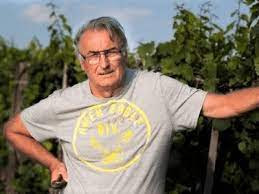
As a child, József Szentesi showed little interest in working in his father’s 1ha vineyard in Budaörs, 10km from Budapest. But, in 1998, he decided to make his own wine, training himself and gaining inspiration from winemakers in Burgundy. Currently, he manages 16ha on the slopes of Lake Velencei, 50km from Hungary’s capital, at an altitude of 175m. He grows 30 different grape varieties – including 20 that are extremely rare.
"I also have traditional varieties, Pinot Noir, Merlot, Cabernet Sauvignon, Cabernet Franc, Kadarka from the reds; Riesling, Zengő, Sauvignon Blanc, some Furmint and Kéknyelű from the whites. In an old publication written in 1880, I read about the ancient first-, second-, and third-class grape varieties. I was surprised that I hadn't even heard about many of the first-class ones. I have chosen 10 red and 10 white varieties; I purchased the rooted grafts from the Winery Research Faculty of University of Pécs, and Dr Pál Kozma (grape breeder) helped with the grafting on. In 2001, I read an article about ‘Buda Red’ wine, which is a blend from Kadarka and Csókaszőlő grapes that was one of the most important export commodities of the Austro-Hungarian monarchy. I decided that I wanted to make this wine. In 2003, we grafted 300 grapevines of Csókaszőlő (below), from which I made 40 litres of wine in 2004. In 2005, Hungarian winemakers visited me and were fascinated by the wine, because since 130 years no one made wine from this variety. Some of them also took grafts, for example, Vylyan winery from Villány.

How wonderful is that?
Most interesting wine trendNew resistant and hardy grape varieties for classic apellations. BookWhich Winegrape Varieties are grown where? by Kym Anderson and Signe Nelgen.This is by no means a new publication although it has been updated. Of course the data is changing all the time but coming to it late in the day doesn't change its fascination. The book is quoted frequently but we are ashamed to say we hadn't taken a look at it until now. You can buy it at over £45 but if you are not in the mood to do that, you can download the 2013 or 2016 edition free of charge.
Kym Anderson re-defines the concept of Renaissance Man and measures of industry, breadth of interest and productivity. According to Wikipedia he is an economist specialising in trade policy and issues relating to the World Trade Organisation.
He has published around 40 books and more than 900 journal articles and chapters in other books.
Eminence personified. -
Our award for 'Which Winegrape Varieties are grown where?' is given for its mighty snapshot of statistics relating to just that: charts from 53 named counries (including unexpected places such as Myanmar and Norway) and 'Rest of World' comprising 9 countries showing
Total Grapevine Area Hervested
Share of World Grapevine Area Harvested
Total Winegrape Area
Share of World Winegrape Area
Share of Wine-Grapes in Total Grapevine Area (%)
Share of National Agricultural Crop Area under Grapevine
Grape Yield (tonnes per ha.)
Total Grape Production (Kt)
Share of World Grape Production (%)
We were especially amused by this chart showing UK Triomphe D'Alsace as top of the Varietal Intensity Index relative to the world in 2010.

A dubious honour.
Indispensible website 2022
Wein.Plus
There are many good websites you need to research wine. Purple Pages, Winesearcher are
two of the indispensible ones. To these we would like to add Wein.Plus which has been going
since 1998. It bills itself as the Wine Platform for Wine Lovers. It has an indispensible
Lexicon which it says is the largest wine encyclopedia in the world with 26,013 entries. It is especially good on grape varieties.

There are pages on Producers, Regions, Wine Basics, Find and Buy, plus Reviews, News, a
Business Directory and 'Events,' but you probably know all that.
Why did it take us so long to join up (free) and add Wein.Plus to our arsenal?
Various accolades and thanks toRosanna Luic, Hannah Tovey, Oleksandra Hryhorieva, Viktoria Palinkash, Irina Diachenkova


