Every time we go to The Netherlands, OK every time we go to Amsterdam we try to seek out Dutch wine or wijn as they call it.
We have enthused about Dutch wine in these pages before: Thorn, De Kleine Schorre, Aan de Breede Beek, Twente and Apostelhoeve. These makers wines are the ones that have found in Amsterdam's wine shops and restaurants.
As for the other producers we were always told, 'you have to go to them to buy their wine.'
This seemed strange in a country you can cross in an afternoon but the Dutch as we have noted are the fiercest critics of their own wine commonly describing it as 'white, sour and expensive.' This we can't understand because our limited experience suggests Dutch still wine is often better than English or Welsh wine - or has been up to now. Jancis Robinson no less has written to this effect.

So when the opportunity arose to attend a Dutch Wine fair at Groesbeek we thought why not? Let's put what the Dutch say to the test.
Groesbeek is south of Amsterdam near Nijmegen. Not the most southerly part of the Netherlands: that is Limburg which may be a better winegrowing area. The only producer we had heard of in Groesbeek was De Colonjes. We had fielded a bottle of their Johanniter 2008 in our 2011 'Clearance Tasting.' Nice.
It was a dull and rainy afternoon. The town square in Groesbeek might have looked a lot jollier in sunshine but sadly the gloom was pervasive.


That didn't prevent people from coming and having a good time.

In the middle of the square was a roundabout dedicated to Groesbeek wines. Around the sides of the square were it has to be said rather more importers of foreign wines and other stalls selling food and produce.

First, De Colonjes. This is the largest Biological estate in the Netherlands and has been going since 2001. Varieties grown include
White
Cabernet Blanc (Blattner)
Helios (Freiburg)
Johanniter (Freiburg)
Muscaris (Freiburg)
Riesel (Blattner)
Red
Cabernet Colonjes (Blattner)
Pinotin (Blattner)
Regent (Geilweilerhof).


We bought their fresh and lively Helios. An underrated Freiburg variety with an incredibly complex ancestry including several Seibel and Seyve-Villard hybrids, Merzling (itself a complex hybrid), two table grapes and some vitis rupestris and vitis labrusca in the background. Did Norbert Becker actually go out to unite all these grapes one day? How these hybrids are bred is a mystery. No wonder the grape breeders themselves sometimes forget what the ingredients are. Mueller-Thurgau and Rondo are prime examples of that with Mueller-Thurgau turning out to be Riesling x Chasselas de Courtiller cross instead of Riesling Sylvaner and Rondo Zarya Severa x Sankt Laurent and not Saperavi Severny x Sankt Laurent.
 |
| Valentin Blattner himself |
It was particularly interesting to see a strong presence of Blattner varieties here and in other Dutch vineyards. In the case of De Colonjes, there is even a special one for them named after their estate.

Klein Amerika would seem to be a strange name for a Dutch wine estate but Groesbeek was the centre of Operation Market Garden in 1944 when thousands of Allied parachutists were dropped into the Netherlands in order to secure the Rhine bridges. The British troops' ultimately unsuccsessful attempt to take the bridge at Arnhem has come down to us in the expression (and film) 'A bridge too far.'
The Americans' drop zone near Groesbeek was designated 'Little America' The area is still known by that name in rememberance. There are innumerable plaques and photos on billboards in the town as well as a Canadian war cemetary nearby,


Cabernet Blanc
Cabernet Colonjes
Regent.
Their Blanc de Noir is made with Cabernet Colonjes by the way.

Plack was another interesting participant.

Again, Cabernet Noir is grown together with Cabernet Blanc and Cal 06 all from Blattner. Other varieties include Helios, Johanniter and Regent.

Another discovery was the 'Biologische Wijngaard van Ditshuizen.


A heartening number of Dutch vineyards and producers are certified biological. Van Ditshuizen must have been one of the earliest ones now counting over 40 years' in this practice. Their varieties are;
Johanniter (Freiburg)
Souvignier Gris (Freiburg)
Cabernet Cantor (Freiburg)
Cabernet Cortis (Freiburg)
Cabertin (Blattner)

The Nederlandse Wijnbouwcentrum has its Wijnhuis Groesbeek on the other side of town so a Choo-choo train (made in Germany) was laid on to take us there.

This institution has a department for analysis, education (up to WSET level) and promotion such as the present festival which was organised by them.
 |
| our first sight of a Dutch vineyard. |

There were further wines on tasting;


Solaris (Freiburg), Villaris (Geilweilerhof), Regent. Cabernet Cortis and Pinotin are mentioned on the label but according to the sign below, the grapes in this Hollandsch Wit are Solaris, Villaris and Riesel (Blattner).


Other wines at the Wijnbouwcentrum were this Cabernet Blanc from De Holdeurn


and this Cabertin in purezza - not something you see every day from our new friends at van Ditsenhuizen.
 |
| Dijso's Bart Dijkema and partner, specialist Armenian wine importers |
Back in the town square we made a tour of the wine importers and merchants in the outer circle of tents. As so often, even at the most out-of-the-way events, there were surprising discoveries to be made.


First of all was a company called Dijso who imported our beloved ArmAs Armenian wines including their brilliant Kamrahyut Rose which we bought even though we had bought it previously from Armenian Brandy and Wine based in Belgium.


We also bought the red version of the same grape, Karmrahyut. The name of this grape is really tricky to spell never mind remember. Karmrahyut just means red juice in Armenian but you can't call a grape Red Juice in English can you?
In any case, respect to Dijso for finding and importing this wine.

This table belonged to a gentleman called Rob Finster and the lady pictured above. Their company is called Wijnimport Lochem.

We noted with pleasant surprise that one of their labels is Fort Berens of British Columbia. We just never imagined a Dutch importer would go for a Canadian wine but historically the Dutch have been almost as active as the British in scouring the world for wine starting in Bordeaux and Porto of course.
In fact Mr. Finster took a lively interest in what we had to say about English and Welsh sparkling and table wine.
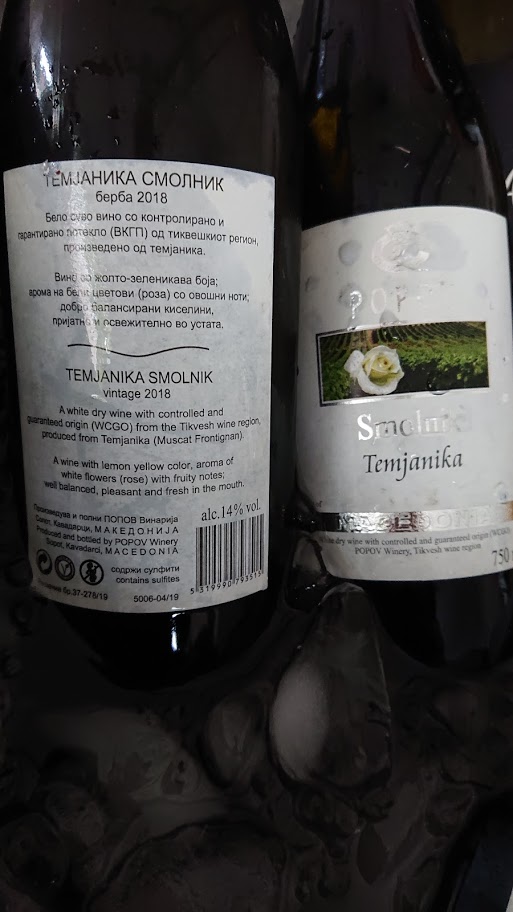
Canadian wine wasn't the only rarity, we thought. This Temjanika from Macedonia is also known as Tamyanka in Bulgaria.
 |
| We bought this at Megavino, Brussels a year ago. |
 |
| We assumed it was a rare variety native to Bulgaria, |

Finally we can say we not only made an interesting contact but also a friendship, we hope. Gianfranco Iacono is originally from Ragusa which is almost exactly where we has spent a week's holiday just a month previously. We had other connections because Gianfranco is a pianist and composer having graduated from the Conservatory of Catania. He now runs a company called 'Taste of Sicily' importing Sicilian wine, olive oil. At the same time he is writing his thesis on 'Eric Satie, the precursor of contemporary music.'
He is married to Els Bruinsma whose company is called Vinilicious. Their wines are mostly from mainland Italy or 'the peninsula' as they call it.


There were many wines we would like to have bought from Gianfranco but space was at a premium as they say and so we settled for a bottle of Moscato di Noto, a dry Muscat. A subsequent check in D'Agata revealed the following:
"Moscato di Noto is the appellation and the grape is Moscato Bianco (also of Moscato di Siracusa)..."[Moscato di Siracusa and Moscato di Noto] "have a long and distinguished history. In fact, some expertes believe Moscato di Siracusa to be the most ancient wine made in Italy, a direct descendent of Pollio or Biblino, a wine named in honor of King Tracio Pollio, who governed Syracuse in the seventh century B.C.E."
All in all, this had been a very interesting day but did you notice something about the Dutch wines mentioned above? There was not a single non-hybrid Vinifera grape involved in any of the wines on show or so it seemed. Strange because the Netherlands' climate is 1 degree centigrade higher than the UK and we have plenty of vinifera grapes in our vineyards. Could it be because so many of the Dutch vineyards are biological and so only no-spray varieties are required?
A final observation: there seems to be a craze in the Netherlands for Blattner varieties. Having planted Blattner's Cabernet Noir ourselves we were fascinated to taste the Dutch wines made from his grapes. the Verdict? Well, plantings cannot have been made long ago so all these vines must be young so the jury is out.
PS. One of the growers said their Blattner variety was not very obliging in poor years.