Friday, 27 September 2019

Planting out our cuttings


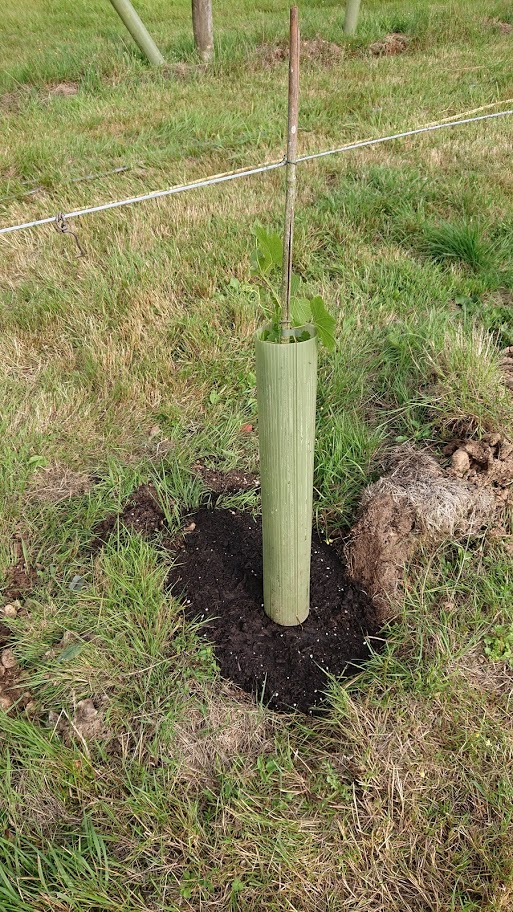
Planting in the summer is not recommended but we had obtained such good root systems from our cuttings that we didn't see the difference between the compacted soil in our plant pots and what you might buy (and plant) from the garden centre. In any case the alternative of keeping them watered until November and planting them out next March didn't seem very different from placing them in a generous bowl of our special soil mix (compost, topsoil, sand, grit and vermiculite) in our hard clay soil right away when they looked like they may enjoy it.


The first thing you need for digging this soil is a good shovel.


Nonetheless it was a bit disconcerting to find one at the garden centre labelled 'Irish Shovel.'


One of us is an Irish passport holder but feelings of political incorrectness soo evaporated when we encountered this rock. It may not look much to you but it took us an hour to get it out of the ground. That's how expert we are. Now we understood why one Bordeaux Chateau calls itself 'Trop d'ennui' (Trotanoy).


On the first day we plugged the gaps in our row of Rondo with some Pinot Noir.

Pinot Meunier

Then on another occasion we planted some Pinot Meunier next to our two mature Meunier vines. Note - rather too close together but we expect to lose a proportion of these plants anyway so perhaps that won't matter.


Such a pretty vine the Pinot Meunier!

6 Dornfelder in forground
Over on the other side of the garden the soil was easier to dig so these Dornfelder took no time at all to bed in. The only thing is that some rather expensive Divico vines from Germany had failed in that position the previous year. Divico is a crossing of Gamaret and Bronner from Agroscope. the Swiss plant research institute which since 2008, has boasted the great Jose Vouillamoz on its faculty.


Saturday, 10 August 2019

Weingut Buergermeister Carl Koch Erben, Dienheimer Paterhof Bacchus Beerenauslese, Oppenheim am Rhein


The title may be a mouthful but then so is this wine found at the Portland Restaurant, London.

One critic has Bacchus down as "Modern, perfumed, often kitsch." We were also not convinced Bacchus could make a great wine but maybe its best expression is Beerenauslese like this example?

Just as good as a fine Barsac or Sauternes for our taste and available from Robersons for under £15.


Wednesday, 7 August 2019

Try this: Simpson's Chardonnay


Well, we suggested you tried Simpson's Pinot Meunier vinificato in bianco. Now in a sudden spurt of energy and initiative, Waitrose has begun to stock that wine (and at a rather lower price than Harvey Nicols where we first found it) together with a Chardonnay from Simpsons.

Being an ABC blog, you don't get many Chardonnay recommendations at Slotovino although we very much like Jura Chardonnay. Well, guess what, this English (Kentish to be precise) Chardonnay is as good as many a Jura Chardonnay and along the same lines: more ethereal than buttery.


Waitrose's price for this Chard is a keen £13.99.

Now for Simpson's Rabbit Hole Pinot Noir (red) and Railway Hill Rose (Pinot Noir). We should also try the Chalklands Classic Cuvee Sparkling Wine. With components like these, how could it not be great?


PS. In case you're wondering, Slotovino is not paid by any of the winemakers featured herein and has only ever received one free sample which was duly acknowledged.

Monday, 29 July 2019

We couldn't be happier


Seen on the Clipstone Restaurant winelist, Clipstone St, London;


6th down, Neronet from Moravia, Czech Republic, We admire this variety a lot. Finding it on a restaurant winelist shows imagination and flair. How often can you say that?


 "Spontaneously fermented, it was matured in oak barrel for 12 months, un-fined and un-filtered. Rich, fruity and satisfying Neronet’s purity come through in the glass with a simple honest and pleasing palate."                                
                                                                                                                                Queens Park Wines.  

Neronet is a crossing of Blauer Portugueiser, St.Laurent and Alibernet.

We haven't actually tasted Korab's Neronet but we hope to soon.


Meanwhile, a reminder of what turned us on to this excellent variety in the first place, Zurek's delicious Neronet (see our post of March 25th, 2016). Don't be put off by the label!

Thursday, 25 July 2019

A recent snapshot of Israeli wine


The wine scene in Israel has changed enormously over the last decade. Quality has risen to make international recognition a given. New wineries have appreared regularly. As we have mentioned in this blog, newly re-dicovered native grape varieties are being used for wine production and the results are very encouraging.

There are sadly still many hurdles to clear. First of all we would suggest is the limited choice of grape varieties permitted. You can't just plant Rossese because you would like to. Each and every grape variety has to be cleared by the University of California at Davis. If this is for safety reasons, it has not stopped leaf roll virus taking a hold.

Apart from the native varieties such as Hamdani, Jandali and Baladi, the grapes currently grown in Israel include*

Chardonnay
Chenin Blanc
Clairette
Colombard
Emerald Riesling
Gewuertzraminer
Grenache Blanc
Malvasia
Muscat d'Alexandrie
Muscat Canelli
Riesling
Rousanne
Sauvignon Blanc
Semillon
Ugni Blanc
Viognier

Argaman
Barbera
Cabernet Franc
Cabernet Sauvignon
Carignan
Gamay
Grenache
Malbec
Marselan
Merlot
Mourvedre
Nebbiolo
Pinot Noir
Petit Verdot
Petite Sirah
Pinotage
Ruby Cabernet
Sangiovese
Syrah
Tannat
Tempranillo
Zinfandel

In practice, most wines are made of different permutations of the Bordeaux and Rhone blends. Very good wines result to be sure but it's all a bit timid and unexciting.

The next hurdle is the fact that no one is allowed to own land in Israel. All vineyard land has to be leased from the state. There is of course no subsidy for vine-growing. A new winemaker writes;

Traditionally, winemakers worked in the winery and the vinegrowers were members of cooperatives that owned the winery.  This was a recipe for poor wine.  Starting 30 years ago, farmers became farmers and wineries had contracts for acerage...better.  Boutique wineries bought grapes and started the drive for quality.  Then the Golan Heights really led the way for big wineries to manage their vineyards and boutique wineries started to grow their own grapes.  


Growing Vines is now going towards more ground cover, more bio-diversity, new growing regions,  and generally better practices, but these changes are very slow. 

In 'The Wine Route of Israel' (2006) 75 wineries were listed. Now there are said to be more than 350  but between them Barkan, Carmel and Golan Heights are responsible for 80% of the production.

Among the other 20% smaller and boutique wineries, a list of prominent ones might be as follows (taken from the Institute of Masters of Wine tour of Israel schedule in April 2018);

Amphorae
Bar'on Vineyard (Yarden)
Bin Nun
Chateau Golan
Clos de Gat
Domaine de Castel
Ella Valley
Flam
Golan heights (Yarden)
Gva'ot
Lahat
Pelter
Psagot
Recanati
Sea Horse
Shiloh
Sphera
Shvo
Teperberg
Tura
Tzora
Tzuba
Yatir


To these we noticed quite prominent representation in shops and on winelists of

Five Stones
Garage de Papa
Jezreel

We also couldn't help but remark on the almost total absence of natural wines and wines made with qvevri or amphorae.

Our vigneron friend said: I don't know of any natural wine makers and I'm not a fan myself.  The organic and bio dynamic scene is tiny, but there is increasing consciousness of sustainability.  


There is at least two exceptions. An impressive person Lina Slutzkin went to Georgia, bought qvevri and now makes wine in them at her Kadma winery. Grapes used include Chenin Blanc, Cabernet Sauvignon, Merlot, Sangiovese and Syrah.


And Feldstein makes an almost natural wine - minimum intervention in any case: unfiltered to be sure. As well as Cabernet Sauvignon, Feldstein works with Argaman, Cabernet Franc, Carignan, Dabouki, Grenache, Merlot, Mourvedre, Roussanne, Sauvignon Blanc, Semillon and Syrah.


If we're not mistaken, the retail sector seems to have improved over the last 10 years.


We visited and bought wine at Avi Ben in Jerusalem and Derech Hayain in Tel-Aviv where customer service was excellent.

Leave plenty of time to browse the James Richardson Duty Free wine shop at TLV.
Equally good was the Duty Free wine shop at Ben Gurion Airport.


Assaf's Chenin Blanc turned out to be particularly good.


We couldn't resist this Segal Argaman - a 'straight' version - not fermented over Merlot skins. This may have been made by Avi Feldstein who was Segal's winemaker before setting up on his own.


Recanati's Bittuni and Marawi were also to be found. Good.


Tishbi's Carignan looked interesting a a relatively modest 13%.


and in an effort to find something modest and uncomplicated, this Merlot from Chateau de Galilee (13%).

In restaurants we tended to choose Pelter's refreshing Sauvignon Blanc by the glass. Also by the glass, some of the less refreshing aforesaid Bordeaux or Rhone blends just for information. They were drinkable enough but a bit on the California fruit-bomb side.


One standout was Amphorae's Grenache Blanc. Really good and interesting even if not made in amphorae.


*Grape varities which might be worth considering for certification in Israel;

Agiorgitiko
Assyrtiko
Aglianico
Bourboulenc
Carmenere
Counoise
Croatina/Bonarda
Dolcetto
Godello
Graciano
Gros Manseng
Gruener Veltliner
Inzolia
Krasnostop Zolotovskiy
Limnio
Marsanne
Montepulciano
Negroamaro
Nero D'Avola
Nero di Troia
Nerello Cappuccio
Nerello Mascalese
Petit Manseng
Pinot Meunier
Picapoll
Raboso
Ramisco
Refosco
Rossese
Sagrantino
Saperavi
Torrontes
Touriga Nacional
Welschriesling
Vilana
Xarel-lo


Indiginous grapes. A USP for Israel?


 One of Cremisan Cellars' vineyards with Beit Jala in the background.


Unique Selling Proposition, USP. Definition: The factor or consideration presented by a seller as the reason that one product or service is different from and better than that of the competition.

Especially in the world of wine, everyone needs their USP.

Here are some of them

Argentina - Malbec
Australia - Shiraz
Canada - Icewine
Chile - Carmenere
France - Champagne, Bordeaux, Burgundy and friends.
Georgia - Qvevri wine
Germany - Riesling
Hungary - Tokaji
Italy - Barolo, Chianti and friends
Japan - Koshu
New Zealand - Sauvignon Blanc, Pinot Noir
South Africa - Pinotage
Spain -Tempranillo
USA/California- Zinfandel

We could go on.

Then there are countries such as Greece, Portugal and Switzerland which have many native varieties with strong personalities to which people may be well disposed having discovered them on holiday. That in itself is a kind of USP. The country is the brand and the wines are unique.

And then there are countries with more recent traditions based on the international grape varieties: Algeria, China, Israel, Lebanon, Mexico, Morocco,  Peru, Tunisia, Uruguay. What would the USP be in these cases?


One way to go it seems to us is to discover a native grape and make that into a speciality. It has already happened in what is known as 'The Holy Land' meaning mainly but not exclusively the West Bank, Israel and southern Lebanon.

The Cremisan Cellars Winery was founded in 1885 in the West Bank and have been producing red and white wine, fortified wine and spirits since then.


A most interesting recent book 'Tasting the Past' by Kevin Begos goes into the subject extensively.

Riccardo Cotarella, right.
No one knows any more exactly what the original Cremisan wines consisted of but today, the Italian consultant and oenologist Riccardo Cotarella has steered them towards  local grape varieties including

Baladi
Bittuni
Dabouki
Hamdani
Jandali
Marawi

Some say Hamdani and Marawi are one and the same but Galet gives them separate entries.

Most of these varieties are native to the area around Cremisan which is just over the border from Jerusalem, near the town of Beit Jala.

Dabouki is found throughout the Middle East as well as in France in the Gers department where it is known as Malaga Blanc. It is authorised also in Spain and Portugal. Many of these grapes were considered dessert grapes which is not surprising as all grapes since the 7th century would have had to be for eating as wine was forbidden.

Apart from a passing reference to Dabouki, none of them appears in 'Wine Grapes' and Baladi and Bittuni are even missing from Galet. He lists various white Baladis but the only possible red version, Baladi Haffe is dismissed as 'Mauvais cepage syrien...qui n'est bon ni pour la table, ni pour la cuve' without specifying if it is red or white. Curious.

Now, not only does Cremisan make a feature of these grapes ('What did Jesus drink?') but Israeli winemakers are beginning to use them too - whether grown in the West Bank or the state of Israel.

The good news is that these wines are really excellent. They have reached winelists in New York (Dizengoff) and London (Ottolenghi restaurants).

On a recent trip to Israel, we decided to visit Cremisan and seek out bottles with these native varieties. To get to the Cremisan monastery and winery entailed in our case finding a Palestinian taxi in West Jerusalem with the appropriate ability to cross over and return.

This was not too difficult. We were certainly lucky in having Hamid as our driver. He called Cremisan to tell them we were on our way (we had previously made an appointment). That conversation was not straightforward as Cremisan asked if we could delay our arrival as they had a lot of visitors but Hamid was firm, telling them we had already started.

Hamid
We had been told the winery practically straddled the border but that was not quite so; more like a good 10 minute drive after entering the West Bank. That was surprisingly easy. There were just a couple of young soldiers who gave a desultory glance inside the car practically without us having to stop. It was the same on the way back although Hamid said sometimes it could take longer.


Entering Cremisan was more tricky. For whatever reason they seemed in no hurry to open the gates and when we were allowed through they said we would have to wait to be shown around the cellars because it was lunchtime.


We were ushered into the shop before the tour for a somewhat hard sell but they were pushing against an open door;


We bought their Baladi (red), Rosso Vecchio (a blend of Cabernet Sauvignon and Merlot) and Dabouki (white) having already bought the white Hamdani/Jandali blend in London from Ottolenghi.

Cremisan have various other wines including their Star of Bethlehem entry-level wines of various blends (the red for example is Cabernet Sauvignon/Syrah and Baladi), Dessert Wine (Malvasia) and some fortified wines including a 'Marsala' and spirits. They work with all sorts of other grapes including

Chardonnay
Emerald Riesling

Argaman
Carignan
Grenache


Left alone while everyone went off to eat lunch, we conducted our own tour of the cellars via an open door in the side of the building.


The cellars are really big and impressive.


every now and again a reminder we were in a Christian establishment.
 Back in Jerusalem we visited one of the recommended wine shops - Avi Ben.


Here we discovered that the Israeli winery Recanati had already got on the bandwagon with a Bittuni (red) and a Marawi white. Ido Lewinsohn is the imaginative winemaker at Recanati.

Another winery taking an interest in these local grape varieties is Jezreel who make a Dabuki Pet Nat. 

Elyashiv Drori, grape archaeologist of Ariel University and partner at Gva'ot winery
Others include Gva'ot and Feldstein.
Gva'ot's Hamdani/Jamdali blend.
Gva'ot has the eminent Dr. Elyashiv (Shivi) Drori on board, We read about Shivi Drori in the pages of 'Tasting the past' mentioned above and immediately wanted to meet him. This was not to be on this occasion but we eventually reached him by email and he kindly sent us his paper entitled 'Collection and characterization of grapevine genetic resources (Vitis vinifera) in the Holy Land, towards the renewal of ancient winemaking practices.' This is a fascinating, highly scientific and academic piece of work in which we learn of scores of native grape varieties that have been collected in Israel and the West Bank over a number of years. Microvinifications have been made and there has been quite a lot of press coverage already in Israel and abroad. No doubt there will be more wines featurng this USP in due course.

Avi Feldstein


Avi Feldstein is a very interesting person. Without realising it we had come into his orbit previously with Segal's Argaman. This was a wine made by Feldstein when working as winemaker at Segal. He decided to give the unloved Israeli crossing of SouzĂŁo and Carignan another chance by planting it at the high altitude Dovev vineyard and fermenting it over Merlot skins.


This has produced a very interesting wine indeed, one of the best in Israel. Argaman might be added to Israeli wine's USP after all.


Feldstein's Dabouki
Now Feldstein has his own operation buying in grapes from Upper Galilee. As well as Dabouki, he works with Semillon, Sauvignon Blanc, Grenache, Mourvedre and Sirah.

We would like to wish everyone involved in the rehabilitation of these native grape varieties well, Israeli, Palestinian, Christian. May this cross-border and ecumenical collaboration prosper.

References

'Rediscovering forgotten grapes.' Elizabeth Gabay MW (blog).
'Wine talk. Feldstein Unfiltered' Adam Montefiore, Jerusalem Post
 'Grape Expectations' Adam Montefiore, Israel Wine Experience
'Holy Land Varieties' Adam Montefiore,WinesIsrael.com
'Israel's Grape Varieties' Adam Montefiore,WinesIsrael.com
'Ancient Grapes are the future of Israeli Wine' Peter Weltman, Food and Wine
'Grapes from Zion. Biblical Prophesy and quality wine in the West Bank.' Ian McGonigle, The Times of Israel.
'What Israel must do to become a wine Superpower.' Hadar Kane, Haaretz.