Saturday, 22 June 2019

Icons grace the Real Wine Fair 2019


Icon - a person or thing regarded as a representative symbol or as worthy of veneration.


In all the time we have been blogging this blog, we had never had the pleasure of meeting Eric Narioo, the founder of Les Caves de Pyrene and founder/impresario of The Real Wine Fair, not to mention vigneron. So it was a terrific honour to be introduced by our dear friend Carla Capalbo, writer, photographer, Chelsea Flower Show Gold Medallist and much more (see below).


M. Narioo now lives on Mount Etna and makes wine from a 2 ha. property under the name Vino d'Anna after Anna Martens who is Eric's wife. 


Mr. Narioo had brought some volcanic rocks from his estate to give an idea of his interesting but difficult terroir. An original touch.

The grapes are mainly Nerello Mascalese with the white being a field blend of Catarratto (50%) and Grecanico Dorato (40%) with approximately 10% of Minnella Bianco, Carricante and Insolia. 


As if this wasn't worth the trip to Tobacco Dock in London's Dockland area, there was a plethora of other luminaries as you will see below. A great tribute to Narioo's charm and success.

Photo taken with glass accidentally in forground even before tasting a drop of wine.
The day we visited there was a big crowd of the young and hip.


The tables started with three young/hip English and Welsh vineyards: an inspiring sight. Davenport is the trailblaiser here with organic vineyards in Sussex and Kent.


Their popular Pet Nat is made from an interesting blend of Auxerrois (53%), Pinot Meunier (30%) and Faber (17%).


Next door was Tillingham Wines. We have already signalled our admiration for Ben Walgate's operation in this blog. He is making cool wines from bought-in grapes while waiting for the vineyard he is planting to come on-stream.


This white is an aromatic, skin contact wine, made principally from Ortega grapes and part-aged in old oak barrels,


This Pinot Noir is made in Qvevri. Who would ahve thought English wine would be going in this direction?


The Tillingham team are enthusiastic proponants. We have no doubts that although young this winery will become an icon soon.

This Orange wine is made from Albarino.
Ancre Hill of Monmouthshire, Wales are a fixture at wine fairs. If hard work is what it takes then they will succeed. It helps to have a state of the art winery and a Demeter certified vineyard that goes above and beyond organic standards in line with the full Biodynamic accreditation they achieved already in 2013.

Grape-wise, you may say that their Pinot Noir and Chardonnay appear to be playing it safe but they have also planted Albarino and they have a certain amount of Triomphe (the grape that dares not speak its name) from which they make a drinkable red - something no one else has been able to do.


The Real Wine Fair always has novelties to offer. This year, Polish wine. We had heard of the valiant efforts to plant vineyards in the south of the country so it was fascinating to be able to taste the early results of this initiative.


Dom Bliskowice use Johanniter (good choice), Riesling, Hibernal, Seyval Blanc, Regent, Pinot Noir, Cabernet Cortis, Cabernet Cantor and Rondo.


Icon, Icon, Icon! The great Oszkar Maurer was there. We had met him at the RAW Wine fair some years ago but he hadn't been able to come to London for some years. But here he was, trimmer and with improved English. His great wines already partly available in the UK thanks to Isabelle Legeron's initiative and now thanks to les Caves de Pyrene.


On show were various Kadarkas for wich Maurer is famous plus Furmint. We have imported his Szeremi Zold and Bakator from Vinoteka Sopron in Hungary (Maurer wines are from a Hungarian enclave in Serbia) and have been fortunate enough bto be able to buy his Fodor Orange wine here in the UK which is made from Welschriesling.


Still on cloud 9 with meeting Oszkar Maurer again we might have missed a nearby exhibitor altogether


but the blackboard slogan caught our eye


as did this spaghetti of different coloured tubes in and out of some transparent kegs.


Keykegs is a means of providing fresh wine on draft in restaurants, pubs and so on. We had an interesting conversation with Keykegs and learned that wine is kept fresh by vacuum and that potentially any wine could be sold this way. All that was needed was to send the kegs to the producers for filling with their wines. The kegs are kept on the small side for ease of carrying. The ecologically best way of bringing wine from the winery to the consumer.


Dierdre Heekin, La Garagista and icon is ubiquitous. She makes wine in Vermont which is hardly the obvious place to do so. Her miracle is to make wine at all in such a difficult environment, especially with some of the less than promising grape varieties which need to be resorted to in that climate.


This Pet Nat for example is from Frontenac Gris. The miracle is that it is very toothsome, as are her wines from the Elmer Swenson variety called La Crescent (sic).


Next icon: Andrea Occhipinti. We had enjoyed his Aleatico vinificato in bianco 'Alter Alea' very much indeed only a week or so previously so it was a happy coincidence to see the winemaker at the Real Wine Fair. Making white wine from red grapes doesn't always produce great results but on this occasion it did.


This is the first mention of that true icon, Salvo Foti in this blog. Shame on us! He is Mr. Mt. Etna wine himself and in many ways Mr. Sicilian wine also. He worked as an oenologist, agronomist and consultant to top Sicilian estates including Benanti, ViniBiondi and Gulfi before setting up his own winemaking operation, I Vigneri di Salvo Foti in 2001.


Foti makes wine from different plots on Etna. One of these, Il Bosco may be Europe's highest vineyard. All the work is done by hand with tonly the aid of a mule called Ciccio.

The main wine in the photo here is 'I Vigneti'. Foti named this after a medieval guild of vignerons (1435) whose tradition he has revived. The owners of Etna's vineyards give a portion of their grapes to the vineyard workers every year so they can make wine for their personal use. There is even a DOC devoted to this wine now. The winemaking is without refrigeration or filtration.


Vinudilice is a Rose from Alicante, Grecanico, Minella and other unspecified varieties.There is also a Spumante version.

Other Foti wines on show were

Vigna Aurora (Carricante 90% and Minella)
Vigna di Milo Carricante
Vinupetra Rosso (Nerello Mascalese and Nerello Cappuccio, Alicante and Francisi).

We came across Francisi a long tome ago when trying to find out what grapes went into Palari's  'Santa Ne.' Francisi or Francisa was one of them but its real identity is not clear. There is no mention of it in D'Agata, Robinson or Galet. Some even think it might be Pinot Noir hence 'francese' or francisi. It may also be a completely individual variety of its own. A website called Xtrawine lusts it only to say it is from Etna which we know already. 

There is so much to say about Salvo Foti and his wines. We are just beginning with this preliminary skirmish, but just one other wine - not shown at the RWF caught our eye: Vinujancu made from Carricante, Riesling, Grecanico and Minella.

Where had we first heard of Vinujancu? From Dierdre Heekin, whose Vinu Jancu (from La Crescent grapes) is her homage to Salvo Foti. Vinujancu is the Sicilian term for Orange Wine apparently.

As you can see above, both Salvo Foti and Dierdre Heekin were present at the Real Wine Fair - not a stones throw away from eachother.


Our next icon was Antonio Caravaglio from Salina, Aeolian Islands whose dry Malvasia had already reached the River Cafe in London before we had the pleasure of meeting him and visiting his winery a few years ago. Our interest was particularly in his Neru du Munti Corinto Nero red wine - the only Corinto Nero of our acquaintance. Some say this is 'merely' a seedless Sangiovese but we like to think of it as something idividual. In any case Caravaglio's Corinto Nero is a delicious wine.

Also featured on the Caravaglio table was his Palmento di Salina Rosso. We couldn't determine what grapes go into this but the Rose version has Nerello Mascalese, Corinto Nero and Calabrese (Nero D'Avola).


Returning to the beginning of our tour, Carla Capalbo merits icon status of her own. As well as having written the book with our favourite title of all time: 'Cheeses of the Amalfi Peninsula' (even better than 'Murderers' Cottages or 'Golfing for Cats' in our view), Carla has written 'Tasting Georgia;' an increduble culinary and anthropological guide to that oenologically extraordinary country. The work of some years of research and writing it is an extraordinary achievement for an author who previously had no personal connection with Georgia. She took her own photos as she has done in previous works she has written or contributed to;

Roger Dean - Views
The book of Gingerbread
Best of America Cookbook
Le Creuset Mediterranean Cookbook
AA Spiral Guide to Venice
The Food and Wine Lover's Companion to Tuscany
Cheeses of the Amalfi Peninsula
La costiera dei fiori: wild flowers and traditional horticulture from Naples to Paestum
The Food and Wine Guide to Naples and Campania
Collio: Fine Wines and Foods from Italy's Northeast.


And here she was helping out at the Okro's Wine table.

This is only a small  selection of the icons at the RWF. John Wurdeman could be seen for example as could Kelley Fox and Martha Stoumen. An all-star lineup.

Thursday, 13 June 2019

BING Barolo


Ever been to Barolo? Cute but surprisingly small and insignificant bearing in mind the global reputation of Barolo wine. St. Emilion, even Montalcino are more substantial. Perhaps to counter that the Comune of Barolo has taken initiatives to put Barolo on he map in a more substantive way that just being at the epicentre of the great vineyards of the area.

D'Agata with friend (Ian: "Don't worry, she's married.")
As we have seen in the previous post, they turned to the redoubtable Ian D'Agata to help them. Who could have been better?

Barolo's long establsihed festival is called Collisioni and has featured some big name pop musicians over the years as well as having a more cultured, more bookish side. Think Glastonbury plus Hay on Wye.

D'Agata has supplied a food and drink element to Collisioni but has also initiated two wine events, 'Indigena' for wine professionals and BING, Best Italian Native Grapes for anyone who might be interested and many were.


It was to BING in particular that we were drawn although we did attend a more academic tasting as well (see previous post).

BING promised 300 bottles and indeed there may well have been that amount. There were plenty of native grapes of course but not all were Cinderellas. Inevitably, Nebbiolo had a number of exhibitors for example.


Our first stop was chez Grosjean, prominent producer from Aosta with Fumin, Torrette (which is mostly Petit Rouge with perhaps Mayolet and Cornalin in the blend), Pinot Noir etc.


By coincidence we had flown in to Torino the night before and enjoyed a bottle of Grosjean Petite Arvine at the fantastically plutocratic 'Del Cambio' restaurant.  We hasten to add we only arrived there following a couple of less than positive experiences attempting to find a table at other Torinese restaurants.


Ristorante del Cambio is a historic place (1757) where Cavour was a regular and everyone should try to eat there once in a lifetime if they can or else just go in and take a peek. The staff there are very nice and amenable.


It is not overpriced by any means and standards are high. We had to try the speciality of the house: Finanziera - a strange combination dating back to 1450 of meaty outcuts (including cockscombs) in an intense reduction sauce. Considered 'cucina povera,'. Oh well, we once ate donkey in Cremona.


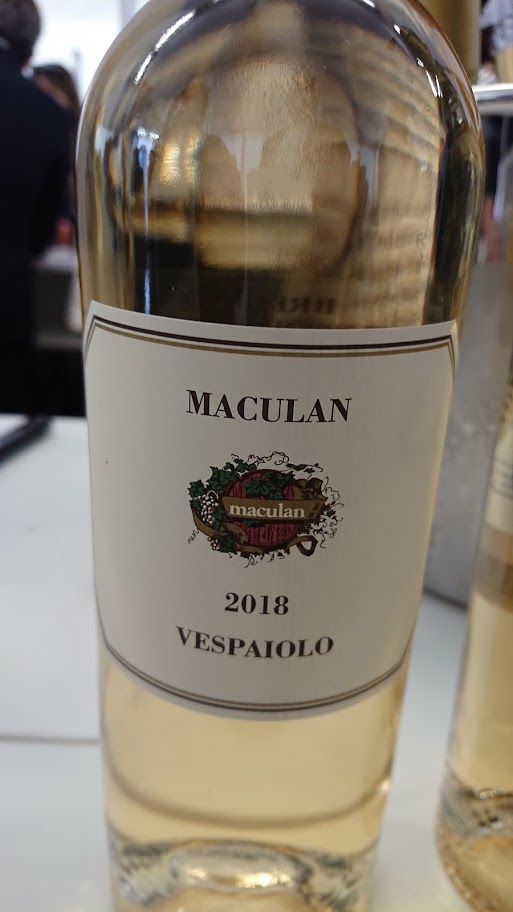
Next, an opportunity to clear up a confusione. We had been aware of  Maculan's Vespaiolo (funny the sign should say Vespaiola) for many years. It's a nice grape making full bodied dry wines or else sweet ones. Maculan are the great producers. We had a senior moment however when we suddenly recalled a red wine of the same name. We asked the Maculan people about this but they had no idea what we were talking about. Then it dawned on us we were thinking about Vespolina. Not a million miles from Vespaiolo but perhaps knowledge of BING varieties is not universal even in Itlay, even in wine circles, thus providing further proof of the need for BING.


 Acting on a tipoff from the man himself (Mr. D'Agata that is), we made for the Quartomoro stand from Sardegna. There was written the word Arvesiniadu. In America they have trouble pronouncing Pinot Noir (Pee-No Nwah). What are the chances of any of us absorbing Ar-ve sin eeadu? Well we'll just have to practise because Arvesiniadu is a major discovery and Quartomoro make a fantastic wine from it.


Arvesiniadu is described in Native Wine Grapes of Italy as 'a true Sardinian native that is now almost extinct.' It was brought back to life by a group of local growers collaborating with experts at the Consorzio Interprovinciale della Frutticoltura di Cagliari and the University of Sassari. They go straight into the Slotovino  Roll Call of Honour.


Ian also mentioned that there was a completely unknown variety called Muristellu to be found here. He was right in that we had never heard of Muristellu but Muristellu may be a biotype of Bovale Sardo.There is another Bovale though - Bovale Grande - again unrelated. What is often referred to just as Bovale is not anything to do with the Spanish Bobal as many supposed. Both Bovales have been  linked to various grapes including Graciano, Cagnulari, Carignano, Monastrell and others, No wonder Native Wine Grapes of Italy says more research is called for.


Whatever the reality may be, Quartomoro's MRS (shorthand for Muristellu) is another amazingly beautiful wine. We were so taken by MRS Muristellu and ARV Arvesiniadu that we begged the Quartomoro people to let us buy a bottle of each. Readers, they wanted to give them to us. We won't describe the argument that followed but suffice it to say that an agreement was reached and we were able to take these two wines home with us.


downstairs signpost
There was an upstairs and a downstairs but in the handy leaflet the grape varieties had been listed. Of these, we were particularly interested in Malvasia di Schierano, Malvasia Rosa, Albarossa and Bracchettone.

The folowing are photos of Albarossa bottles not on show at BING but in a showcase in the lecture hall of the Castello di Barolo where the tutored tastings took place. Someone believes in Albarossa for sure;


In the show too, Albarossa figured quite widely considering it's origins. It is a 1938 crossing of Chatus and Barbera. Giovanno Dalmasso thought he was making a cross between Nebbiolo and Barbera but his Nebbiolo was Nebbiolo di Dronero aka. Chatus.


We should have investigated Brachettone because it is not just Brachetto with longer grapes. Growers like to call it Birbet because there is a well known brand of Salami called Brachettone. D'Agata tells us Brachettone is more rustic and wild than Brachetto with greater salinity and acidity. It just shows that you can never do everything at a big show like BING.


For example, this bottle of Incrocio Bruni 54. We know about Incrocios from Luigi Manzoni and Rebo Rigotti but not so far about Bruno Bruni. His was a particularly amusing story which nonetheless had a happy ending. The 54 refers to the number of attempts he made to cross Sauvignon Blanc with Verdicchio. On the face of it not the most difficult thing to do but apparently it was and 54 was the number of attempts poor Bruni made to achieve this. When he finally succeeded he lost all interest in the matter and had nothing more to do with it.

The happy ending is that the wine as realized by the interesting Terracruda estate is quite wonderful and proved a crowd pleaser at a tasting with some friends.


Terracruda is between Pesaro and Urbino and pactices low-impact methods with everything being done by hand.


 Their other claim to fame was a Garofanata in purezza. Garofanata is actually an offspring of Trebbiano Toscano but never mind. It has a personality all of its own and a very pleasant one at that.

Of course there were other grapes we had never heard of. One, Malvasia di Schierano had not just one but two producers.


Gilli


Malvasia di Castelnuovo Don Bosco seems to be a DOC. The grape is Malvasia di Schierano.

Malvasia di Castelnuovo Don Bosco in the glass.
Gilli by Cascina Gilli is made from two red Malvasias, Malvasia Nera Lunga as well as Malvasia di Schierano.


Dlica in the glass


Cascina Gilli's Dlica is from the same varieties but sweeter - the grapes having been dried.

Ca del Prete


The other poducer of Malvasia di Schierano was Ca del Prete, a certified biological producer from Pino d'Asti. This wine, MALVĂš has a beautiful garnet was nicely petillant.As Ca del Prete describe it:

MALVĂš
La bacca aromatica di un antico vitigno del Monferrato, coltivata e vinificata rispettando il disciplinare comunitario di VINO BIOLOGICO, regala questa sorprendente bollicina rosa extra dry.
Un vino moderno nato dalle antiche tradizioni contadine,

We're not sure it was Extra Dry, more amabile really.


Moscato Rosa sounded vaguely familiar and we found we had included this as one of the many varieties recovered by Emilio Bulfon. He of the Slotovino Roll Call of Honour of course. The Malvasia Rosa at BING was made by Marco Donati.

not your usual car park view
Having been a bit deprecating about the village of Barolo we should mention the exquisite scenery around there with other even more picturesque places such as Serralunga nearby. The above is a photo taken from our hotel car park.


There are also a number of natural 'Amphitheatres'. Impressive.

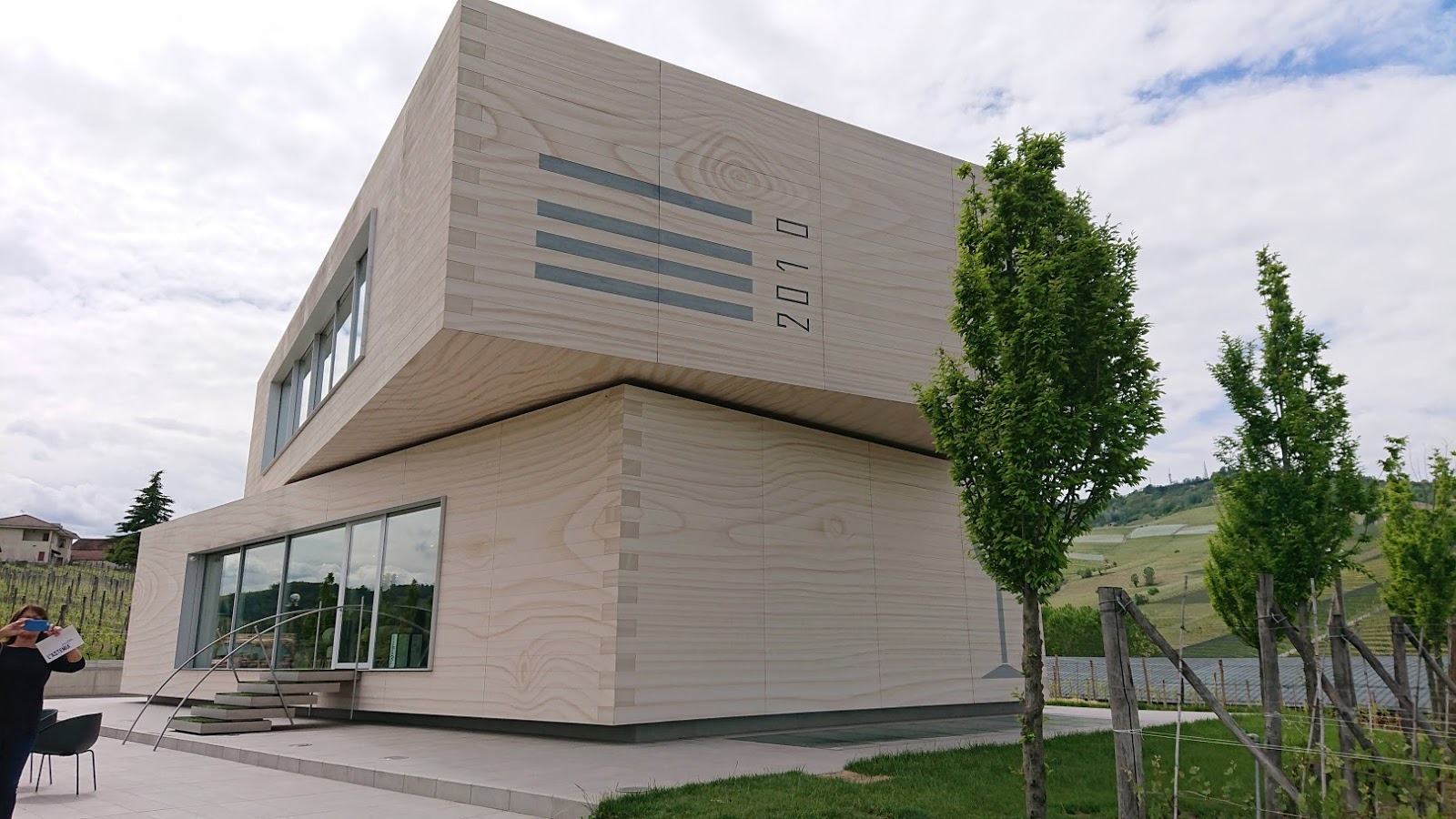
Gianni Arnaudo is the architect (2010)
L'Astemia Pentita means the Penitent Teetotaller.
What is that on the ceiling?
Stand in the right spot and you'll see.
You can tell you are in one of the world's great wine-producing areas when you come across archtecture such as the l'Astemia Pentita winery.

Risotto al Barolo - delicious
And of course there is good food to be had,


with wines from E.85 - E.3,900. The choice is yours.


Congratulations to all concerned with this opening edition of BING.It was as instructive as it was fun. We are sure of its continuing success and recommend it to all who can make their way there next year.