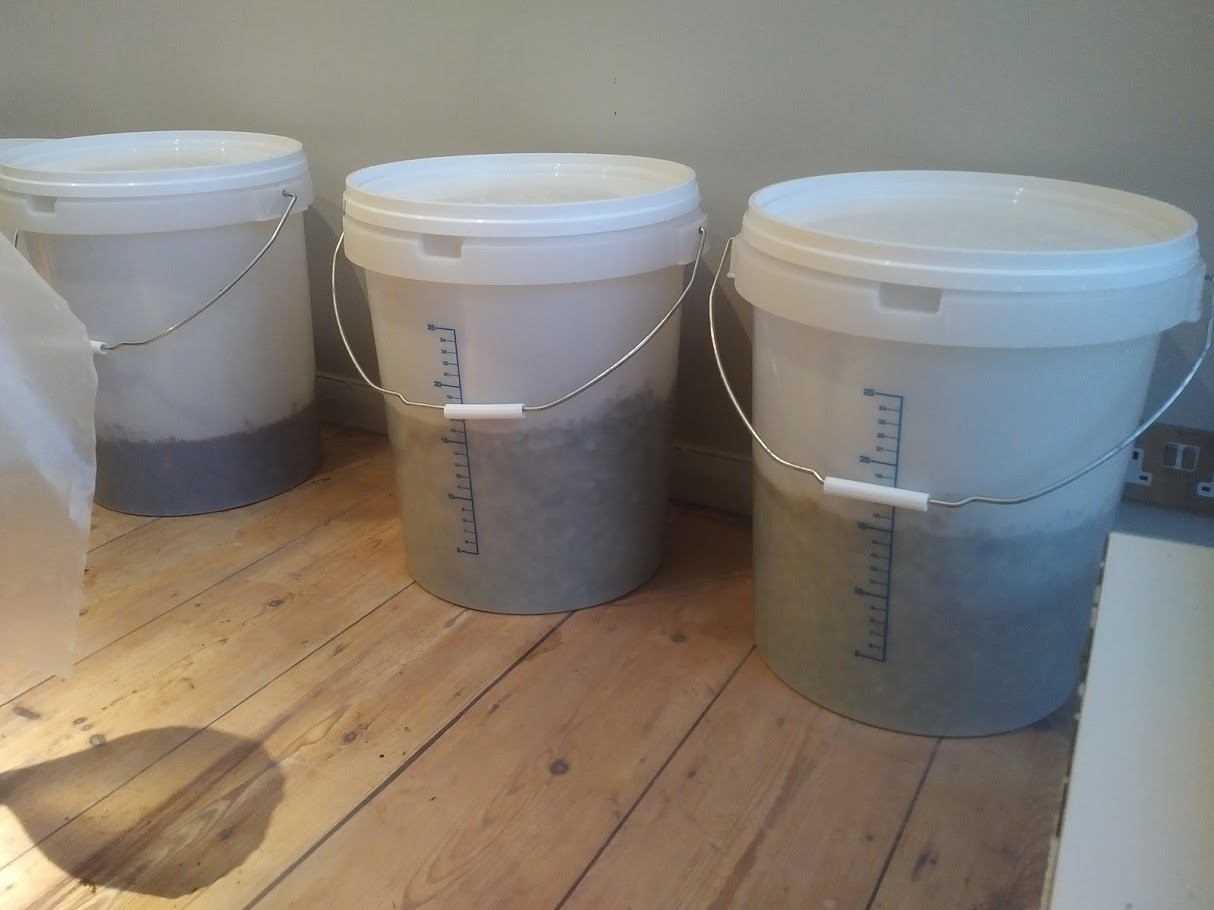
|
| equipment laid out ready for cleaning |
Our 2018 winemaking efforts have been mixed to say the least. For the first time we have had to pour whole fermentations down the sink even before bottling. More of that later.
 |
| operating table ready to go |
This year we went to town because it could be the last when grapes from the EU are affordable or even available.
We attempted 11 different cuvees;
 |
| Macabeo and Malvasia |
 |
| 10 x Bombino boxes ready to go |
White/Orange
Bacchus Orange wine
Bombino Bianco white wine
Field Blend Orange wine
Macabeo Orange wine
Malvasia Orange wine
Solaris and Malvasia Amphora ferment
White 2017 Field Blend macerated on 2018 White Field Blend pomace
 |
| Uva di Troia |
Red
Garnacha
Red Field Blend
White 2017 Field Blend macerated on 2018 Uva di Troia pomace
Uva di Troia
This needs explaining. First of all, most of these grapes were imported.
 |
| Chris with his Puglian supplier Giuseppe Tedone. An EU cooperation from 1978 on |
Once again we went to Chris at Hatfield who has been importing grapes since 1978 from Italy (Puglia and Sicilia) and Spain (Valencia) for the Italian and Spanish communities here in the UK and assorted maniacs such as ourselves.
This year we bought from Chris (in order of arrival)
Garnacha (Valencia)
Bombino Bianco (Puglia)
Macabeu (Valencia)
Malvasia (Puglia)
Uva di Troia (Puglia)
 |
The refrigerated lorry arrives in Hatfield hot from Puglia
deliveries are keenly anticipated
|
 |
| Grapes are stored under refrigerated conditions |
It had been a great year and quality was very good.
 |
| rows of Bacchus after summer pruning |
The other grapes we grew ourselves in our little experimental vineyard in the Thames Valley. The white ones included mainly Bacchus with the addtion of tiny amounts of
GM 8107-3
GF 93-22-6
Goldriesling
Helios
Johanniter
Phoenix
Sirius
Souvignier Gris
Solaris
and the red, mainly Regent with equally small amounts of
Dornfelder
Pinot Meunier
Pinot Noir
Pinot Noir Precoce
Rondo
Apart from Bacchus (141 vines), none of these amounted to enough to make a separate vinification - even a microscopic one so we hit on the idea of making Field Blends, combining all the grapes together.
We even pressed a vine growing up a wall into service.
This particular plant has an interesting history. It was given up for dead two years ago but someone told us to stick it in the ground and indeed it came back the next year. We planted it against the wall and it shot up producing 7 nice if small bunches of red grapes. We had thought it was a white variety, Phoenix.
But it was Regent. Crushed with a potato masher, it produced this thimble full of juice which we added to out red field blend. What you call a microscopic vinification.
Earlier in the year as we reported we grubbed up our main red variety for 25 years, Triomphe d'Alsace (131 vines) and planted the Blattner variety Cabernet Noir. That explains why we made hardly any red wine from our own grapes this year.
 |
| vines stripped bare by birds |
Had it not been for the birds (also reported in this blog) we would have had a bumper crop of great quality Bacchus but only after 10 backbreaking spray treatments.
As it is we made just over 20 litres of Bacchus with what the birds left us.
 |
| white grape pomace |
 |
| red pomace |
Now about the 2017 Field Blends macerated on 2018 pomaces, we got this idea from two producers - Segal in Israel who makes an Argaman macerated on Merlot skins and wines from the Swiss Vinigma estate who soak some of their reds on Gamaret skins. The Argaman is improved no doubt by its brush with Merlot and the result is one of the most interesting wines produced in Israel.
 |
| 2018 Field Blend grapes |
Our 2017 'Gemischter Satz' Field Blend was not a success. Some bottles were used for cooking, others drunk with the kind of concern whereby the next sip is taken in an attempt to find some pleasure missing from the previous one. Left with 15 bottles of this 2017 wine we thought we might experiment with pouring the wine over the pomaces of the 2018 Field Blend from the exact same grapes and one red (Uva di Troia).
 |
| Uva di troia macerating in Speideldum and Speideldee |
It has to be said the results were an improvement as our 2018 white fruit had been better in any case and the Uva di Troia was beautiful. We gave the white 4 days - probably too much but the red only 24 hours after which we bottled it.
 |
| bottle of 2017 white field blend poured over 2018 Uva di Troia pomace after explosion |
What we didn't realise was that the Uva di Troia pomace provoked a quite dramatic fermentation proving that wine is a living thing. Out of only 4 bottles produced, one exploded when our backs were turned, showering the small room where it was laid down with purple rain and a second one blew its top soon after we had stood it upright on finding the remains of the first.
 |
| 2018 Red Field Blend fermenting |
The actual beverage obtained from this concoction was rather pleasant; Ribena in character. Although made predominantly with white grapes it looks red and tastes red so we call it red. We toyed with calling it 'ripasso' but the ripasso process is not one of simply pouring one wine over the pomace of another and leaving it for an unspecified period. We're keeping surviving bottles in the fridge well wrapped up.
 |
| 2017 white field blend after 4 days' maceration on 2018 field blend pomace, returned to original bottles |
The white Field Blend 2017 on the 2018 white field blend pomace seems not to be similarly explosive but we'll take care when opening. The jury is out as to whether the 10 bottles we have of this will be improved to the degree where actually drinking the wine is pleasurable. We could always bung it over a pomace of something else next year!
 |
| our 2018 white field blend looks great and tastes promising as an orange wine |
We decided to live dangerously with most of the other white grapes this year. With the exception of the Bombino Bianco which we pressed as soon as it had been through the masher and foot trodden,
 |
| Long maceration - left, white field blend, centre and right Bacchus |
all the other whites were subject to a 'lungo macerazione' of up to 17 days. We had been aiming for 3 weeks as practiced in Friuli and Slovenia not to mention Georgia but the mash seemed to be losing freshness after 2 weeks so we called a halt and pressed the grapes.
 |
| a champion bunch of Maccabeu |
What we learned was that different grape varieties react differently to long macerations. We had been warned that Macabeu didn't like expsure to oxygen and so it proved. More surprising was that Malvasia was also not too keen on oxygenation so out these went with one exception which we'll come to shortly.
A friend who is a professional potter and ceramicist making handsome art works as well as useful vessels for flowers and other purposes made us an exquisite terracotta amphora with 10 litres capacity. We were very much looking forward to making wine in this amphora in the ancient way or perhaps a la Georgian Qvevri. Reading up on the subject, it seems you can go two ways concerning the preparation of the amphora: to seal or not to seal.
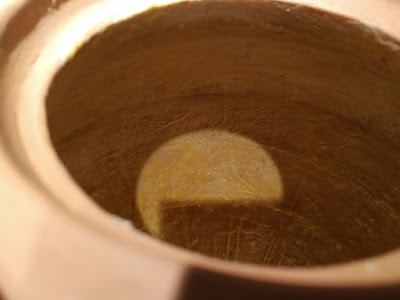 |
| after coating inside with beeswax |
Food grade beeswax is the seal of choice so obtaining this online we went about trying to cover the inside. We thought this went well but we were mistaken.
 |
| patches occur where beeswax coating is insufficient |
In the event the amphora leeches liquid in parts so we had either the best or worst of both worlds. Nil desperandum.
 |
| Solaris stalks |
 |
| Solaris berries |
We had de-stalked our Solaris crop - a sweet dessert grape variety - and filled the amphora up to the brim. This was very satisfying as we had exactly the right amount. We then put the lid on and sealed that with more food grade beeswax. We put a one-way valve in the hole our friend had provided and stood back for a fermantation to begin. Weeks went by and nothing happened. We went back to Google and realised we had probably made a mistake by not crushing the grapes to start with. We had heard about whole berry fermentation and even tried Carbonic Maceration before (a failure). We thought fermantation would just happen.
After about 3 weeks we decided to take a look at what was going on. The contents had shrunk to about half and now presented a less than attractive sight, somewhat grey in color smelling of vinegar and smelly feet. We had a bit of Malvasia sitting around so we threw that in up to the brim and re-sealed the amphora. We also injected some Lalvin yeast. After a day or two we fancied seeing the valve bubbling up in a desultory fashion. Not encouraging.
The Geogian recipe for Qvevri wine is to fill the Qvevri at harvest, seal it and re-open it in the spring. That's what we shall do, but with no great expectations.
As well as the amphora we had intended to age 20 litres of wine in our 3 year old French oak barrel. Maintainig barrels is a science of its own - clearly we have much to learn. We had made the cardinal mistake of leaving the barrel empty for many months and then filling it with water on discovering gaps had opened up between some of the staves.
 |
| our patent method of suspending a sulphur candle in the barrel |
We failed to put a chemical called Detersol into the water or to change it regularly
 |
| patent method of suspending whisk with sulphur candle |
 |
| boiling water treatment was also in vain |
so eventually no amount of flushing with the power hose, filling with boiling water, igniting sulphur candles or radical treatment with a strong chemical called Sanaton made it clean again.
We have come to the sad conclusion that this is an ex-barrel. As they say, it is time to put flowers in it. We have until March to import a new one under EU freedom of movement of goods rules. Sobering.
 |
| 6 boxes of Garnacha grapes from Castello de Rugat, south of Valencia |
Back to our grape imports. Our Grenache is from Valencia so we call it Garnacha.
Since the grape comes from Spain originally that is appropriate. We have always liked Garnacha. It is in fact a fabulous variety to work with. We are delighted with the result so far. The beginning of a love affair?
 |
| 16 boxes of Giuseppe's Uva di troia from Ruvo, west of Bari, Puglia |
Uva di Troia had been promised last year but failed to materialise. This year, we had been away when it arrived and somehow our allocation also didn't materialize but a week later we were rewarded with a lovely batch. Determined to fill one of our Speidel 60 litre fermenters and age the wine there, we bought 16 boxes of Uva di Troia grapes (each box weighing 8kg) and found ourselves with more like 70 litres.
Uva di troia is also known as Nero di Troia. It can be a bit soft and flabby but thanks to advice from Giuseppe's papa, we macerated it for a short 48 hours only and it has come up deliciously fresh so far. We think this variety is every bit as good as Primitivo and preferable to Negroamaro and Susumaniello to name the other Puglian red grapes.
After a few weeks in the Speidel and after fermentation, we racked the wine off the gross lees and topped up the fermenter with an excellent organic Uva di Troia called Maree d'Ione for some reason
obligingly on sale at £6.99 a bottle at Waitrose what luck! To our astonishment the level dropped considerably over a short space of time. The angels certainly had been taking their share. We topped the fermenter up again and realised a secondary fermentation was in progress. Could this be the famous Malolactic fermentation? So exciting!
 |
| equipment for sale at Wine Grapes Club, Hatfield |
Chris in Hatfield also sells wine equipment including Demijohns or Damigiani since they come from Italy. Having seen microvinifications ageing in damigiani at the Vivai Cooperativo di Rauscedo we decided to buy some of different sizes, 34 l. and 15 l. mainly. We also bought a 10 l. one online. Even when new these damigiani need a good deal of cleaning before they can be used but we rather like working with them as they are easy to pick up even when full thanks to the handles on their plastic jackets. We haven't dropped one yeat but we have had a couple of close calls.
 |
| bottled: 2018 Red field blend (gold capsules) and Red and White field blends 2017/8 |
We have started bottling wine from some of the smaller vessels lying around and also drinking some of the wine from these bottles. So far so good but experience tells us that the wines will be totally different a year on.
At the mention of next year, Chris says 'Don't ask.' He has been importing grapes for nearly 30 years. We don't know of anyone else who does. Of course it would be nice if we could grow all the grapes here but that would mean no Bombino, no Garnacha, no Uva di troia etc. We'll report on the situation next September.
 |
| all gone |