Tuesday, 10 September 2013

What we drank this summer

Being abysmally ignorant we supposed Lucca had always been part of Toscana but this year we discovered it had until the unification of Italy been either an independent city state or part of something called the Garfagnana - this after making Lucca our summer HQ for perhaps 35 years.

The Garfagnana is a geographical area which had belonged to the Duchy of Modena and Reggio with Castelnuovo Garfagnana as its capital. The d'Este family ruled and they appointed the poet Lodovico Ariosto as its governor in the 16th century. It is mountainous and one of the wettest - and greenest parts of Italy.

Local grape varieties have survived, some of them, dare we venture, are unknown to 'Wine Grapes' (unless they are unrecognised synonyms for other grapes). We discovered these in wines in Barga, a pretty hill town right in the middle of the Garfagnana. The wines of Poderi di Garfagnana, Vini di Montagna.


Seduced partly by the name (Riana) we bought this beauty before discovering the grapes involved were Balsoina and Verdolino. Verdolino turns out to be Verdeca - not exactly unknown but Balsoina? The wine by the way is excellent and deserves to be widely known.


The red is composed of Pighetta and Farinella which our preliminary researches suggest might be quite unknown elsewhere. The wine is tannic and a bit rustic but opens out nicely and is not unpleasant by any means.


In our post about wine at the Frieze Art fair, New York back in April this year we had noted that a wine from Lucca had finally crossed the Atlantic and promised to take a look at the estate concerned, Sardi Giustiniani.


This we did and bought a Colorino in purezza as well as a blend. We had enjoyed Colorino previously and this was no less attractive.


So much so that we picked up another Colorino at Enoteca Vanni in Lucca of which more shortly. This second Colorino proved that the grape has merit in more than just one or two emanations.


The Sardi Giustiniani operation is interesting as they are working to revive heritage varieties and have created an attractive Agriturismo.

Enoteca Vanni, Lucca is the best wine shop we know in the area. Apart from Champagne practically all their wines are Italian and inevitably as well as the Colorino mentioned above we found some other lovely wines. The one we kept coming back to was a Demeter Biodynamic natural Cortese of all things from Bellotti


Now Slotovino has had a problem with Cortese in the past as in we never had one we actually liked. This one we loved. At less than ten Euros it was also reasonable in alcohol at 12.5%. And it's available in the UK.


By luck, again this year we were practically neighbours of what we consider to be the best producer in the Lucchese, Fabbrica San Martino of Pieve Santo Stefano. As previously we introduced ourselves to the delightful Giuseppe Ferrua who has built up the less then 3 ha. vineyard to produce 2 reds,


the San Martino and the Arcipressi (meaning 'over by the cypresses in local dialect), a white, now a Rose and Olive oil. There are in addition all sorts of toiletries made from ingredients grown on the 20 ha. property (annual production only 12,500 bottles).

Sr. Ferrua had been at Vinitaly this year but we had contrived to miss him as we had missed so much else. He has distribution now in the USA (Louis/Dressner), Japan and several European countries although not yet the UK. He also exports to a private customer in Russia for his own consumption.


Last year we had found the Arcipressi, a blend of 9 grapes more interesting than the San Martino (only 3 varieties; Sangiovese, Canaiolo and Colorino) but this time it was the other way around. The white (Vermentino, Malvasia and Trebbiano) continues to be a delight and the Rose (only made in certain years) was pleasurable too.

There was at least one variety in the Arcipressi which we couldn't find in 'Wine Grapes.' We asked Sr. Ferrua how he had identified all the vines that go into his field blend. The answer was that he had invited an ampelographer to examine them and this was the list he came up with.

Aleatico
Canaiolo
Cilegiolo
Colorino
Malvasia Nera
Montanina
Muscatellone
Muscat d'Amburgo
Sangiovese


Sunday, 8 September 2013

Here's another one, Jancis


Jancis Robinson, on the button again wrote in yesterday's FT about highly-priced entrants to the market.


We didn't know the phenomenon was as frequent as it would seem from her piece but we had clocked an example of our own at San Francisco International Airport Duty Free of all places.

Could the cop on his Segway have been providing security?


Wednesday, 28 August 2013

WARNING


Reading SLOTOVINO may induce drowsiness, exhaustion, languor, lassitude, lethargy, listlessness, sleepiness, sluggishness, somnolence, tiredness, weariness.


Saturday, 24 August 2013

A rare creature


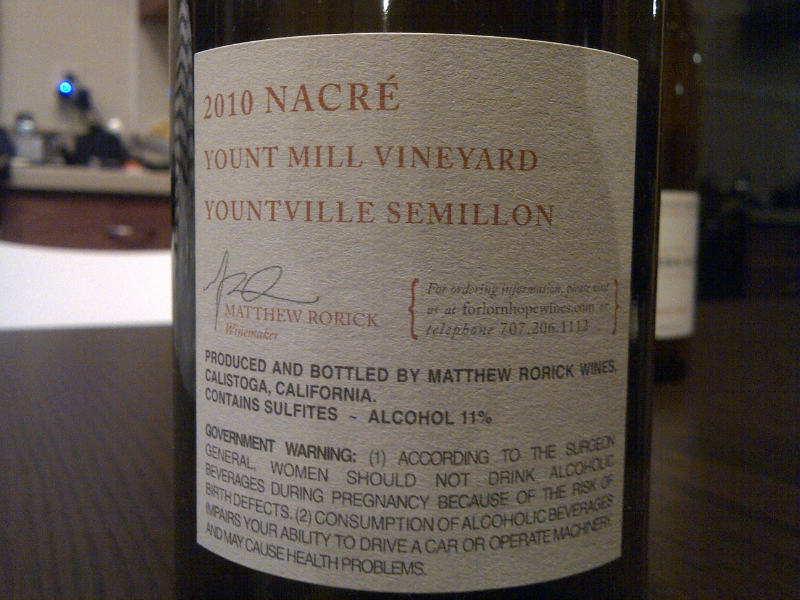
Matthew Rorick is a busy man. Without the benefit of a large staff he creates a remarkable number of what he calls 'Rare Creatures'.

L'Asino Santo - Barbera
Batiscafo - Verdelho
Les Deux Matthieu - Petite Sirah
The Faufreluches - Gewurtztraminer
Gascony Cadets - Petit Verdot
La Gitana - Torrontes
Kirschenmann - Orange of Pinot Gris
Kumo to Amo - Rose of Touriga Nacional/Tinta Roriz/Tinta Cao/Tinta Amarella
Mil Amores - Red of Touriga Nacional/Tinta Roriz/Tinta Cao/Tinta Amarella
Nacre - Semillon
Norgard - Chenin Blanc
Old Woodsbull - Syrah
Ost-Intrigen - St. Laurent
Les Paresseux - Late Harvest Chenin Blanc
Picpoul de Rutherford - Picpoul Blanc
Que Saudade - Verdelho
San Hercurmer delle Freccie - Barbera
Sihaya - Ribolla Gialla
Sogni della Speccia - Sangiovese
Suspiro del Moro - Alvarelhao
Trou Grit - Trousseau Gris

He also works with Valdigue, Charbono, Gamay and Mourvedre.

From this list you can see that Matthew Rorick is not only a prolific maker of wines but a poet of winemakers. Indeed, the wines themselves are poetic if one can allow oneself that expression and not only for the choice of grapes. Matthew Rorick's Forlorn Hope Blog is full of poetic formulas even concerning winemaking. Viz;

In the winery, the Alvarelhão has been unsure of whether or not it wants to be pressed yet but it appears that it’s leaning toward leaving the fermentor and cozying up in barrel tomorrow.

(the Blog is a delight; really interesting reading).


And so to the name, 'Forlorn Hope'. Who better to explain than Mr. Rorick;

At Matthew Rorick Wines, we love the longshots. We love the outsiders, the lost causes, the people/projects/ideas abandoned as not having a chance in the world. We love the longshots because we’re all about tenacity, we relish a challenge, and – we admit it – we love us a good tussle.
Hans Brinker, the Dutch boy who stuck his finger in the dike? We’re big fans of his. Penelope – weaving all day and ripping it out all night? She’s with us. Henry V’s speech at the Battle of Agincourt? Pretty much our theme song.
Taken from the Dutch ‘verloren hoop’, meaning ‘lost troop’, Forlorn Hope was the name given to the band of soldiers who volunteered to lead the charge directly into enemy defenses. The chance of success for the Forlorn Hope was always slim, but the glory and rewards granted to survivors ensured no shortage of applicants.
These bottles, the first produced by Matthew Rorick Wines, were our headlong rush into the breach. Rare creatures from appellations unknown and varieties uncommon, these wines are our brave advance party, our pride and joy – our Forlorn Hope.

So forget 'Alles Verlorenen' of South Africa, 'Forlorn Hope' is basically the same as Avant Garde, just more poetic of course.
 

Matthew Rorick has an interesting CV including service in the Navy during the first Gulf War, wine studies at UC Davis and Anthropology at Chicago University, winemaking experience at Errazuriz and several others.

We had made a vague arrangement to meet Mr. Rorick but it wasn't clear when or where. The only address we had was in Napa which turned out to be his home.


His charming and helpful wife Susanne, herself from a famous Napa wine family (Snowden Vineyards) not only made contact for us but gave us 3 bottles of Rare Creatures refusing all payment.


We headed over to Fairfax about 20' away where the Forlorn Hope Winery is near. Matthew was on his way but helpers were already preparing equipment for the first harvest of the season, Verdelho the next day (August 3rd).


When Matthew arrived we introduced ourselves hurriedly not wanting to take up his time at probably the worst possible moment to call. But he was all charm and seemed disappointed we couldn't stay all day and bombard him with boring questions. He is a charismatic person as are his co-workers - all young and good-looking (this is California after all).


We asked where we could buy a bottle of the Suspiro del Moro. Matthew looked puzzled and then mentioned a shop called By Right in San Francisco. We said we would try there but if they didn't have it might he send us a couple of bottles to our address in Santa Cruz where we would be for the next week. He promised to do so when we had made a quick call to the retailer and found they were out of all Forlorn Hope wines (they do sell out wherever they are).


There is a characteristic end to this story. Ashamed to say we couldn't believe that with so much else going on Mr. Rorick would have the time to send the wine or even remember agreeing to ship it so we ordered a couple of bottles  to be sent by courier from a shop called Domaine LA in  Los Angeles.


The day after these arrived came a large box from Forlorn Hope with a charming hand-written note and no less than 6 bottles including 2 of Suspiro del Moro and 4 others of different kinds.


There was no invoice contained. We emailed our thanks beseeching to know the amount owing and payment details. No answer has been received to date. Matthew Rorick is just one of those people who want you to enjoy his wines! Production of any one Rare Creature never surpasses 2,500 bottles it is reported. Fortunately there are no lack of takers.


And the wines themselves? Rorick's says "All Forlorn Hope wines are produced from winegrapes. That's it." and "Just being wierd isn't enough. It's got to be the right variety on the right soil". So putting everything else aside, from the very few wines we have tasted we can say they are all very well made (Mil Amores red, San Hercurmer delle Frecce) and sometimes outstanding (Suspiro del Moro). We can't wait to try the others.


Monday, 19 August 2013

Napa changing?


It seems to be in the air. The September edition of  'Decanter' has an interesting supplement on California stressing the diversity to be found there among a new wave of small producers (Jon Bonne; 'The new California'). Alfonso Cevola's blog 'On the wine trail in Italy' chimes in with a post on the same subject (July 21st - 'What does a native Californian drink in California on his birthday?'), all co-inciding with our own trip to Napa and our researches into the same widening of choices available to the consumer.

We had registered the fact that California is more diverse than its reputation already in our post of December 9th, 2008 ('American Diversity after all') but this was our first opportunity to investigate in person. With only half a day to look at one of the most valuable areas of wine real estate in the world we set out early from San Francisco hoping also to make contact with the maker (Matthew Rorick) of our Slotovino Red of  the Year (2012/13), the 'Suspiro del Moro' Alvarelhao of Forlorn Hope and acquire some more of this and other wines.Rorick may live in Napa but he takes his grapes from many different parts of California, notably Lodi and always credits the growers and their Vineyards.


In preparation we had surfed the internet and discovered a charming Riverside operation called 'Forgotten Grapes' run by Chris Kern.


As the name suggests, he specializes in all kinds of wines not found in the supermarket or most other places for that matter; certainly not abroad. We were able to arrange for a shipment including the following Californian mono-varietals to be made to an accommodating wine bar in San Francisco for collection on our arrival;


Aglianico
Alicante Bouschet
Baco Noir
Cabernet Pfeffer
Colombard
Counoise
Malvasia
Rousanne
Pinotage
Pinot Blanc
Tannat
Teroldego
Torrontes
Touriga Nacional

As we have mentioned in this Blog, it was Andrew Jefford who had tipped us off about 'Forlorn Hope' and also 'The Scholium Project', both leaders in the New California. 'Forlorn Hope' uses uncommon varieties and Scholium uncommon (natural) procedures. On our quest we found plenty of examples of both of these trends as we shall see.


The town of Napa itself was not quite what we had imagined.


Entering, we followed a sign to the Opera House and indeed there it was - a small but handsome Victorian building with columns. We searched in vain for the placard for last season or next.


Not expecting 'Der Ring des Nibelungen' exactly there was not even a mention of anything perhaps more appropriate such as 'L'Elisir d'Amore'.


Similarly there was an air of dejection in the town with an entire shopping centre opposite the Opera House closed down and what was a large wine shop over the river also out of business.


Numerous tasting rooms suggested a stream of visitors on the wine trail but that was about it. One person we spoke to said the city of Napa was"struggling".


Clueless as to where to go in the short time available, we stopped in at the Railway Station which now serves the Napa Wine Train.

This seems to be a popular tourist attraction whereby you can visit 4 wineries between Napa and St. Helena 18 miles away, taste the wines, have a meal and be spirited through beautiful countryside consisting of vines,


more vines and even more vines, uniformly neat and tidy with machines we have never seen before no doubt for the purpose of managing climatic conditions.


Taking the Wine Train itinerary, we set off by car along what is a first class 'Weinstrasse'. Legendary and celebrated names passed by one after the other; Mondavi,


Beaulieu,


Heitz,


Grgich etc., surprisingly at this part of the Napa, all on the floor of the valley. Yountville is to the side of the road so that would have to wait for another time


but St. Helena is right on it and there the atmosphere was more salubrious than that of Napa and much more how we had pictured things in the valley.


The pretty main street has nice boutiques such as you may find in Carmel with an attractive wine merchant where we had to buy the poster of co-incidentally the 13 major Napa varieties to hang alongside the poster 'La Symphonie des 13 Cepages' we was picked up in Chateauneuf du Pape. The varieties listed for Napa are, in what order we know not;

Zinfandel
Petite Sirah
Barbera
Cabernet Franc
Sangiovese
Chardonnay
Semillon
Sauvignon Blanc
Merlot
Pinot Noir
Verdelho
Cabernet Sauvignon
Syrah

Some of these are quite a surprise even if they don't include some of the really interesting varieties rumored to be grown in California (Poulsard, Peloursin!).

California is the world's 4th largest wine area after France, Italy and Spain. 90% of US wine comes from this state. One can now talk of wine production here almost over hundreds of years but what we think of as Californian wine dates only from the 1960s or 70s. The image we have of California wine is not at all the whole story. The original plantings were brought by missionaries.


In the 19th century, the manic entrepreneur Agoston Haraszthy who (apart from a bewildering number of other achievements was the first Hungarian immigrant to the United States) brought in 300 cuttings from France, Germany, Switzerland and Spain. His Buena Vista estate may even have been the origin of the Phylloxera plague.

 Ancient Tokay vine (planted 1888) in Jessie's Grove, showing some of vestiges of the early July heat wave ("fried" grapes)
an 1888 Tokay vine survivor, Jessie's Vineyard, Lodi

Miraculously not all the original plantings were lost and it was of course the Americans who were first to find a solution to the problem. For an overview of Haraszthy's other achievements (founding cities, building factories and jails, being the first Mississipi steamer operator as well as being the father of Californian wine, going bust and possibly meeting his death by being eaten by alligators)  see the particularly good entry in Wikipedia. Werner Herzog seems to have forgotten to make a biopic about him.

Later immigrants often brought their vines with them from home so there are diverse varieties to be found in plantings of various sizes all over California, often farmed by the same family over generations. Winemakers have become expert at seeking these sources out. Ridge, no less being an early one to exploit these resources. For fascinating examples see www.lodiwine.com/blog/the-most-spectacular-time-of-year-veraison-2-13-in-lodi

Prohibition was just as bad a scourge as Phylloxera but a peculiar side-effect was the introduction of further diversity as vine growers exploited a loophole in the law which allowed them to grow grapes for individuals to make 'Grape Juice'. These grapes had to be hardy enough to withstand shipping to the private addresses all over America so hardy varieties had to be sought out.

So there has always been greater diversity in California that its image has suggested and now a new generation of pioneering winemakers are using more and more interesting varieties to make fascinating wines unlike anything you might have found before. They call themselves the Seven Percenters because 93 percent of vineyards in the North Coast are planted to eight grape varieties: Cabernet Sauvignon, Chardonnay, Pinot Noir, Syrah, Merlot, Sauvignon Blanc, Zinfandel and Petite Sirah. The remaining seven percent of vineyard land is left for those interested in making wine from other varieties. It has to be said Napa is not an area prominent in supplying grapes as yet to these Seven Percenters but there are grapes other than these eight varieties grown there so who knows, col tempo...

Due to the particular situation in America concerning distribution, these Seven Percenters do not get a look in internationally or even nationally. they are told by the few giant distribution companies that their "books are full" and even if they were not, the small production would not be of interest to these companies.

So they mostly sell to mailing lists, online, at the cellar door and to local wine shops.


Just recently, Chambers St. Wines - the paragon of winemerchants which leans towards Natural, Organic and Biodynamic wines announced they they had bought in wines from the following;

AmByth
Dirty and Rowdy
Farmers Jane
Field Recordings
Forlorn Hope
Matthiasson
Porter Creek
Salinia
The Scholium Project

with others from Oregon and New York State.

These names may be added to make up a roll-call of like-minded producers;

Arnot Roberts
Bedrock Wine Co.
Idlewild Wines
Jolie-Laide
Leo Steen
Massican
RPM
Ryme Cellars
Stark Wine
Two Shepherds
Unti Vineyards
Wind Gap

and no doubt many others little known outside their immediate circles.

This is a pity because they should be among the standard bearers for Californian wine and would provide a valuable counterweight to what is often an industrial product so sadly to be found on supermarket shelves all over the world. Nevertheless, these wines are beginning to make an impact across the US and now abroad. They will do wonders for the image of Californian wine.

On our brief visit to Napa we determined to track down one of the leading lights of this group, Matthew Rorick of Forlorn Hope, mentioned above who will be the subject of our next post.