Saturday, 6 July 2013

Frieze New York, not just an Art Fair


In New York primarily for the 2nd Frieze New York Art Fair but with Vineous side-effects.

At the Fair itself we spotted something intriguing at the St. Ambroeus restaurant, a Rosato from Lucca. Now we have watched the wines of Lucca progress over abut 35 years of visits to the Versilia and they have gone from being available just from local shops to getting into the supermarkets and finally making it abroad but this was the first time we have seen anything in a context such as this.

Otherwise put, with all the pink wine in the world to choose from the good people of St. Ambroeus seem to have decided on one from Lucca. Quite something.

 Planning to spend some time in the Lucca area this summer, we decided to contact the winemaker, Matteo Giustiniani of Tenuta Sardi Giustiniani just to see if he accepts visitors (he does, most graciously). There resulted a really interesting correspondence in which we learned that Sr. Giustiniani is planting experimental varieties at the Tenuta. In his own words; "a particular clone of Moscato d'Amburgo that we call Moscato nero. The Sangiovese ronco is a very old vineyard in which one we have a particular clone of Sangiovese and a variety of Lucca called Buonamico. The Buonamico and the Moscato nero give wines for all days, with rich aromas. However, The Colorino nero gives structured and very spicy wines. In our vineyards we gave a lot of Ciliegiolo grapes that we use for our Rosé wine, and a particular clone of Vermentino." Art Fairs can be fascinating for all kinds of reasons.


We couldn't be in New York without calling in on Chambers St. Wines and there we picked up two rarities; Champagne Nature, Beaufort Coteaux Champenois Blanc and Beaufort 1989 Coteaux Champenois Ambonnay Rouge, i.e.Champagne nature, i.e. without bubbles) as a present for a very special person old enough to remember when Champagne Nature was more easily available.


We also took a chance on a bottle of Trepat from Josep Foraster and as it turned out we were very happy we did. Trepat is a red grape  from Montblanc, DO Conca de Barberà. The first Festa del Trepat was held in 2010 in Barberà de la Conca. Trepat is used as a constituent of Cava. This wine was a rare example of a light wine from Spain, low in alcohol. There are such wines but you have to seek them out very assiduously indeed. Bobal is another example although Big Bobals are made.We would like to admit Trepat to the Slotovino Hall of Fame.


On a mission to find specific wines we had the pleasure in discovering Flatiron Wines and Spirits in Manhattan and Heights Chateau in Brooklyn.


At Flatiron there were several wines of great interest.


A 100% Cimixia (Scimiscia) from Portofino


as well as a blend of Bosco, Vermentino and Alabarola from the Cinque Terre. They also had more or less the whole range of Clos Ouvert, the interesting Chilean wines made by Frenchmen using Pais and other varieties from very old vines vinified naturally which is unusual in that country.


At first we got a bit excited by the name Huasa but this is just a synonym for Pais. The other wines from Clos Ouvert included  their Secano Primavera (Pais, Carignan, Cinsault and Cabernet Franc), Vino Puro, and Loncomilla (both 100% Carmenere).


We were there to pick up a bottle of Ponce's Buena Pinta Moravia Agria/Garnacha blend, unavailable in the UK since the sad disappearance of Green and Blue.


 but couldn't help noticing a bottle of red Colares (Ramisco), perhaps the only one in America (North or South). Chambers St. have white Colares Arenae Malvasia. We had no interest in this until we found out Colares Malvasia is a distinct variety.

An even more extraordinary moment occurred at Heights Chateau, Atlantic Avenue in lovely Brooklyn.


Here dear Slotovino reader we actually stmbled on a bottle of Enantio. That's right, the wine grape formerly known as Lambrusco a foglia frastagliato, now called Enantio. It comes from Castello di Avio, Trentino and for years, yes years, we have been opening our gambits with floor walkers in wine shops by asking if they haven't by any chance got any Enantio (they never had).

Sadly unbounded joy subsequently turned to disappointment on tasting Enantio. It just goes to prove that rarity is sometimes deserved even if we have uncovered many gems on our voyages of discovery.


As if to prove the point, we alighted on just such a gem on the winelist at our hotel restaurant. Unlikely as this sounds, this was the undisputed highlight of our visit: Forlorn Hope's 2012 Suspiro del Moro Silvaspoons Vineyard Alta Mesa ALVARELHAO by our new hero, Matthew Rorick. Alvarelhao was a name which rang a bell. Maybe we had encountered it in Portuguese blends, maybe with characteristic Slotovino attention to detail we had misread it for Alvarinho. Forlorn Hope also rang a bell thanks to Andrew Jefford who had kindly tipped us off about this extraordinary operation in Napa. We will cover Forlorn Hope with the detail it deserves one day but in the meanwhile, the following description by Karen Ulrich lifted from T. Edward Wines website (we hope we will be forgiven) could not be better;

"The Forlorn Hope wines are the result of a project devoted to displaying the wealth of California's viticultural potential -- as well as championing varieties less common. Taken as a departure from the stereotypical Californian product, the Rare Creatures of the Forlorn Hope display what is possible when great care is taken in combining soil type, climate/site, and variety to produce wines which require no manipulation."
We were well aware that all kinds of interesting varieties are grown in California and had always wondered what happened to them since you never encountered any on the shelves of wine shops. Could they all be shoved into Jug Wine blends? 
Here are some of the Californian grapes which Matthew Rorick has sourced from various parts of the state.

Chenin Blanc
Gewurztraminer
Piquepoul
Ribolla Gialla
Semillon
Torrontes
Trousseau Gris
Valdiguie
Verdelho

Alvarelhao
Barbera
PetiteSirah
Petit Verdot
St. Laurent
Sangiovese
Syrah
Tinta Amarela
Tinta Cao
Tinta Nacional
Tinta Roriz

There are two quotes from Matthew Rorick which appeal to us greatly;

"Just being wierd isn't enough. It's got to be the right variety on the right soil".

and on his website under 'Wine Elaboration'

"All Forlorn Hope wines are produced from winegrapes. That's it."


Emerging regions


Georgia is arguably the oldest wine producing country in the world and many represented here at the Landmark Hotel have been in the business for milennia so and emerging has more to do with our consciosness rather than their being new to wine production.


As well as Georgia, here represented by Bagrationi sparkling wine and named after the great general of the Napoleonic wars


was Lebanon with a Ksara made from 50% Arinarnoa and 50% Cabernet Sauvignon. Arinarnoa is a crossing of Merlot and Petit Verdot. We have tracked down a 100% Arinarnoa from Domaine  Isle St. Pierre (Vin de Pays des Bouches du Rhone) and will report on that eventually.


and some fascinating wines from the Canary Islands which proved quite a magnet.

Madeira and the Canary Islands were extremely important in the history of wine in America because they were the last ports of call before sailing ships crossed the ocean. Wine from there presumably had less time to spoil that that taken on at the beginning of the voyage. The largest single component of Thomas Jefferson's cellar was Madeira, not Bordeaux.

Mmmmm.


In praise of Henderson Wines, Edinburgh

We have been fans of Hendersons from a previous visit to Edinburgh so were pleased to see that they have doubled in size since then, opening a 2nd shop in the West End on the other side of the city.

The day we returned to the original Morningside establishment we were fortunate enough to meet the boss with one of his main suppliers.

Independent wines for independent minds

On the previous occasion we had visited we found a sparkling Australian Pinot Meslier - not something you see very often. We rightly gave them our first award in the Slotovino 2011/12 "Best Wine Merchant Outside London" category, newly created for them.

On this occasion we were delighted to see they had enlarged their Hungarian selection to make something of a feature of these wines - not something you see very often either. 

with some nice Austrians next door;

Why do we like this shop so much? There is always something of interest. That's all.

Friday, 21 June 2013

Seen in Edinburgh


Ha!Ha! Reminds us of the fantastically politically incorrect Scottish joke -

Headline in Glasgow Evening News "2 Taxis collide in Sauchiehall Street, 14 injured".

Sunday, 2 June 2013

VINITALY


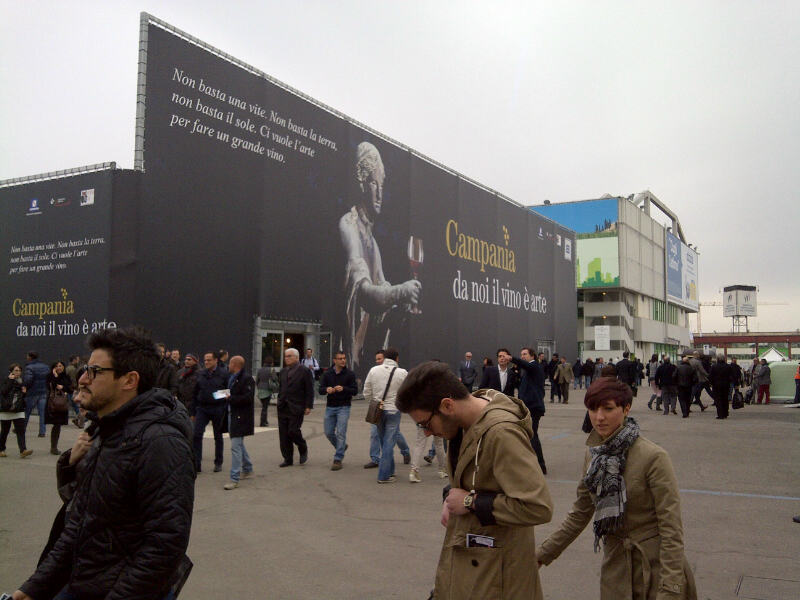
They said Vinitaly was big. They were wrong – it is IMMENSE. Unbelieveably huge. In 2012 there were 94,862 Sq. metres of exhibition space, 4,255 exhibitors of which 94 were from abroad , 140,655 of which 50,066 were foreigners and 2,496 journalists of which 328 were from abroad. Vast beyond imagination. Each province of Italy is represented by an enormous edifice larger than many an airport terminal. 


There is even a building entirely devoted to Franciacorta 


and another for what some Marketing people have decided should be known as 'Maremmawineshire' (Ha, ha).

In addition there are open air spaces full of winery equipment. 


There are all kinds of restaurants, even one devoted to the promotion of rice dishes and another to 'Le donne del vino!


The fair takes place in Verona over 4 days in April and has been a fixture in the Wine calendar for Italy and the World for over 40 years. Everyone except us seemed to know what they were doing. Innocently we had bought our day pass and just turned up assuming we could just take a look around and get a ‘tour d’horizon’ in an afternoon. This is impossible because there is no guide or catalogue on offer either online before the event as far as we could see nor on entering the fair. 


Having queued just to enter, there was only a small plan on the ground shortly after the turnstiles for guidance.


While standing in front of this wondering which way to turn, we took stock of the crowd and immediately noticed how diverse they were and different from the people any British wine event.


It seemed every Italian wine waiter and barista was there together with everyone who ever toiled in a vineyard or even enjoyed a glass of wine. The middle class middle-aged gents typical of British wine events were also to be found as well as smooth be-suited wine execs to be sure but the democratic nature and the variety of the visitors was striking. Even on the train from Venice we had caught snatches of conversation from American restaurant owners. To be sure the whole world was there.


The first pavilion on hand was Emilia Romagna, certainly an interesting province. We wandered in but soon became aware that we needed guidance. Near the entrance was a desk. 


There we found an interesting leaflet which gave a directory to the exhibitors by wine type, which is to say in this province by grape variety. 


Among the Sangiovesi di Romagna were more Ortrugos than you could shake a stick at and – what was this? A few wines from something called ‘Uva Longanese’ 


and what’s this? ‘Famoso’.


Our handy leaflet led us directly to a counter where we found the producer of these wines, Daniele Longanese of Azienda Agricola Longanese Daniele.


 Sr. Longanese explained that his family had found a strange grape growing on their smallholding and had cultivated it because it made such good wine. Their reward was to have the grape named after them and now they are not the only ones to plant it. It did indeed make beautiful wines. Not content to stop there, Daniele Longanese is making wine from a white grape he calls Famoso. This has traditionally been known as Rambela but is so obscure as to be more or less another rescue grape as it were.


Neither 'Famoso' nor 'Rambela' is known to the first edition of "Wine Grapes" incidentally but there it was and delicious too. 


Sharing the booth with A.A. Longanese was Azienda Agricola Agrituristica "La Sabbiona" who were already known to us for their Savignon Rosso. 


We had a bottle of this at home and were looking for an opportunity to taste this rarity. Savignon Rosso is another rescue grape. We had met another grower at the Real Wine Fair in London, Stefano Bariani of A.A. Fondo San Giuseppe and learned that it was also called Centesimino. La Sabbiona also produce a Spumante from Famoso!


This was great! We thought we just had to enter every building, take their leaflet and zero in to the producers of wines made from interesting and unknown grape varieties. Sadly, this was not to be. 


The only help was in each case a board with an alphabetical list of exhibitors. The prospect of finding needles in these haystacks was daunting to say the least. All we could do was to meander aimlessly along the aisled saluting old friends as we passed by. These included


Benanti, the great Sicilian producer


Colosi, a Salina winery whose wines we had encountered on our trip there last October but whose vineyard and cellar we never found

Giona, another Salina producer we had missed


Ivaldi whose Albarossa we had discovered a couple of years ago at the London International Wine Fair at Excel


La Montecchia whose wines we have appreciated for their reasonable pricing and interesting range


Pravis, our favourite Trentino producer who make a Negrara in purezza as well as Rebo, Gropello and much else


Serrapetrona whose Vernaccia Nera we have appreciated


San Felice who revived Pugnitello in partnership with the University of Siena


Feudo di Sannta Tresa, maker of our favourite Frappato - so much lighter than any others we know


and the nice man from Virgona who gave us such a charming tour of his operation in Salina

Treading the aisles the sheer effort made by so many just for these few days was staggering. This is not unique to Vinitaly but the Italians do it so well with friendly spaces for entertaining and meetings. 


There were even spaces where agencies could do business across a counter.


One afternoon was not going to suffice. A day at each province would be a minimum for a preliminary skirmish. 


The Veneto building was the largest. Not surprising as we were still in the Veneto itself. About two-thirds of this was given over to Prosecco. How depressing was that!

Every subsection of Italian wine appeared to be represented to some degree though;


Feeling down with the whole situation we passed by a little kiosk and something caught our eye; a large book shrink wrapped with another smaller one seemed to be on sale. We took a closer look. It was only the bloody catalogue to the whole bang-shoot; a work almost the size of ‘Wine Grapes’ (992pp plus a visitors guide of 220pp and an appendix of 6pp - total 1,118pp as opposed to 1,242pp) 


with everything you needed to prepare you for your visit to Vinitaly – as long as you could study it in the preceding 3 or 4 months that is! We immediately bought this tome (30 Euros) but it was sort of worse than useless at that point. 


Subsequently it has been a source of much fascination of course but the opportunity to get much out of the fair had been missed. We didn’t see anyone else with the mighty publication in their hands during the entire remainder of the afternoon. Weird.


The immensity of Vinitaly is of course a tribute to the diversity of Italian wine. Indeed, there would probably have been no difficulty in the show being twice the size. In a way, the sheer enormity is so daunting that it probably results in people sticking to what they know and not trying to get a handle on the entirety. That in itself is interesting of course.


Apart from Uva Longanese and Famoso, we came away with a few gems including a Foja Tonda, (Casetta) by a winery in Valdadige called Armani whose labels were appropriately tasteful and some very nice Ruche and Grignolino from a Piemontese Azienda called Crivelli whose labels might have been better for a re-think but whose wines were outstanding.


.


It had been an experience. We are not sure if we will rush back in 2014. Maybe ogni morte di Papa  as they say in Italy.