Thursday, 21 October 2010

Torino: chocolate and wine

Sitting in the very epicentre of Italy's greatest wine area, Torino appears more interested in chocolate than their famous local wines.

Indeed we even saw an invitation to a chocolate-tasting

at a certain venerable establishment in this city of Pasticcerias and sweet shops;

birthplace of the chocolate bar.


As for their Barolos, Barbarescos, Barberas, Dolcettos and Nebbiolos of Alba and the Langhe it would seem that producing such marvels just happens effortlessly. How wrong can one be?

We entered Torino determined to find good cheap Barolo or at least one under €20. Why should it always be so expensive? Firmly believing that the price of wine has more to do with the lifestyle and aspirations of the vigneron than intrinsic worth or cost of production we were sure of finding Barolo at half the price for local consumption.

Wrong. There was the same explanation wherever we went. Barolo is difficult to produce. It requires certain sites. It only ripens properly if the conditions are right. It must be aged for 2 or 3 years in cask and then further in bottle. You may find Barolo for under €20 but it will not give the experience of proper Barolo. This information came from establishments such as the great Gastronomia Paissa

and the Casa del Barolo,

an appropriately plutocratic establishment with entry only in response to a buzzer.

Research had thrown up two Vino Sfuso outlets in Torino so why not go from the pillar of expensive Barolo to the post of wine on draft? First we visited Scaringella Vini e Bevande which was quite different from any of the other Vino Sfuso shops we had seen in Venezia.

It was more like something we had once found in Napoli with large tanks of wine in bulk where customers could fill a demijohn (minimum 5 litres) with a small selection of wines; Dolcetto, Barbera and one or two others.

The shop also sold other wines and spirits in bottle. Over the yard they had yet more tanks and a bottling plant.

So as well as filling your demijohn, you could buy the wine in bottle. What Scaringella wouldn't do was to fill your empty mineral water bottle or other container (unles it had 5 litres or more capacity presumably). We bought a bottle of Dolcetto and one of Barbera at around €3 each. The Barbera was better but neither was better than ordinaire.

From there we went to 'L'angolo del vino' in another part of town.

This was rather extraordinary - a Venetian establishment transposed to Torino complete with Veneto varieties 'delle Marche Trevigiane' (Treviso), selected from a company called 'l'Azienda vitivinicola La Costa di Vò coming from barrels with taps.
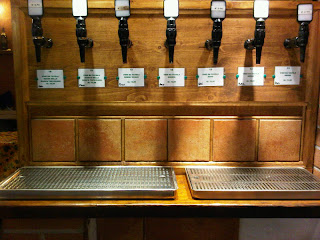

We found the following varieties (there are 21 on offer);

Ancelotta (YES Ancelotta, despite dire warnings we had heard from Venezia to Edinburgh that the Ancelotta crop had failed)
Barbera (OK there had to be one or two local varieties - provided by Rolfo Pietro, producers in Govone and San Bartolomeo)
Blends of various reds
Cabernets S. and F.
Chardonnay
Pinot Grigio
Raboso (rose and red)
Refosco

These were just as good as could be found in Venezia which seems to be a model for Vino Sfuso shops outside Venezia itself. We bought a litre of Ancelotta which was every bit as good as the first Ancelotta in purezza we ever tried and which convinced us of the high merit of this grape.

Like all the best Vino Sfuso shops, l'angolo del vino is something of a meeting place. We had to wait our turn while several others were served. We had to be patient to get these shots without embarassing anyone by including them in them


In ordinary restaurants we concentrated on the 'lesser' Barberas, Dolcettos etc. Pleasant and attractive though these were we still didn't fall head over heals for them. The only consolation was a continuing pleasure in drinking Grignolino.

Torino is a delight, preferable to Milano in our opinion. The Teatro Regio is well run and they produce better opera than most Italian houses. There is a convenient Ryanair flight from London, so no excuse for Brits not to visit. It was also the site of the 2006 Winter olympics so is in a way a Ski resort as well as everything else. We hope to return one day and crack the Barolo problem once and for all.

At Torino/Caselle airport there is a good selection of Subalpino (Piemonte) wines. The girls in the Duty Free shop answered our questions by saying 'look, all the wines here are from the best producers in Piemonte so anything you buy we can promise you will be OK.' Hmmmmmmm.

In fact we came away with a couple of rarities; a sparkling Bonarda and a still, dry Freisa which boasted quite the most bizarre label we have ever seen.

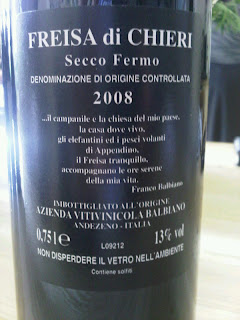
No doubt a marketing department's bright idea of how to sell such an interesting wine.

Taking up position near our gate there was a welcoming wine bar where various wines were on tasting. Asking the guy with the apron if he had a Grignolino on tasting, rather than open a bottle he said 'Grignolino e un vino da ragazza' or words to that effect.

We would have been pleased to have been ragazzi in this case.

Enoteca Costantini, Roma


Passing through Roma, we had to make a pilgrimage again to Enoteca Costantini whose Aladdin's cave held such promise and where we had first encountered our beloved Vernaccia Nera. Again we were not disappointed, despite a false start in the form of a retainer with only fitful understanding or interest in what we were after.

As in Parma, both he and the more collaborative colleague we subsequently buttonholed pointed us to a Piemontese blend which they swore was an indiginous grape variety. A misunderstanding which was clarified by reading the minute print on the back label.

Nevertheless, we exited like Max Bialystock coming out of the bushes waving an old lady's check with the following two treasures:

1. A Nero Buono from Lazio. The only known facts about Nero Buono seem to be that it is rarely found, that it comes from the area around a place called Cori and that it is "used as a blending-component in the red Cori DOC. The grape is said to add good colour, concentration and tannins to the blend. With this grape added the wines ability to age increases." The London merchant Slurp has a version from Poggio le Volpi. Their website says "The Poggio le Volpi estate was established in the 1990s by Felice Mergé. The vineyards are situated in Frascati (Lazio). This is an elegant and velvety wine with a lingering finish showing aromas of berries, chocolate, liquorice and coffee in the background." £21.60. Our version was considerably cheaper quite understandably. It seems a pattern is emerging in our discoveries of worthwhile new grapes. So many have been used to add colour or body to blends. We only have to think of Alicante Bouschet, Persan, Ancelotta etc. We have similar hopes for Nero Buono.


2. Cagnulari - a grape from Sardegna.


Here's another fine mess. According to Wikipedia, this is both Graciano and Morrastel (which we thought was Mouvedre) from Spain - understandable considering Sardegna's centuries under Spanish rule. However, Wikipedia warns us severely that Morrastel (with one 'l') is not Mourvedre: Il ne faut surtout pas le confondre avec le morastell ou monastrell (with 2 'l's) des pays catalans qui est en réalité le mourvèdre, il est vrai que ce dernier ressemble de beaucoup au Morrastel.

On another ampelographic website, synonyms also include Bastardo Nero which we thought we had heard in connection with Trousseau but all the lists of synonyms equate Bastardo (without the Nero) with Trousseau Noir (i.e. with the Nero). Could Bastardo be different from Bastardo Nero? That would really be too much to swallow (joke). NB also our friend Tintilla making an appearance here;

Bastardo Nero, Bois Dur, Bordelais, Cagliunari, Cagnonale, Cagnovali Nero, Cagnulari, Cagnulari Bastardo, Cagnulari Sardo, Cagnulatu, Caldareddu, Caldarello, Cargo Muol, Courouillade, Courouillade, Couthurier, Drug, Graciana, Graciano Tinto, Grosse Negrette, Jerusano, Karis, Marastel, Matarou, Minostello, Minustello, Monastel, Monestaou, Morastel, Morestel, Morrastel, Mourastel, Perpignan, Perpignanou Bois Dur, Plant De Ledenon, Tinta Do Padre Antonio, Tinta Miuda, Tintilla, Uva Cagnelata, Xeres, Xerez, Zinzillosa, Cendrón, Juan Ibáñez, Tanat Gris, Tintilla de Rota.

the ever informative and eclectic Caves de Pyrene has its own list of synonyms for Cagnulari;

(a.ka. Cagnorali nero, also a.k.a. Cagnonale)also a.k.a. cagliunari in Alghero, also a.k.a. cagnulari Sardo, also a.k.a. Tinta Miuda also a.k.a. caldareddu( in Gallura) recommended in the provinces of Cagliari, Oristano and Sassari.

They go on to say;

It is said to have come from France( in the second half of the 19th century) under the incorrect name of Mourvedre, but it is in fact very different from Mourvedre, and it is also said to come from Spain( during the Aragonese occupation of the island between 1322 and 1713. It is in particular found in the province of Sassari. it is very rarely vinified alone. there are 250 ha of Cagnulari planted in Sardinia.

Whatever. We love Graciano so an Italian version promises a great deal. We are looking forward to tasting this bottle, again thanks to Enoteca Costantini.

Wednesday, 20 October 2010

In praise of Parma

What a place! The site of the first theatre in the world where scenery could be flown (Teatro Farnese).

City of Verdi and Toscanini. Parma ham,

Parmigiano.

There are even Musei del Cibo:

a Museo del Parmigiano and even more improbably a Museo del Pomodoro.


Countless Gastronomie grace the shopping streets.

Verdi is everywhere. We were there for the Verdi Festival at the Teatro Regio where, for Italy the performance was a rarity: really rather good.

It was booed by the infamous loggionisti who think they are experts and sing along with the performance to show it but are just chauvinists who like to boo any foreign artists when in fact the only glaringly awful performance was home grown.

The festival is a model of what such events should be. It was impossible not to be aware of it with banners hanging from every lampost

How many times have we arrived at a Festival city to be greeted with not a scintilla of evidence that anything at all was going on? There have even been times when the festival brochure was nowhere to be seen and taxi drivers had no idea where the venue was. Not so Parma.

And it is here that we found what appeared to be one of the best wine merchants in all of Italy, Enoteca Maurizio Cavalli

We stumbled on this in the Via Verdi (where else?) on our way from the railway station to the Theatre. Cavalli is a diffident man with what we thought was a French accent but this turned out to be the Parmitano accent with the 'r' produced at the back of the throat a la francaise (perhaps a relic from the French republic of Parma).

By asking Sr. Cavalli and members of his knowledgeable staff we left the shop with no les than 4 bottles:

1. A Rossese which we had been trying to find all over the place - even in New York (subsequently we saw quite a few examples on our travels)


2. A Ruche (pronounced 'Roo-Kay') (ditto)


3. A bottle of Benanti's Nerello Capuccio in purezza (rarissimo!).


4. A bottle of something we had never heard of - Pantera (by Luretta) which we were assured was a grape but turned out to be a blend of Bonarda, Barbera and Cabernet S.


We forgave them for the sake of the Nerello Capuccio which in Slotovino's estimation is the mark of an exceptional wine merchant. There is also a large selection of French and other wines.

Further along we stopped for a glass of Gutturnio which we had heard about together with Ortruga as being a Parma speciality. This turns out like the Pantera not to be a grape but another blend including Bonarda, here going under its synonym Croatina. We are great fans of Bonarda/Croatina so it iwas gratifying to find that both Gutturnio and Luretta's Pantera were excellent as well as inexpensive.

Ortruga on the other hand really is a separate grape variety and we later found a wine bar happy to open a bottle for us and sell us a glass. This version was sparkling and although very idiosyncratic a little reminiscent of a medium-dry Verduzzo. We wish we had bought a bottle there and then but the performance was about to begin so duty called. Back at the ranch we looked almost in vain for Ortruga on Winesearcher. This really was an instance where you had to go to the place of origin to find a wine. Italy is so rich in these local specialities: one is rarely disappointed.

A footnote: at the really wonderful banquet after the performance, all the wines were Spanish.

Tuesday, 28 September 2010

What Mr. Posh drank in Venice

We don't always have Mr. Posh on our team but we had the pleasure of his company recently in Venice so we had to be extra careful to find good things for him to drink.

It all started so well with an acceptable Refosco


and an excellent Raboso


one of the best we have ever had. The maker is Cescon Italo (Italo Cescon).

Then sadly things went downhill and Mr. Posh ceased drinking anything whatsoever until he was able to find a glass of Vino Nobile di Montepulciano at the airport which he pronounced the only decent thing he had had all trip. We suggested that was only because he was used to the Vino Nobile but he said not.

In our researches, we discovered a new Enoteca called Mille Vini.


This is the shop which supplies others in Venice. They don't have very many bottles at all - certainly not mille but they do have a good selection and the gentleman is knowledgeable and helpful. It is just at the bottom of the Rialto steps on the opposite side from the market.

Ever practical (we hope), Slotovino has a patent way of ensuring that the suitcase with a dodgy zip (due in part to too many bubble wrapped bottles) doesn't explode en-route. Buy some elasticated rope or shock cord and tie these around the case. At 5 Euros, these are so much cheaper than fabric belts.


Just so we can be as posh as Mr. Posh himself, here's a picture of what might have been the world's worst Bruschetta proving that as well as being able to eat well in Venice it is still possible to eat very badly:

Venice Vino Sfuso on our minds

The remaining reader of this blog will remember our interest in Vino Sfuso (wine on draft). We frequently wonder why the kind of transaction to be found in Venice and a few other places in Italy and to a very much lesser extent France has not been tried out elsewhere and what would happen if it was. The transaction we mean is the one whereby people take an empty 1.5 litre or 2 litre mineral water bottle to their local Vino Sfuso shop and get it filled with any of a number of different wines for about 2 - 3 Euros. We have witnessed the scene many times. The customers are people picking up wine on their way home. The wine will be drunk in the next couple of days because that is how long it will last. They buy the wine regularly and have a chat while they are in the shop. There are also bottles available - some of which are definitely sophisticated costing well over 50 Euros. This is the wall opposite the Vino Sfuso at Al Canton del vin

In this way, the merchant knows how much Vino Sfuso he will sell which allows him or her to store the wine without using gas to keep it from oxydising. He or she knows that they will sell a demijohn of this or that in a day and so when they have done so they just put a note on it saying 'esaurito' (sold out) and start a new one in the morning.

We have tasted wine from stainles steel vats which is stored under gas but it always bears the taste so buying from this source doesn't seem sensible to us. We found on this trip that there are different sizes of storage vessels. here for example are the quite small ones to be found in a shop in San Polo called 'La Cantina di Calzavara Ivona'

Our favourite remains 'Al Canton del Vin' especially as they gave us a full blown tasting and then refused to charge anything whatsoever on the grounds that we had hardly had a glass of wine in total. Most un-Venetian.

It would also seem that Veneziani like their Vino Sfuso even when eating Cicchetti. This is delivered at Fiore by means of taps on a barrel set into the wall:

The wines available from this contraption included Cabernet Franc, Chardonnay and Prosecco. We tried the first two and both were excellent.

Vino Sfuso is even available from quite up-market shops such as Vino......e Vini (Salizada del Pignater, Castello)
and more modest establishments such as the little bar near the Campo Bandiera e Moro called Cantina Antica Vigna is where we discovered Ancelotta in 2008.

Sadly there seems to be no Ancelotta this year and Giuliano in Edinburgh even told us that Mancini's crop had failed and therefore he had not produced any more 'Il blu' which is a very sad state of affairs indeed. Notice the fancy barrels here:

So would it work in the UK? Even if problems concerning tax, duty, weights and measures, hygeine etc. were overcome it seems, according to expert advice, the Great British Public might not buy on the way home but consume the wine in or outside the shop, get drunk and make a nuisance of themselves. This is a great pity.

By the way, we didn't see one chewing gum mark on any pavement in Venice. Could this have anything to do with the fact that we have never seen anyone drunk in Italy either?