Thursday, 26 March 2009

Perhaps London's most interesting Wine Merchant?


The unpromising name is 'Wine of Course' and the less than pukka address is 216 Archway Road, London N6 5AX (0208 347 9006) but make no mistake this is one of the most exciting wine shops in the world and probably the most interesting in London. Why? Because it is the only importer of 'Vins Naturels' and most of their range is not available anywhere else in the UK.

We bought

Melon de Bougogne which is actually from Burgundy (and not Muscadet)

Emmanuel Houillon Poulsard Arbois Pupilin Jura (which we had only ever encountered at Le verre vole in Paris)

Domaine le Briseau Les Longues Vignes Coteaux du Loir (Pineau d'Aunis)

Domaine Causse Marines Vin De Table “Rasdu” Gaillac South-West France (90% Duras, 10%Syrah)

Domaine Causse Marines GRAIN DE FOLIE DOUCE Doux Gaillac South-West France (Muscadelle, Ondenc, Mauzac, Loin de L’œil, Semillon)

Terra Tangra Medos Mavrud Merlot Cabernet Sakar Bulgaria (Mavrud, Merlot, Cabernet Sauvignon)

Apart from the Bulgarian red with a majority of Mavrud which is unknown to us, these wines were not cheap at an average of about £15 but having samples only the extremely rare Melon de Bourgogne we are sure each bottle will be a treat (hope springs eternal). There is a generous range of wines under £10 which we will have to explore.

The Patron is unusually a Bulgarian gentleman called Plamen Georgiev. He is charming, knowledgeable and clearly a man of ideas - great ones at that. He has an offer for a case of 100% Natural Wines (6 wines to a case) at 50% discount on joining his Zelas Natural Wine Club. Therafter he will select six bottles of Natural Wine every couple of months and deliver it free of charge. The pressure is taken off by his promise to notify club members well in advance of delivery so they can cancel rather than having to send the case back. You don't even have an obligation to take any more cases after buying your initial case (with 50% off). We saw no mention of a joining fee.

Plamen is already having an impact on North London at least. He relates how his customers curse him for having introduced them to Vins Naturels because now they can drink nothing else! We think this initiative deserves to flourish. www.zelas.co.uk is the efficient website.


all the above wines are

Dispatches ITV2, 17.9.08; an update

In our report of September 18th 2008 we referred to the fact that only the Co-op listed the ingerdients on their wine bottles in the UK. We finally found a branch of this reclusive chain and bought two bottles so we can bring you the ingredients on the back label.

INGREDIENTS: Grapes (Torrontes, Chardonnay), Tartaric acid, Preservatives (Sulphur dioxide, Potassium metabisulphite). Made using: Acidity regulator (Potassium tartrate), Antioxidants (Nitrogen, Carbon dioxide), Yeast, Yeast nutrient (Diammonium phosphate). Cleared using Bentonite, Casein (Milk), Filtration, Pectinolytic enzymes.
ALLERGY ADVICE: Contains Milk, Sulphites.

INGREDIENTS: Grapes (Bonarda, Shiraz), Tartaric acid, Preservatives (Sulphur dioxide, Potassium metabisulphite). Tannin. Made using: Yeast, Acidity regulators (Potassium tartrate, Potassium bitartrate), Antioxidants (Nitrogen, Carbon dioxide), Yeast nutrient (Diammonium phosphate), Lactic bacteria. Cleared using Pectinolytic enzymes, Filtration.
ALLERGY ADVICE: Contains sulphites.

This may be less alarming than it sounds, but hats off to the Co-op and let's hope this shames everyone else into listing their ingredients.

Monday, 9 March 2009

More tips


A good German Sekt (yes, really!). Doesn’t attempt to copy Champagne. Think of it as Sparkling Riesling. Originally recommended by Eytan Pessen, head of music staff at Germany’s leading opera house, the Wuerttemburgische Staatstheater, Stuttgart. Eytan is a true connoisseur in all things; Weinmanufaktur Riesling Sekt is from Untertuerckheim, a pretty village just outside Stuttgart.

Monday, 2 March 2009

'Merca, February 2009


Not a very rewarding expedition. Slotovino was destined for the Coachella Valley (Palm Desert/Palm Springs) so did some research into any wine that may be grown locally. The nearest vineyards are in Temecula near Marietta and the Cucamonga Valley near the towns of Ontario and Riverside. The latter is on the way from LA to Palm Desert: 76 miles. Temecula is 44 miles from Palm Desert but the road is poor and the complicated trip takes about 90 minutes by car. In the end we didn't visit either area but emailed about a dozen wineries asking where we could buy their wines in Palm Desert/Palm Springs. Most replies said their wines were only available at the Cellar Door and the only one which could identify retailers anywhere nearby sent us to La Quinta. There we drew a blank at 'Desert Discount Wines' but at 'Bev Mo' which appears to be the largest chain of Liquor Stores in California, we found 4 examples of Temecula 'wines'.

These included an "Almond Champagne" and an unspecified sweet white with lots of golden retriever puppies on the label and some copy linking the same to the wine, a "chocolate port" and a Chenin Blanc from Maurice Car'rie (they seem to have problems not only with their prose but also their apostrophies in Temecula).

Amazed at how the terms "Champagne" and "Port" could still be bandied about in 'Merca, we bought the Chenin Blanc which turned out to be no more than competent. They say that a visit to Temecula makes a very pleasant day's outing and it is fabled that some good wine is made there. Amazing reverse Campanalismo that hardly any of this wine is available locally.

We combed the usual wine outlets in Palm Desert and were depressed as ever with the rows of Chardonnay and Cabernet Sauvignon. Does the 'Merican public never tire of making choices between versions of the same varieties? Alcohol content has crept up since last year (the only thing to point that way is the economic situation, it seems) and now reaches 16%. We read a survey by a physician who pointed out the bleeding obvious about the difference the effects a wine of this alcohol would be from one of 12% except to say that he reckoned the declarations were exaggerated downwards and not upwards which was our experience chez Berry Bros and Rudd.

Dr. Max Slotover drew our attention to a recent film called "Bottle Shock" which told the story of Stephen Spurrier and the Judgement of Paris in 1976 and we searched out one of the winners on that occasion, a Chateau Montelena Chardonnay (in this case, 2006) from Jensen's in Palm Desert (who have quite a decent selection for a supermarket) and later consumed this with great pleasure.


Surprisingly Montelena is not yet available everywhere but will surely be ubiquitous if the example of what the film "Sideways" did for Pinot Noir is anything to go by. There are now acres of Pinot Noir to accompany those of Ch. and Cab Sauv in every 'Merican store.

Over in Florida, more visits to wine outlets and more disappointment. At 'Total Wine and More' of Biscayne Boulevard however, we stumbled on something we had been looking for all over Italy since it had been recommended in 'Decanter': an Alicante Bouschet from the Maremma by Mantellassi "Querciolaia". Watch this space.


We also tried a Rioja Alta Reserva 1995 and a Cusumano Nero d'Avola but both made a rather muted impression perhaps as a result of a recent cold.

Finally to New York and our beloved Bathazar Restaurant on Spring Street. There three Jura whites were standouts on the French only winelist. The first was a Savignin which Mrs Slotovino does not appreciate. The second was an Arbois Pupillin Melon "La rouge-queue" Bornard 2004 at $66 rather expensive for the likes of us so we asked the nice Sommeilliere which grape went into the third, a Domaine de Montbourgeau "L'Etoile" (appellation L'Etoile controllee) 2006. The answer was Chardonnay.


We have always wanted to try a Jura Chardonnay: hope of something different springs eternal and the Jura is the place for individuality. The wine sure as hell tasted like a Savignin and we had to order a Chignin by Berlioz for Madame S to save the evening.


We didn't want to create a scene concerning the Domaine de Montbourgeau because it was also possible that the grape was Chardonnay made in a Rancio style, oxydised to the extent where sherry/Savignin-like flavours predominate. We managed to drink the wine with a pleasure of a kind resolving to check on the internet as to the actual variety in this wine. Strangly enough it appears that the wine is sometimes made with Chardonnay and sometimes with Savignin. There are no indications as to the content of the 2006. Curiouser and Curiouser.

An internet trawl produced this tasting note for a similar wine: wild aromas ranging from oily walnuts and pounded beef jerky to chalky limestone, dried sea salt, mineral spirits and latex.

The confusion over grape varieties extended also to the "Rouge-Queue" mentioned above. One internet source claimes Melon and Malbec (vinified white) as the components and another 100% Chardonnay. Clearly, Slotovino will have to solve these weighty matters with telephone calls to the vignerons.

And now an acknowledgement to our dear friend Gerard McBurney currently working out of Chicago who coined the affectionate diminutive 'Merca which for us encapsulates a G.W. Bush like innocence pervading the liquor store canyons of comfortably and reassuringly familiar grape varieties; Chardonnay, Sauvignon Blanc, Other White, Cabernet Sauvignon, Merlot, Pinot Noir, Zinfandel, Syrah and Other Red...

Sunday, 15 February 2009

India


There is a small Indian wine industry and signs of increasing demand for wine from the young upwardly mobile middle class. Most states are 'dry' (we even saw a bottle with the old warning 'For sale only in Gujarat') but wine finds its way to hotels and restaurants easily enough. In India a long time in the modern wine industry means 1984 when Chateau Indage was founded and 1988 when Grover Vineyards was set up, both being already established growers of table grapes. The third major player is Sula, set up in the late 1990s. Ch. Indage and Sula are in Nashik, described as 'heart of India's wine capital' about 180km north-east of Mumbai. Grover Vineyards are in Nandi Hills, 40km north of Bangalore which itself is exacly in the centre of India on a level with Chennai (Madras), so very much further south.

All these vineyards are said to have excellent sites, soils and microclimates but the question has been asked about siting vineyards further north and indeed Chateau Indage are planning to plant vineyards in Himachal Pradesh whose climate is claimed to be much nearer that of Bordeaux. At tropical latitudes grapes can be harvested twice or even all year round but the monsoon is not beneficial to grape-growing and special pruning and trellising have to be employed. All work is by hand but a surprising amount of state-of-the-art winery equipment is used.

Michel Rolland has been advising Kanwal Grover and the result seems to have been very good. The best wine we tasted in our admittedly limited choice was a Grover Shiraz. Sula's Sauvignon Blanc is also very pleasant. The others varied between rustic ('Riviera' white and red) and "cooked" or tasting of raisins. A Merlot was the chief offender here.

There are plenty of Indian vineyards which are unknown and may produce excellent wine for all we know. Robert Joseph tasted 77 different wines for the 2008 India Wine challenge and was encouraged on the progress the industry had made. Here is a list of his medal winners (source, indianwine.com);

Chateau d'Ori
Terroir India Wineries
Seagram's (Nine Hills)
Big Banyan
UB Group (Four Seasons, Zinzi)
Mercurey Winery
Vinetage Wines, Reveilo
Valley du Vin, Zampa
Vin & Volulor

and of course Grover, Sula and Chateau Indage.

The latter is part of the Indage conglomorate which includes divisions devoted to Construction, Hotels and Restaurants, Retail, Agriculture, Personal and Home Care and Fashion. Of their numerous wine labels, Tiger Hills has been set up by a daughter of the house, the fashion designer Kavita Chogule who is without doubt one of the world's most glamorous vigneronnes.


Varieties are unimaginative despite claims that many were 'trialed' before vineyards were set up including Saperavi, Vermantino (sic) and Garganega. The only point of interest was Grover's espousal of Clairette in a blend with Viognier. Chenin Blanc is produced to satisfy those with a preference for off-dry to sweet wines (Sula has one at 15.5%) and some Malbec, Ugni Blanc/Trebbiano, Zinfandel, Grenache, Carignan and something called Convent Large Black are also grown in what must be insignificant quantities.

There are indiginous Indian varieties such as Arkavati, Arkashayam and Anabeshahi which are all table grapes. One wonders if there are others growing wild which might be investigated or whether some of the extremely late ripening European varieties were trialed and what happened in those experiments; Refosco? Nebbiolo? Petit Verdot? A great deal of research has been carried out by the National Research Centre at Pune, Maharashtra. Some of this is reported on the actahort.org (International Society for Horticultural Science) website.

A footnote; in the late 19th century, Baron Edmond de Rothschild engaged Gerard Ermens, an agronomist from the gardens of the palace of Versailles to bring cuttings of the noble varieties he had planted in Kashmir to Israel in an attempt to avoid Phylloxera. These cuttings were from vines which themselves had been grown from cuttings from Chateau Lafite. Of course the tactic failed in Israel but it is unclear as to whether Phylloxera took hold across all of India. It is credited with having destroyed the plantings made by the British at the end of the 19th century but many modern plantings are on American rootstock for the avoidance of Nematodes and Phylloxera does not seem to be considered a threat. What happened to the Rothschild Kashmiri plantings? No information seems to be available...


Monday, 2 February 2009

Roma, Lazio, January 27/28, 2009


Enoteca Costantini is in the Piazza Cavour opposite the Corte Suprema di Cassazione in Roma. It is a venerable and institutional temple to wine. The art nouveau (or perhaps 'Liberty' as the Italians will have it) grills and door handles suggest up to 100 years' pedigree.

Red jacketed gentlemen floor walkers in the basement will gruffly direct you to whatever you are looking for. Laconic but indubitably knowledgeable, mine produced a contender Cesanese which I needed to prove whether or not there was any merit in the regional grape of Lazio (the jury is still out), a Vernaccia Nera in response to my request for an 'uvaggio sconosciuto'


and a Piedirosso which ended up as one we have already had from Ischia - none the worse for that.

Now the story of the Vernaccia Nera has an interesting epilogue. We opened our bottle of Pianetta di Cagnore 2003 from Antico Terreno Ottavi of San Severino, near Macerata, Marche to console ourselves on returning home after being thrown out of LHR Terminal 5 following the cancellation of our BA flight to Delhi on the snowy 2nd of February. We reported thet the wine tasted 'rustic and assertive'. On our return almost 2 weeks later we removed the Vac-U-Vin to discover the wine was not only in great shape but had evolved into something very delicious indeed: something reminiscent of a good Douro red. Further research on the internet show this wine is well known to connoisseurs in Germany and Italy. A palpable find!

All three were between 10 and 15 Euros and especially the Vernaccia Nera was worth the Schlep. Fiumicino was more disappointing than I remember it for the purchase of wine: no discoveries to be made there!

In the restaurants of Rome there were some pleasant experiences. In a new and very idiosyncratic outfit called 'Methodo Classico' (but without any name outside), Via Guglielmo Calderini 62/64, 063244262, there is cultivated and original cuisine of a high order dispensed by a Romanian, a Slovenian and an Italian. The wines are chosen with enormous flair. We had a Cuvee including Sauvignon Blanc and 'others' from an appelation we had not encountered previously ('Dolomiti') and mirabile dictu an extraordinary Montepulciano d'Abruzzo chosen by The Maestro who had enjoyed it already the previous evening and wisely stuck to what he knew was good.

This was the first Italian restaurant where we have seen Grange Hermitage on display and maybe even available to order.

The other pleasant discovery was in the Ristorante Amatriciana opposite the Teatro dell'Opera where the vino della casa is a Cesanese/Merlot blend. Surprisingly good.


Sunday, 25 January 2009

Milan/Venice, January 2009

A premiere at La Scala with two of our artists was a great pleasure, but we managed to discover a gold mine in the short time between arriving and the opera. Thanks to that wonderful thing called the Internet, we found ourselves chez Adriano at the Enoteca 'per Bacco', Via Pecchio 4, 2031 Milano (02 7428 1110). www.perbaccomilano.it

Now Adriano is an opera lover as well as a wine merchant of genius. He comes from Venezia and has a wonderful range of Vino Sfuso including


Rossi

Cabernet Franc

12,00 %Vol

Rosso rubino carico, profumo intenso, erbaceo, vinoso. In bocca robusto, vellutato, giustamente tannico.

Merlot Base

10,50 %Vol

Rosso rubino con riflessi violacei. Profumi caratteristici di mora ed erba tagliata. In bocca vinoso morbido ed avvolgente, leggermente aromatico.

Incrocio Manzoni 6015

12,00%Vol

Rosso rubino trasparente. Tipici profumi erbacei uniti a sentori di frutta rossa matura. Elegante di stoffa sottile, persistente, tannico

Bordolese

12,50%Vol

Rosso rubino intenso, profumo erbaceo ricco di citazioni fruttate. In bocca asciutto, complesso fresco e dai tannini equilibrati

Pinot Nero

11,50%Vol

Rosso rubino non molto intenso. Elegante, molto profumato, delicato e speziato. In bocca beverino, fresco, floreale

Cabernet Sauvignon

11,50%Vol

Rosso rubino trasparente, Profumi erbacei e sentori di frutta rossa matura. .Robusto, di equilibrata acidità.

Merolt riserva

12,00 %Vol

Rosso rubino brillante. Sentori di marasca, e di more mature. Vellutato delicatamente acidulo, giustamente tannico.

Marzemino

11,50%Vol

Rosso rubino acceso, brillante e trasparente. Profumi persistenti. In bocca secco, armonico con finale gradevolmente amarognolo.

Refosco

11,5 % Vol.

Rosso con tendenza al violaceo. Vinoso fruttato, speziato. In bocca asciutto, fruttato e floreale, fresco e vellutato.

Bianchi

Sauvignon

12,00%Vol

Giallo paglierino con riflessi verdognoli. Aromatico e delicato al naso. Ricordi di melone, peperone, banana. In bocca asciutto, elegante, carezzevole.

Chardonnay

11,50%Vol

Giallo paglierino brillante. Sentori di mela matura, melone. In bocca complesso, mielato elegante e armonico.

Pinot Grigio

12,00%Vol

Colore da giallo paglierino intenso ad ambrato. Delicato e fine, fruttato con ricordi di pera. In bocca sapido delicatamente acidulo con finale appena amarognolo

Prosecco Spento

10,50%Vol

Giallo paglierino. Vinoso e fruttato leggermente aromatico. In bocca rotondo, sentori di mandorla, gradevole e beverino.

Tocai

11,50%Vol

Giallo paglierino con riflessi verdognoli. Fresco asciutto e sapido, sottile ed elegante. In bocca asciutto, armonico e sapido.

Incrocio Manzoni 6013

12,50%Vol

Giallo paglierino scarico. Profumi mediamente complessi floreali e fruttati. In bocca fresco elegante e beverino

Prosecco frizzante

12,00%Vol

Vino da imbottigliare in primavera. Giallo paglierino con perlage abbastanza sottile e persistente. Profumi di crosta di pane, fiori di campo. In bocca elegante con una gradevole vena amabile sul finale.

Verduzzo

10,50%Vol

Giallo paglierino con riflessi dorati. Vinoso, lievemente fruttato. In bocca armonico, fresco, persistente con gradevole nota finale acidula

Vini dolci

Verduzzo Ramandolo

11,50%Vol

Giallo dorato chiaro. Sentori di miele con delicata presenza di mandorla tostata. Sapore dolce, delicato, accattivante

We include the whole range because these wines represent not only the bargain of the century but also tremendous diversity and interest. We bouight the Refosco and Incrocio Manzoni. When we explained to Adriano that we were going to have to transport these bottles in hold luggage he sold us two beautiful bottles (which we subsequesntly used for olive oil) with metal caps which did the job of keeping in the wine without any leaks and maintaining its freshness.

Both vini sfusi were delicious. They were surely the new wine of the 2008 vintage which had just been distributed to these outlets. We asked Adriano how he kept the wine fresh in his demijohns and the answer was surprising; he doesn't use gas or vacuum. He know he can sell the contents of his demijohns each day.

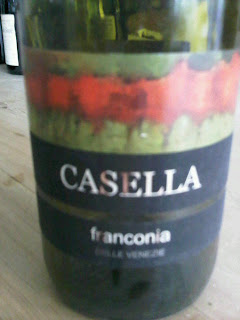
Adriano also sold us three wines otherwise unknown to us, two of which subsequently turned out to be old friends. They were

Franconia delle Venezie' = Blaufraenkisch


Terrano = Mondeuse


A third wine from the Vallee d'Aoste (where French still rules) was Mayolet which turns out to be the parent, together with Petit Rouge of Cornalin.

In Milano we trawled through Peck's wine department but were warded off by the prices. In Venezia we visited the Wine Nazi (Qv) but he has moved to smaller premeses and so the choice is diminished. Typically neither he nor the other sellers of Vino Sfuso had anything like the selection of Per Bacco in Milan. We did however find a litre of Malbech at 'Al Canton del Vin' (Castello 3156) for 1.95 Euros which was also very 'novello' and delightful.

Arriving at the Aeroporto Marco Polo early with the express intention of having lunch with our friends at the Wine Bar there (surely the best in any airport in the world, not that there is much competition) we got into an arguement with the delightful people serving there over what was called Traminer on the wine list and Gewurztraminer which is what was poured for us. When we said what we wanted was Traminer we were told it was the same thing. Slotovino maintained Traminer is something completely different and a good-natured arguement ensued. We are happy to say that in a sense we were both right. There is an excellent entry in Wikipedia on the subject.

Good buys at the Duty Free shop included a Pinot Bianco and a Fiulano from Proietti, and a Bardolino from Fratta Pasini.