Sunday, 15 February 2009

India


There is a small Indian wine industry and signs of increasing demand for wine from the young upwardly mobile middle class. Most states are 'dry' (we even saw a bottle with the old warning 'For sale only in Gujarat') but wine finds its way to hotels and restaurants easily enough. In India a long time in the modern wine industry means 1984 when Chateau Indage was founded and 1988 when Grover Vineyards was set up, both being already established growers of table grapes. The third major player is Sula, set up in the late 1990s. Ch. Indage and Sula are in Nashik, described as 'heart of India's wine capital' about 180km north-east of Mumbai. Grover Vineyards are in Nandi Hills, 40km north of Bangalore which itself is exacly in the centre of India on a level with Chennai (Madras), so very much further south.

All these vineyards are said to have excellent sites, soils and microclimates but the question has been asked about siting vineyards further north and indeed Chateau Indage are planning to plant vineyards in Himachal Pradesh whose climate is claimed to be much nearer that of Bordeaux. At tropical latitudes grapes can be harvested twice or even all year round but the monsoon is not beneficial to grape-growing and special pruning and trellising have to be employed. All work is by hand but a surprising amount of state-of-the-art winery equipment is used.

Michel Rolland has been advising Kanwal Grover and the result seems to have been very good. The best wine we tasted in our admittedly limited choice was a Grover Shiraz. Sula's Sauvignon Blanc is also very pleasant. The others varied between rustic ('Riviera' white and red) and "cooked" or tasting of raisins. A Merlot was the chief offender here.

There are plenty of Indian vineyards which are unknown and may produce excellent wine for all we know. Robert Joseph tasted 77 different wines for the 2008 India Wine challenge and was encouraged on the progress the industry had made. Here is a list of his medal winners (source, indianwine.com);

Chateau d'Ori
Terroir India Wineries
Seagram's (Nine Hills)
Big Banyan
UB Group (Four Seasons, Zinzi)
Mercurey Winery
Vinetage Wines, Reveilo
Valley du Vin, Zampa
Vin & Volulor

and of course Grover, Sula and Chateau Indage.

The latter is part of the Indage conglomorate which includes divisions devoted to Construction, Hotels and Restaurants, Retail, Agriculture, Personal and Home Care and Fashion. Of their numerous wine labels, Tiger Hills has been set up by a daughter of the house, the fashion designer Kavita Chogule who is without doubt one of the world's most glamorous vigneronnes.


Varieties are unimaginative despite claims that many were 'trialed' before vineyards were set up including Saperavi, Vermantino (sic) and Garganega. The only point of interest was Grover's espousal of Clairette in a blend with Viognier. Chenin Blanc is produced to satisfy those with a preference for off-dry to sweet wines (Sula has one at 15.5%) and some Malbec, Ugni Blanc/Trebbiano, Zinfandel, Grenache, Carignan and something called Convent Large Black are also grown in what must be insignificant quantities.

There are indiginous Indian varieties such as Arkavati, Arkashayam and Anabeshahi which are all table grapes. One wonders if there are others growing wild which might be investigated or whether some of the extremely late ripening European varieties were trialed and what happened in those experiments; Refosco? Nebbiolo? Petit Verdot? A great deal of research has been carried out by the National Research Centre at Pune, Maharashtra. Some of this is reported on the actahort.org (International Society for Horticultural Science) website.

A footnote; in the late 19th century, Baron Edmond de Rothschild engaged Gerard Ermens, an agronomist from the gardens of the palace of Versailles to bring cuttings of the noble varieties he had planted in Kashmir to Israel in an attempt to avoid Phylloxera. These cuttings were from vines which themselves had been grown from cuttings from Chateau Lafite. Of course the tactic failed in Israel but it is unclear as to whether Phylloxera took hold across all of India. It is credited with having destroyed the plantings made by the British at the end of the 19th century but many modern plantings are on American rootstock for the avoidance of Nematodes and Phylloxera does not seem to be considered a threat. What happened to the Rothschild Kashmiri plantings? No information seems to be available...


Monday, 2 February 2009

Roma, Lazio, January 27/28, 2009


Enoteca Costantini is in the Piazza Cavour opposite the Corte Suprema di Cassazione in Roma. It is a venerable and institutional temple to wine. The art nouveau (or perhaps 'Liberty' as the Italians will have it) grills and door handles suggest up to 100 years' pedigree.

Red jacketed gentlemen floor walkers in the basement will gruffly direct you to whatever you are looking for. Laconic but indubitably knowledgeable, mine produced a contender Cesanese which I needed to prove whether or not there was any merit in the regional grape of Lazio (the jury is still out), a Vernaccia Nera in response to my request for an 'uvaggio sconosciuto'


and a Piedirosso which ended up as one we have already had from Ischia - none the worse for that.

Now the story of the Vernaccia Nera has an interesting epilogue. We opened our bottle of Pianetta di Cagnore 2003 from Antico Terreno Ottavi of San Severino, near Macerata, Marche to console ourselves on returning home after being thrown out of LHR Terminal 5 following the cancellation of our BA flight to Delhi on the snowy 2nd of February. We reported thet the wine tasted 'rustic and assertive'. On our return almost 2 weeks later we removed the Vac-U-Vin to discover the wine was not only in great shape but had evolved into something very delicious indeed: something reminiscent of a good Douro red. Further research on the internet show this wine is well known to connoisseurs in Germany and Italy. A palpable find!

All three were between 10 and 15 Euros and especially the Vernaccia Nera was worth the Schlep. Fiumicino was more disappointing than I remember it for the purchase of wine: no discoveries to be made there!

In the restaurants of Rome there were some pleasant experiences. In a new and very idiosyncratic outfit called 'Methodo Classico' (but without any name outside), Via Guglielmo Calderini 62/64, 063244262, there is cultivated and original cuisine of a high order dispensed by a Romanian, a Slovenian and an Italian. The wines are chosen with enormous flair. We had a Cuvee including Sauvignon Blanc and 'others' from an appelation we had not encountered previously ('Dolomiti') and mirabile dictu an extraordinary Montepulciano d'Abruzzo chosen by The Maestro who had enjoyed it already the previous evening and wisely stuck to what he knew was good.

This was the first Italian restaurant where we have seen Grange Hermitage on display and maybe even available to order.

The other pleasant discovery was in the Ristorante Amatriciana opposite the Teatro dell'Opera where the vino della casa is a Cesanese/Merlot blend. Surprisingly good.


Sunday, 25 January 2009

Milan/Venice, January 2009

A premiere at La Scala with two of our artists was a great pleasure, but we managed to discover a gold mine in the short time between arriving and the opera. Thanks to that wonderful thing called the Internet, we found ourselves chez Adriano at the Enoteca 'per Bacco', Via Pecchio 4, 2031 Milano (02 7428 1110). www.perbaccomilano.it

Now Adriano is an opera lover as well as a wine merchant of genius. He comes from Venezia and has a wonderful range of Vino Sfuso including


Rossi

Cabernet Franc

12,00 %Vol

Rosso rubino carico, profumo intenso, erbaceo, vinoso. In bocca robusto, vellutato, giustamente tannico.

Merlot Base

10,50 %Vol

Rosso rubino con riflessi violacei. Profumi caratteristici di mora ed erba tagliata. In bocca vinoso morbido ed avvolgente, leggermente aromatico.

Incrocio Manzoni 6015

12,00%Vol

Rosso rubino trasparente. Tipici profumi erbacei uniti a sentori di frutta rossa matura. Elegante di stoffa sottile, persistente, tannico

Bordolese

12,50%Vol

Rosso rubino intenso, profumo erbaceo ricco di citazioni fruttate. In bocca asciutto, complesso fresco e dai tannini equilibrati

Pinot Nero

11,50%Vol

Rosso rubino non molto intenso. Elegante, molto profumato, delicato e speziato. In bocca beverino, fresco, floreale

Cabernet Sauvignon

11,50%Vol

Rosso rubino trasparente, Profumi erbacei e sentori di frutta rossa matura. .Robusto, di equilibrata aciditĂ .

Merolt riserva

12,00 %Vol

Rosso rubino brillante. Sentori di marasca, e di more mature. Vellutato delicatamente acidulo, giustamente tannico.

Marzemino

11,50%Vol

Rosso rubino acceso, brillante e trasparente. Profumi persistenti. In bocca secco, armonico con finale gradevolmente amarognolo.

Refosco

11,5 % Vol.

Rosso con tendenza al violaceo. Vinoso fruttato, speziato. In bocca asciutto, fruttato e floreale, fresco e vellutato.

Bianchi

Sauvignon

12,00%Vol

Giallo paglierino con riflessi verdognoli. Aromatico e delicato al naso. Ricordi di melone, peperone, banana. In bocca asciutto, elegante, carezzevole.

Chardonnay

11,50%Vol

Giallo paglierino brillante. Sentori di mela matura, melone. In bocca complesso, mielato elegante e armonico.

Pinot Grigio

12,00%Vol

Colore da giallo paglierino intenso ad ambrato. Delicato e fine, fruttato con ricordi di pera. In bocca sapido delicatamente acidulo con finale appena amarognolo

Prosecco Spento

10,50%Vol

Giallo paglierino. Vinoso e fruttato leggermente aromatico. In bocca rotondo, sentori di mandorla, gradevole e beverino.

Tocai

11,50%Vol

Giallo paglierino con riflessi verdognoli. Fresco asciutto e sapido, sottile ed elegante. In bocca asciutto, armonico e sapido.

Incrocio Manzoni 6013

12,50%Vol

Giallo paglierino scarico. Profumi mediamente complessi floreali e fruttati. In bocca fresco elegante e beverino

Prosecco frizzante

12,00%Vol

Vino da imbottigliare in primavera. Giallo paglierino con perlage abbastanza sottile e persistente. Profumi di crosta di pane, fiori di campo. In bocca elegante con una gradevole vena amabile sul finale.

Verduzzo

10,50%Vol

Giallo paglierino con riflessi dorati. Vinoso, lievemente fruttato. In bocca armonico, fresco, persistente con gradevole nota finale acidula

Vini dolci

Verduzzo Ramandolo

11,50%Vol

Giallo dorato chiaro. Sentori di miele con delicata presenza di mandorla tostata. Sapore dolce, delicato, accattivante

We include the whole range because these wines represent not only the bargain of the century but also tremendous diversity and interest. We bouight the Refosco and Incrocio Manzoni. When we explained to Adriano that we were going to have to transport these bottles in hold luggage he sold us two beautiful bottles (which we subsequesntly used for olive oil) with metal caps which did the job of keeping in the wine without any leaks and maintaining its freshness.

Both vini sfusi were delicious. They were surely the new wine of the 2008 vintage which had just been distributed to these outlets. We asked Adriano how he kept the wine fresh in his demijohns and the answer was surprising; he doesn't use gas or vacuum. He know he can sell the contents of his demijohns each day.

Adriano also sold us three wines otherwise unknown to us, two of which subsequently turned out to be old friends. They were

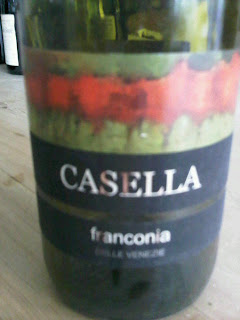
Franconia delle Venezie' = Blaufraenkisch


Terrano = Mondeuse


A third wine from the Vallee d'Aoste (where French still rules) was Mayolet which turns out to be the parent, together with Petit Rouge of Cornalin.

In Milano we trawled through Peck's wine department but were warded off by the prices. In Venezia we visited the Wine Nazi (Qv) but he has moved to smaller premeses and so the choice is diminished. Typically neither he nor the other sellers of Vino Sfuso had anything like the selection of Per Bacco in Milan. We did however find a litre of Malbech at 'Al Canton del Vin' (Castello 3156) for 1.95 Euros which was also very 'novello' and delightful.

Arriving at the Aeroporto Marco Polo early with the express intention of having lunch with our friends at the Wine Bar there (surely the best in any airport in the world, not that there is much competition) we got into an arguement with the delightful people serving there over what was called Traminer on the wine list and Gewurztraminer which is what was poured for us. When we said what we wanted was Traminer we were told it was the same thing. Slotovino maintained Traminer is something completely different and a good-natured arguement ensued. We are happy to say that in a sense we were both right. There is an excellent entry in Wikipedia on the subject.

Good buys at the Duty Free shop included a Pinot Bianco and a Fiulano from Proietti, and a Bardolino from Fratta Pasini.


Vin naturel


We hadn't come across this before. Vin naturel is a movement for not only Biodynamic vineyard practices but vinification with only local wild yeasts, non-filtration and many other refinements ("pas de tracteur sur le domaine"!). There is a centre for such wines in Paris described as a wine-bar. The name is Racine. The owner is Pierre Jancou and he runs a wine shop and cafe combining organic produce from the best producers. The address is

8 Passage des Panoramas, Paris 75002 (00 33 14 031 0641)

How did we find Racine's? We didn't. We came to it from an oblique angle (a good way to get there). On a recent visit to Paris, we printed out the 'Paris Artisan-Wines Cavistes' page from www.wineterroirs.com in order to find some alternative cavistes to our beloved Lavinia. Looking for wines from lesser known grape varieties as ever, we gravitated towards Le verre vole, 67 Rue Lancry, 10e. where we could have lunch and buy wine at the same time and La Cremerie, 9 Rue des Quatre Vents, 6e. where this so-called 'natural wine' was available.

After a delicious Betterave hors d'oeuvre and Saucisse et pomme puree dish of the day, not to mention a dodgy glass of Cabernet Franc d'Anjou and a much better Gamay de l'Ardeche we bought a bottle of Pierre Overnoy 2007 Arbois Pulillon Poulsard. Now what set bells ringing was the mec who was dishing the food and selling the wine told us to keep the wine 'au frais' which we did. It is original, delicious and excellent.

La Cremerie was even more interesting. Having declared our interest for 'cepages inconnues' we were introduced to a Chasselas from Eric Pfifferling in the Cotes du Rhone - L'Anglore Cuvee des Caprices 12.5%, we went on to buy a Clos du Rouge Gorge Pays des Cotes Catalanes (Macabeo, white) by Cyril Fhal, another mainstay of vin naturel ad a Domaine Navarre Vin d'Oeillades 11.5% From Roquebrun. Oeillade turns out to be a hybrid between Pinot Noir and Hermitage (Cinsault). That sounds very much like Pinotage, surely? We can't wait to try it.

At Lavinia (how could we forsake it?), we found a Cot (Malbec) from the Loire, a Menu Pineau (white) called Le Brin de Chevre. The producer seems to be called Sari and the wine also bears the inscription 'Le Clos de Tue-Boeuf, 41120 Les Montels which we think is in the Languedoc.

There were two other bottles from Lavinia, our first Slovenian wine, a Tocaj Gredic from Brda 'since 1820' (sic) 12% and not for the exorbitant prices we have previously seen on wines from Slovenia and an Arbois Traminer from Stephan Tissot in the Jura.

Now hereby hangs a tale. In our next blog you will read about our little contretemps at the wonderful wine bar at Marco Polo Airport in Venice. It turns out Traminer is not our old friend Gewurztraminer but Savignin which in the Jura is seriously salty and dry as hell. We will see why Stephane Tissot, one of the Jura's leading producers decided to label this wine Traminer instead of Savignin which is in commen usage in the Jura (it is responsible for 'Vin Jaune' after all). This bottle was not cheap (17 Euros) so let's hope it is something enjoyable rather than just wierd.


A Colares Evening

This did not turn out as hoped for but we had a very jolly evening and so perhaps this is something to be said in favour of the Colares wines which were drunk exclusively that night (10.1.09).

There was a very distinguished line up for what turned out to be some very disappointing bottles: in alphabetical order

Carla Capalbo
Paul Levy
Penelope Levy
Jeffrey Tobias
Rebecca Willer
Robert Willer

The main mistake was to have relied too much on Colares' reputation as ageworthy. Whether due to poor storage or any actual inability to age, the old wines were all more or less kaput and although of interest to some in a geriatric way they did nothing to establish enthusiasm for the Ramisco grape or Colares itself.


There was mild enthusiasm for the 2004 Fundacao Oriente and 2005 D'Areia. A venerable Tinta Chao ('Red Clay') NV was downright corked. The 1967 and even the 1995s from Chitas and D'Areia were past their best to say the least.


Oh well, as stated a very enjoyable evening thanks in no small degree to Jill Slotover's cooking.

Hungary - an update


We have worked our way through about half the plunder from Hungary and the results have been mostly fair to disappointing so far. As a reminder here is the list. Comments on the bottles opened to date follow in blue.

Whites
Harslevelu (Tornai) 12.5%. Clearly Harslevelu is a sweet variety only of interest as a component of Tokaj. This was a well made wine but need not detain us in purezza.
Harslevelu (Tornai) 13%
Furmint (Tornai) 12%
Very good indeed! Drier as well as less alcoholic than other Furmints we have encountered. Perhaps not surprisingly we have found this wine in London imported by Zelas Wines and Sprits and available albeit at a rather hefty price from 'Wine of Course', 216 Archway Road, N6 5AX (2028 347 9006).
Leanyka (Toth Ferenc) 13% Turns out to be the same as Feteasca (Romania). Pleasant but off-dry. No 'ethnic' notes (in other words 'individuality'). Not unlike a Vinho Verde.
Cserszegi Fuszeres (Gelbmann Pince) 10.6% Quite pleasant but again off-dry. Reminiscent of Riesling.
Keknyelu and Olaszrizling (Badacsonyi Tomaj Cuvee) 12.5%

This is a find. We were beginning to think Hungarian white was all off-dry to medium sweet. This was refreshing and interesting. Not a sensational discovery but let's say worthwhile importing provided the price was right (£6?). Better than anything Chapel Hill has to offer!
Juhfark by Pantlika at 12.5%
Slightly petillant, less aromatic and perhaps less characterful than the example tasted in Buda but pleasantly drinkable. Sadly not an essential candidate for export.

Reds
Kadarka (Duzsi Tamas) 12.5%
More enjoyable but less 'ethnic than the Kadarka tasted at the Kiraly Borhaz cellars in Buda. Akin to a light Beaujolais. By the same token a bit 'international' and so less interesting.
Cabernet Franc (Tamas & Zsolt Gere, Villanyi) 13% This was "good enough but not enough good" as my dear artist, the great Russian bass Evgeny Nesterenko used to say.
Egri Bikavers by Tibor Gal for Gundel at 13% and the other by Thummerer (13.5%) The first should be passed over in silence and the second soon forgotten.
Bock Kekfrankos from Villanyi (13%). Again pleasant while it lasted but to be honest - unmemorable.

There are surely better Hungarian wines to be had but it is beginning to become clear why they are not very much in evidence internationally, with the exception of Tokaj of course. We will have to find another pretext to return there and perhaps come back with a mixed case from the (more expensive) wine merchant, Bortarsasag.

Tuesday, 30 December 2008

A great site for Italian varieties

Estimates say there are 22,200 grape varieties in the world so Italy has 10% at 2,200. here's a great site for those varieties prepared by Cinzia Forino:

www.vinoinrete.it/sommelier/_vitigni.html

Check it out: it's amazing how many unknown varieties there are in the Veneto and even Toscana